显示标签为“inductionbrazingheater”的博文。显示所有博文

2024年4月30日星期二

Induction Brazing Basics

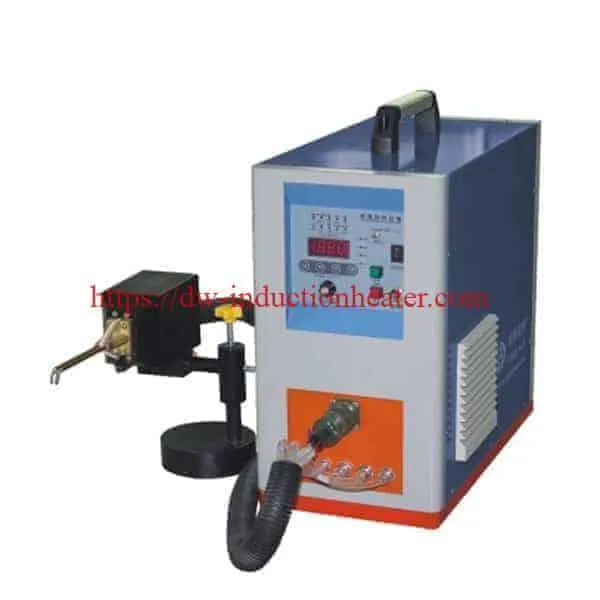
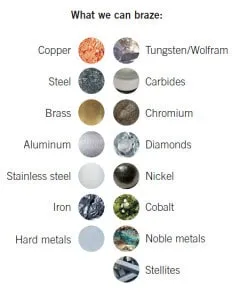
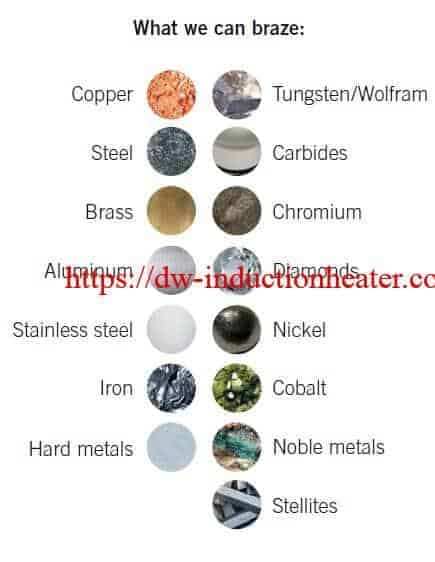
Induction Brazing Basics for jointing copper,silver,brazing,steel and stainless steel,etc. Induction Brazing uses heat and filler metal to join metals. Once melted, the filler flows between close-fitting base metals (the pieces being joined) by capillary action. The molten filler interacts with a thin layer of the base metal to form a strong, leak-proof joint. Different heat sources can be used for brazing: induction and resistance heaters, ovens, furnaces, torches, etc. There are three common brazing methods: capillary, notch and moulding. Induction brazing is concerned solely with the first of these. Having the correct gap between the base metals is crucial. A too-large gap can minimize the capillary force and lead to weak joints and porosity. Thermal expansion means gaps have to be calculated for metals at brazing, not room, temperatures. Optimum spacing is typically 0.05 mm – 0.1 mm. Before you braze Brazing is hassle-free. But some questions should be investigated — and answered — in order to assure successful, cost-effective joining. For instance: How suitable are the base metals for brazing; what’s the best coil design for specific time and quality demands; should the brazing be manual or automatic? brazing material At DAWEI Induction we answer these and other key points before suggesting a brazing solution. Focus on flux Base metals must usually be coated with a solvent known as flux before they are brazed. Flux cleans the base metals, prevents new oxidation, and wets the brazing area prior to brazing. It is crucial to apply sufficient flux; too little and the flux may become saturated with oxides and lose its ability to protect the base metals. Flux is not always needed. Phosphorous-bearing filler can be used to braze copper alloys, brass and bronze. Flux-free brazing is also possible with active atmospheres and vacuums, but the brazing must then be performed in a controlled atmosphere chamber. Flux must normally be removed from the part once the metal filler has solidified. Different removal methods are used, the most common being water quenching, pickling and wire brushing.   https://dw-inductionheater.com/induction-brazing-basics.html?feed_id=243828&_unique_id=663150791ff90
2024年3月25日星期一

Induction Brazing T Shaped Copper Tubing Assemblies

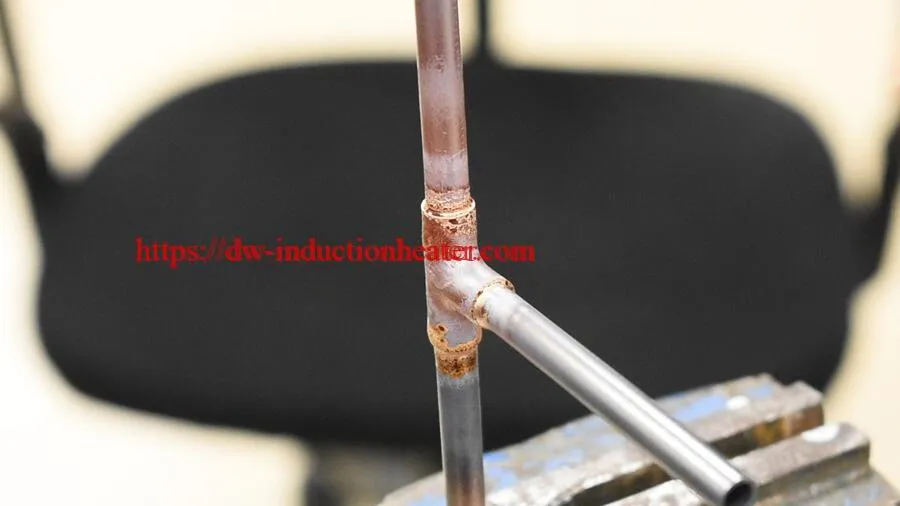
High Frequency Induction Brazing T Shaped Copper Tubing Assemblies

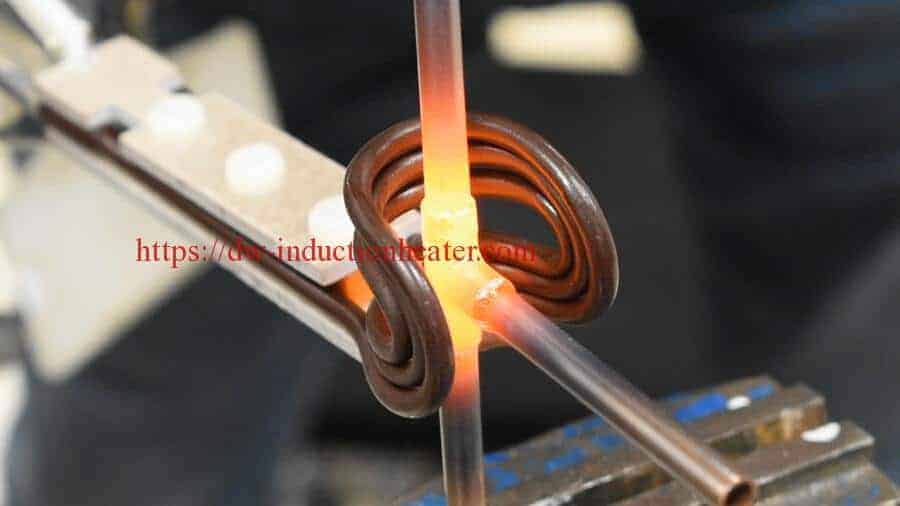
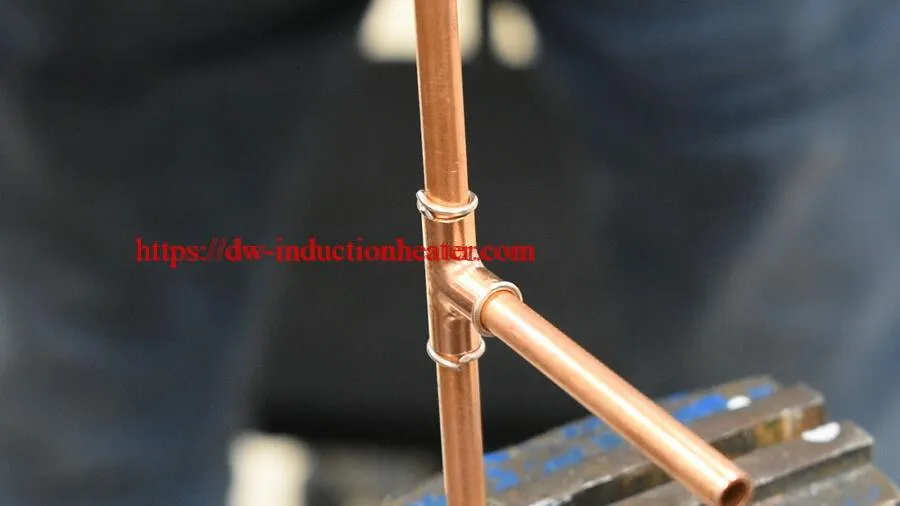
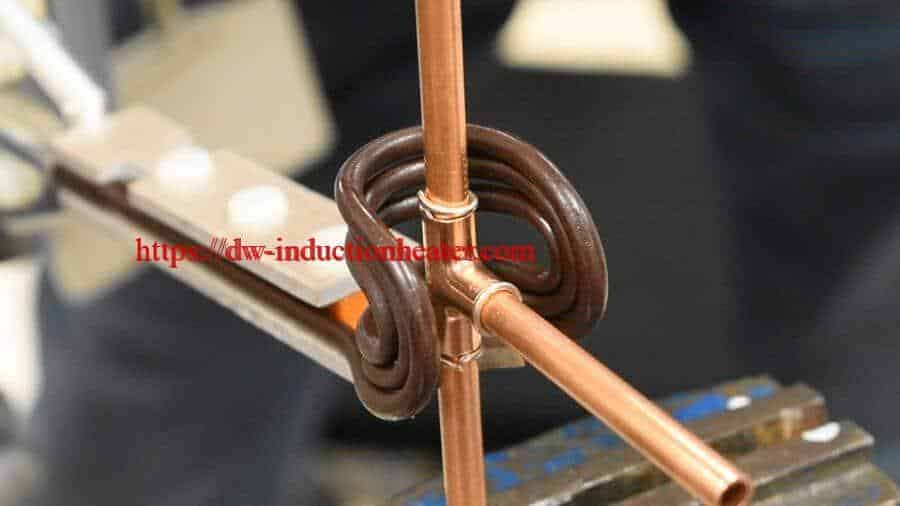
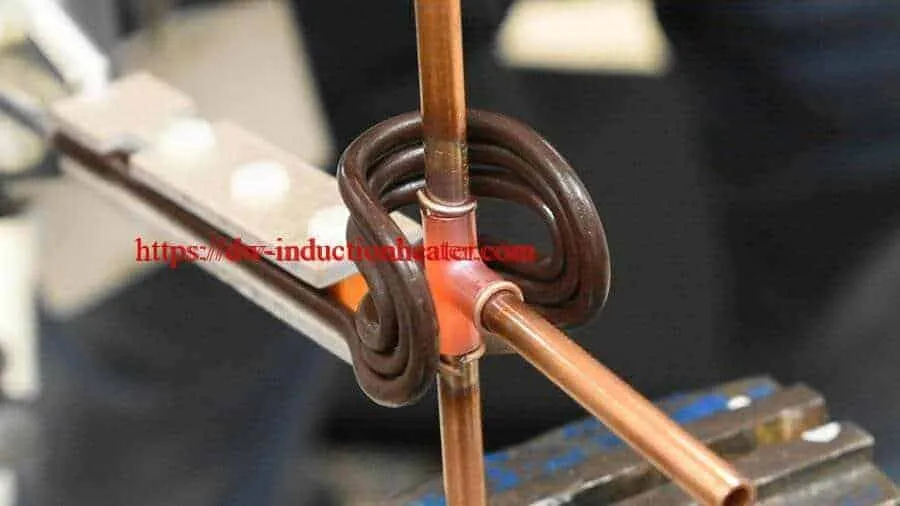
Objective: Test 1 – Induction brazing T-shaped copper tubing assemblies – 3 joints simultaneously Test 2 – Induction brazing copper tubing Industry: HVAC Materials: Copper tubers  6, 8, 10, 12 mm ( 015⁄64, 05⁄16, 025⁄64, 015⁄32inch. ); thickness: 1 mm ( 03⁄64 inch.) Alloy: Cu-P-Ag rings TIP: The use of alloy rings is highly recommended with a hand-held brazing gun.
Equipment: DW-UHF-20kw induction brazing machine Power: Test 1 ( 7-8kW ) Test 2 ( 6.5-9.2kW ) Time: 8 secs. Coil: Regular induction heating coil. Custom coil design is possible upon request. The Process: We successfully carried out two induction brazing tests with several copper assemblies.  First, Cu-P-Ag alloy rings were placed around the thinner of the copper tubings. No additional flux was needed.  The pipes were then carefully aligned. The process of induction brazing was initiated. Once the induction brazing was complete, the two samples were submerged in cold water in order to be cooled instantly. The excessive amount of flux can be furtherly cleaned.
https://dw-inductionheater.com/induction-brazing-t-shaped-copper-tubing-assemblies.html?feed_id=238359&_unique_id=6601784ba36e6

2024年3月4日星期一

induction brazing steel tube to copper tube

High Frequency Induction Brazing Steel Tube to Copper Tube

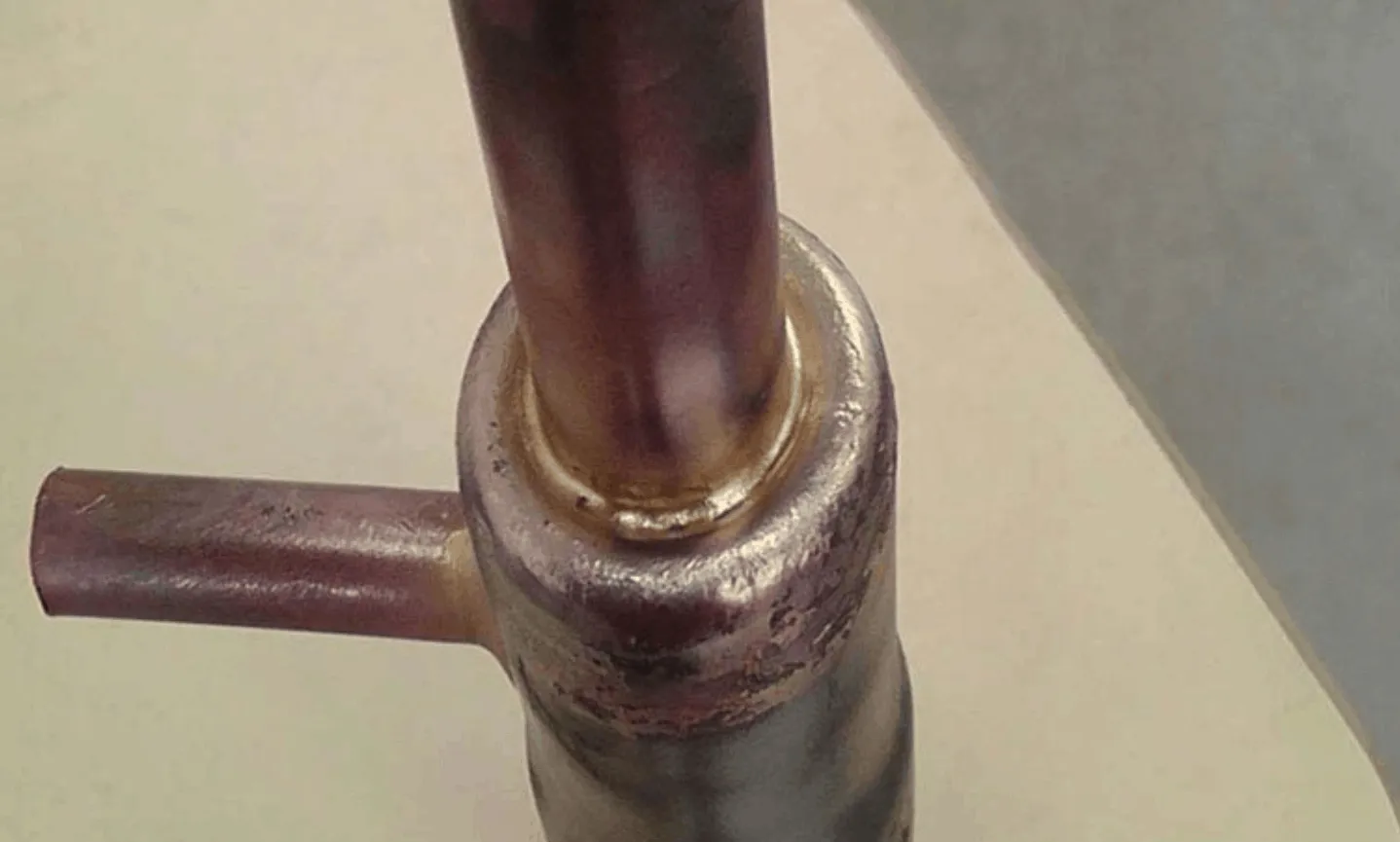
Objective The goal is to braze a steel tube to a copper tube in 60 seconds using flux and brazing alloy.
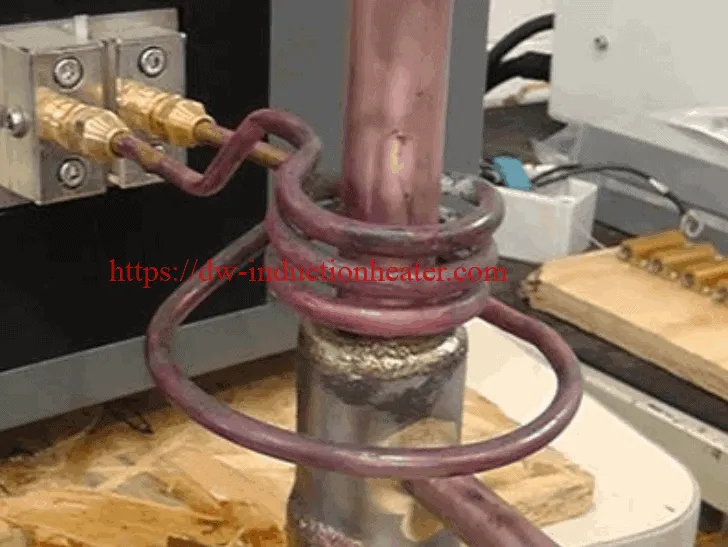
Equipment DW-UHF-10kw induction brazing heater Three turns dual diameter coil Materials • Steel tube and copper receiver • Braze alloy (CDA 681) • B-1 flux Key Parameters Temperature: Approximately 1750° F (954° C) Frequency: 148 kHz
Process:
  1. The assembly section was pre-assembled and fluxed (B-1) then located in the two diameter coil with a single pre-formed alloy ring set at the interface area.
  2. Alloy flow and joint completed in 60 seconds.
  3. The material was cooled in water following the completion of induction brazing.
  4. The joint was then cross-sectioned to validate that the brazing process had produced a strong, high quality joint.
Results/Benefits:
  • Strong durable joints with induction heating
  • Selective and precise heat zone, resulting in less part distortion and joint stress than welding
  • Less oxidation
  • Faster heating cycles
  • More consistent results and suitability for large volume production, without the need for batch processing
  • Safer than flame brazing
induction brazing steel tube to copper tube process
https://dw-inductionheater.com/induction-brazing-steel-tube-to-copper-tube.html?feed_id=235607&_unique_id=65e65518d8a86

2023年8月9日星期三

induction brazing steel tube to copper tube

High Frequency Induction Brazing Steel Tube to Copper Tube

Objective The goal is to braze a steel tube to a copper tube in 60 seconds using flux and brazing alloy.
Equipment DW-UHF-10kw induction brazing heater Three turns dual diameter coil Materials • Steel tube and copper receiver • Braze alloy (CDA 681) • B-1 flux Key Parameters Temperature: Approximately 1750° F (954° C) Frequency: 148 kHz
Process:
  1. The assembly section was pre-assembled and fluxed (B-1) then located in the two diameter coil with a single pre-formed alloy ring set at the interface area.
  2. Alloy flow and joint completed in 60 seconds.
  3. The material was cooled in water following the completion of induction brazing.
  4. The joint was then cross-sectioned to validate that the brazing process had produced a strong, high quality joint.
Results/Benefits:
  • Strong durable joints with induction heating
  • Selective and precise heat zone, resulting in less part distortion and joint stress than welding
  • Less oxidation
  • Faster heating cycles
  • More consistent results and suitability for large volume production, without the need for batch processing
  • Safer than flame brazing
induction brazing steel tube to copper tube process

2023年8月2日星期三

Induction Brazing T Shaped Copper Tubing Assemblies

High Frequency Induction Brazing T Shaped Copper Tubing Assemblies

Objective: Test 1 – Induction brazing T-shaped copper tubing assemblies – 3 joints simultaneously Test 2 – Induction brazing copper tubing Industry: HVAC Materials: Copper tubers  6, 8, 10, 12 mm ( 015⁄64, 05⁄16, 025⁄64, 015⁄32inch. ); thickness: 1 mm ( 03⁄64 inch.) Alloy: Cu-P-Ag rings TIP: The use of alloy rings is highly recommended with a hand-held brazing gun.
Equipment: DW-UHF-20kw induction brazing machine Power: Test 1 ( 7-8kW ) Test 2 ( 6.5-9.2kW ) Time: 8 secs. Coil: Regular induction heating coil. Custom coil design is possible upon request. The Process: We successfully carried out two induction brazing tests with several copper assemblies.  First, Cu-P-Ag alloy rings were placed around the thinner of the copper tubings. No additional flux was needed.  The pipes were then carefully aligned. The process of induction brazing was initiated. Once the induction brazing was complete, the two samples were submerged in cold water in order to be cooled instantly. The excessive amount of flux can be furtherly cleaned.
https://dw-inductionheater.com/induction-brazing-t-shaped-copper-tubing-assemblies.html?feed_id=221536&_unique_id=64ca072e4dee7

2023年7月12日星期三

induction brazing steel tube to copper tube

High Frequency Induction Brazing Steel Tube to Copper Tube

Objective The goal is to braze a steel tube to a copper tube in 60 seconds using flux and brazing alloy.
Equipment DW-UHF-10kw induction brazing heater Three turns dual diameter coil Materials • Steel tube and copper receiver • Braze alloy (CDA 681) • B-1 flux Key Parameters Temperature: Approximately 1750° F (954° C) Frequency: 148 kHz
Process:
  1. The assembly section was pre-assembled and fluxed (B-1) then located in the two diameter coil with a single pre-formed alloy ring set at the interface area.
  2. Alloy flow and joint completed in 60 seconds.
  3. The material was cooled in water following the completion of induction brazing.
  4. The joint was then cross-sectioned to validate that the brazing process had produced a strong, high quality joint.
Results/Benefits:
  • Strong durable joints with induction heating
  • Selective and precise heat zone, resulting in less part distortion and joint stress than welding
  • Less oxidation
  • Faster heating cycles
  • More consistent results and suitability for large volume production, without the need for batch processing
  • Safer than flame brazing
induction brazing steel tube to copper tube process
https://dw-inductionheater.com/induction-brazing-steel-tube-to-copper-tube.html?feed_id=218611&_unique_id=64aedfb67501c

2023年7月8日星期六

Induction Brazing T Shaped Copper Tubing Assemblies

High Frequency Induction Brazing T Shaped Copper Tubing Assemblies

Objective: Test 1 – Induction brazing T-shaped copper tubing assemblies – 3 joints simultaneously Test 2 – Induction brazing copper tubing Industry: HVAC Materials: Copper tubers  6, 8, 10, 12 mm ( 015⁄64, 05⁄16, 025⁄64, 015⁄32inch. ); thickness: 1 mm ( 03⁄64 inch.) Alloy: Cu-P-Ag rings TIP: The use of alloy rings is highly recommended with a hand-held brazing gun.
Equipment: DW-UHF-20kw induction brazing machine Power: Test 1 ( 7-8kW ) Test 2 ( 6.5-9.2kW ) Time: 8 secs. Coil: Regular induction heating coil. Custom coil design is possible upon request. The Process: We successfully carried out two induction brazing tests with several copper assemblies.  First, Cu-P-Ag alloy rings were placed around the thinner of the copper tubings. No additional flux was needed.  The pipes were then carefully aligned. The process of induction brazing was initiated. Once the induction brazing was complete, the two samples were submerged in cold water in order to be cooled instantly. The excessive amount of flux can be furtherly cleaned.

2023年4月26日星期三

induction brazing steel tube to copper tube

High Frequency Induction Brazing Steel Tube to Copper Tube

Objective The goal is to braze a steel tube to a copper tube in 60 seconds using flux and brazing alloy.
Equipment DW-UHF-10kw induction brazing heater Three turns dual diameter coil Materials • Steel tube and copper receiver • Braze alloy (CDA 681) • B-1 flux Key Parameters Temperature: Approximately 1750° F (954° C) Frequency: 148 kHz
Process:
  1. The assembly section was pre-assembled and fluxed (B-1) then located in the two diameter coil with a single pre-formed alloy ring set at the interface area.
  2. Alloy flow and joint completed in 60 seconds.
  3. The material was cooled in water following the completion of induction brazing.
  4. The joint was then cross-sectioned to validate that the brazing process had produced a strong, high quality joint.
Results/Benefits:
  • Strong durable joints with induction heating
  • Selective and precise heat zone, resulting in less part distortion and joint stress than welding
  • Less oxidation
  • Faster heating cycles
  • More consistent results and suitability for large volume production, without the need for batch processing
  • Safer than flame brazing
induction brazing steel tube to copper tube process

2023年4月22日星期六

Induction Brazing Basics

Induction Brazing Basics for jointing copper,silver,brazing,steel and stainless steel,etc. Induction Brazing uses heat and filler metal to join metals. Once melted, the filler flows between close-fitting base metals (the pieces being joined) by capillary action. The molten filler interacts with a thin layer of the base metal to form a strong, leak-proof joint. Different heat sources can be used for brazing: induction and resistance heaters, ovens, furnaces, torches, etc. There are three common brazing methods: capillary, notch and moulding. Induction brazing is concerned solely with the first of these. Having the correct gap between the base metals is crucial. A too-large gap can minimize the capillary force and lead to weak joints and porosity. Thermal expansion means gaps have to be calculated for metals at brazing, not room, temperatures. Optimum spacing is typically 0.05 mm – 0.1 mm. Before you braze Brazing is hassle-free. But some questions should be investigated — and answered — in order to assure successful, cost-effective joining. For instance: How suitable are the base metals for brazing; what’s the best coil design for specific time and quality demands; should the brazing be manual or automatic? brazing material At DAWEI Induction we answer these and other key points before suggesting a brazing solution. Focus on flux Base metals must usually be coated with a solvent known as flux before they are brazed. Flux cleans the base metals, prevents new oxidation, and wets the brazing area prior to brazing. It is crucial to apply sufficient flux; too little and the flux may become saturated with oxides and lose its ability to protect the base metals. Flux is not always needed. Phosphorous-bearing filler can be used to braze copper alloys, brass and bronze. Flux-free brazing is also possible with active atmospheres and vacuums, but the brazing must then be performed in a controlled atmosphere chamber. Flux must normally be removed from the part once the metal filler has solidified. Different removal methods are used, the most common being water quenching, pickling and wire brushing.  

2023年4月12日星期三

induction brazing steel tube to copper tube

High Frequency Induction Brazing Steel Tube to Copper Tube

Objective The goal is to braze a steel tube to a copper tube in 60 seconds using flux and brazing alloy.
Equipment DW-UHF-10kw induction brazing heater Three turns dual diameter coil Materials • Steel tube and copper receiver • Braze alloy (CDA 681) • B-1 flux Key Parameters Temperature: Approximately 1750° F (954° C) Frequency: 148 kHz
Process:
  1. The assembly section was pre-assembled and fluxed (B-1) then located in the two diameter coil with a single pre-formed alloy ring set at the interface area.
  2. Alloy flow and joint completed in 60 seconds.
  3. The material was cooled in water following the completion of induction brazing.
  4. The joint was then cross-sectioned to validate that the brazing process had produced a strong, high quality joint.
Results/Benefits:
  • Strong durable joints with induction heating
  • Selective and precise heat zone, resulting in less part distortion and joint stress than welding
  • Less oxidation
  • Faster heating cycles
  • More consistent results and suitability for large volume production, without the need for batch processing
  • Safer than flame brazing
induction brazing steel tube to copper tube process

2023年3月6日星期一

Induction Brazing Basics

Induction Brazing Basics for jointing copper,silver,brazing,steel and stainless steel,etc. Induction Brazing uses heat and filler metal to join metals. Once melted, the filler flows between close-fitting base metals (the pieces being joined) by capillary action. The molten filler interacts with a thin layer of the base metal to form a strong, leak-proof joint. Different heat sources can be used for brazing: induction and resistance heaters, ovens, furnaces, torches, etc. There are three common brazing methods: capillary, notch and moulding. Induction brazing is concerned solely with the first of these. Having the correct gap between the base metals is crucial. A too-large gap can minimize the capillary force and lead to weak joints and porosity. Thermal expansion means gaps have to be calculated for metals at brazing, not room, temperatures. Optimum spacing is typically 0.05 mm – 0.1 mm. Before you braze Brazing is hassle-free. But some questions should be investigated — and answered — in order to assure successful, cost-effective joining. For instance: How suitable are the base metals for brazing; what’s the best coil design for specific time and quality demands; should the brazing be manual or automatic? brazing material At DAWEI Induction we answer these and other key points before suggesting a brazing solution. Focus on flux Base metals must usually be coated with a solvent known as flux before they are brazed. Flux cleans the base metals, prevents new oxidation, and wets the brazing area prior to brazing. It is crucial to apply sufficient flux; too little and the flux may become saturated with oxides and lose its ability to protect the base metals. Flux is not always needed. Phosphorous-bearing filler can be used to braze copper alloys, brass and bronze. Flux-free brazing is also possible with active atmospheres and vacuums, but the brazing must then be performed in a controlled atmosphere chamber. Flux must normally be removed from the part once the metal filler has solidified. Different removal methods are used, the most common being water quenching, pickling and wire brushing.  
2023年2月4日星期六

Induction Brazing Basics

Induction Brazing Basics for jointing copper,silver,brazing,steel and stainless steel,etc. Induction Brazing uses heat and filler metal to join metals. Once melted, the filler flows between close-fitting base metals (the pieces being joined) by capillary action. The molten filler interacts with a thin layer of the base metal to form a strong, leak-proof joint. Different heat sources can be used for brazing: induction and resistance heaters, ovens, furnaces, torches, etc. There are three common brazing methods: capillary, notch and moulding. Induction brazing is concerned solely with the first of these. Having the correct gap between the base metals is crucial. A too-large gap can minimize the capillary force and lead to weak joints and porosity. Thermal expansion means gaps have to be calculated for metals at brazing, not room, temperatures. Optimum spacing is typically 0.05 mm – 0.1 mm. Before you braze Brazing is hassle-free. But some questions should be investigated — and answered — in order to assure successful, cost-effective joining. For instance: How suitable are the base metals for brazing; what’s the best coil design for specific time and quality demands; should the brazing be manual or automatic? brazing material At DAWEI Induction we answer these and other key points before suggesting a brazing solution. Focus on flux Base metals must usually be coated with a solvent known as flux before they are brazed. Flux cleans the base metals, prevents new oxidation, and wets the brazing area prior to brazing. It is crucial to apply sufficient flux; too little and the flux may become saturated with oxides and lose its ability to protect the base metals. Flux is not always needed. Phosphorous-bearing filler can be used to braze copper alloys, brass and bronze. Flux-free brazing is also possible with active atmospheres and vacuums, but the brazing must then be performed in a controlled atmosphere chamber. Flux must normally be removed from the part once the metal filler has solidified. Different removal methods are used, the most common being water quenching, pickling and wire brushing.  
2022年11月3日星期四

induction brazing steel tube to copper tube

High Frequency Induction Brazing Steel Tube to Copper Tube

Objective The goal is to braze a steel tube to a copper tube in 60 seconds using flux and brazing alloy.
Equipment DW-UHF-10kw induction brazing heater Three turns dual diameter coil Materials • Steel tube and copper receiver • Braze alloy (CDA 681) • B-1 flux Key Parameters Temperature: Approximately 1750° F (954° C) Frequency: 148 kHz
Process:
  1. The assembly section was pre-assembled and fluxed (B-1) then located in the two diameter coil with a single pre-formed alloy ring set at the interface area.
  2. Alloy flow and joint completed in 60 seconds.
  3. The material was cooled in water following the completion of induction brazing.
  4. The joint was then cross-sectioned to validate that the brazing process had produced a strong, high quality joint.
Results/Benefits:
  • Strong durable joints with induction heating
  • Selective and precise heat zone, resulting in less part distortion and joint stress than welding
  • Less oxidation
  • Faster heating cycles
  • More consistent results and suitability for large volume production, without the need for batch processing
  • Safer than flame brazing
induction brazing steel tube to copper tube process

2022年10月19日星期三

Induction Brazing Basics

Induction Brazing Basics for jointing copper,silver,brazing,steel and stainless steel,etc. Induction Brazing uses heat and filler metal to join metals. Once melted, the filler flows between close-fitting base metals (the pieces being joined) by capillary action. The molten filler interacts with a thin layer of the base metal to form a strong, leak-proof joint. Different heat sources can be used for brazing: induction and resistance heaters, ovens, furnaces, torches, etc. There are three common brazing methods: capillary, notch and moulding. Induction brazing is concerned solely with the first of these. Having the correct gap between the base metals is crucial. A too-large gap can minimize the capillary force and lead to weak joints and porosity. Thermal expansion means gaps have to be calculated for metals at brazing, not room, temperatures. Optimum spacing is typically 0.05 mm – 0.1 mm. Before you braze Brazing is hassle-free. But some questions should be investigated — and answered — in order to assure successful, cost-effective joining. For instance: How suitable are the base metals for brazing; what’s the best coil design for specific time and quality demands; should the brazing be manual or automatic? brazing material At DAWEI Induction we answer these and other key points before suggesting a brazing solution. Focus on flux Base metals must usually be coated with a solvent known as flux before they are brazed. Flux cleans the base metals, prevents new oxidation, and wets the brazing area prior to brazing. It is crucial to apply sufficient flux; too little and the flux may become saturated with oxides and lose its ability to protect the base metals. Flux is not always needed. Phosphorous-bearing filler can be used to braze copper alloys, brass and bronze. Flux-free brazing is also possible with active atmospheres and vacuums, but the brazing must then be performed in a controlled atmosphere chamber. Flux must normally be removed from the part once the metal filler has solidified. Different removal methods are used, the most common being water quenching, pickling and wire brushing.  
2022年9月29日星期四

induction brazing steel tube to copper tube

High Frequency Induction Brazing Steel Tube to Copper Tube

Objective The goal is to braze a steel tube to a copper tube in 60 seconds using flux and brazing alloy.
Equipment DW-UHF-10kw induction brazing heater Three turns dual diameter coil Materials • Steel tube and copper receiver • Braze alloy (CDA 681) • B-1 flux Key Parameters Temperature: Approximately 1750° F (954° C) Frequency: 148 kHz
Process:
  1. The assembly section was pre-assembled and fluxed (B-1) then located in the two diameter coil with a single pre-formed alloy ring set at the interface area.
  2. Alloy flow and joint completed in 60 seconds.
  3. The material was cooled in water following the completion of induction brazing.
  4. The joint was then cross-sectioned to validate that the brazing process had produced a strong, high quality joint.
Results/Benefits:
  • Strong durable joints with induction heating
  • Selective and precise heat zone, resulting in less part distortion and joint stress than welding
  • Less oxidation
  • Faster heating cycles
  • More consistent results and suitability for large volume production, without the need for batch processing
  • Safer than flame brazing
induction brazing steel tube to copper tube process

2022年9月20日星期二

induction brazing steel tube to copper tube

High Frequency Induction Brazing Steel Tube to Copper Tube

Objective The goal is to braze a steel tube to a copper tube in 60 seconds using flux and brazing alloy.
Equipment DW-UHF-10kw induction brazing heater Three turns dual diameter coil Materials • Steel tube and copper receiver • Braze alloy (CDA 681) • B-1 flux Key Parameters Temperature: Approximately 1750° F (954° C) Frequency: 148 kHz
Process:
  1. The assembly section was pre-assembled and fluxed (B-1) then located in the two diameter coil with a single pre-formed alloy ring set at the interface area.
  2. Alloy flow and joint completed in 60 seconds.
  3. The material was cooled in water following the completion of induction brazing.
  4. The joint was then cross-sectioned to validate that the brazing process had produced a strong, high quality joint.
Results/Benefits:
  • Strong durable joints with induction heating
  • Selective and precise heat zone, resulting in less part distortion and joint stress than welding
  • Less oxidation
  • Faster heating cycles
  • More consistent results and suitability for large volume production, without the need for batch processing
  • Safer than flame brazing
induction brazing steel tube to copper tube process

2022年8月25日星期四

Induction Brazing T Shaped Copper Tubing Assemblies

High Frequency Induction Brazing T Shaped Copper Tubing Assemblies

Objective: Test 1 – Induction brazing T-shaped copper tubing assemblies – 3 joints simultaneously Test 2 – Induction brazing copper tubing Industry: HVAC Materials: Copper tubers  6, 8, 10, 12 mm ( 015⁄64, 05⁄16, 025⁄64, 015⁄32inch. ); thickness: 1 mm ( 03⁄64 inch.) Alloy: Cu-P-Ag rings TIP: The use of alloy rings is highly recommended with a hand-held brazing gun.
Equipment: DW-UHF-20kw induction brazing machine Power: Test 1 ( 7-8kW ) Test 2 ( 6.5-9.2kW ) Time: 8 secs. Coil: Regular induction heating coil. Custom coil design is possible upon request. The Process: We successfully carried out two induction brazing tests with several copper assemblies.  First, Cu-P-Ag alloy rings were placed around the thinner of the copper tubings. No additional flux was needed.  The pipes were then carefully aligned. The process of induction brazing was initiated. Once the induction brazing was complete, the two samples were submerged in cold water in order to be cooled instantly. The excessive amount of flux can be furtherly cleaned.

2022年7月29日星期五

Induction Brazing Basics

Induction Brazing Basics for jointing copper,silver,brazing,steel and stainless steel,etc. Induction Brazing uses heat and filler metal to join metals. Once melted, the filler flows between close-fitting base metals (the pieces being joined) by capillary action. The molten filler interacts with a thin layer of the base metal to form a strong, leak-proof joint. Different heat sources can be used for brazing: induction and resistance heaters, ovens, furnaces, torches, etc. There are three common brazing methods: capillary, notch and moulding. Induction brazing is concerned solely with the first of these. Having the correct gap between the base metals is crucial. A too-large gap can minimize the capillary force and lead to weak joints and porosity. Thermal expansion means gaps have to be calculated for metals at brazing, not room, temperatures. Optimum spacing is typically 0.05 mm – 0.1 mm. Before you braze Brazing is hassle-free. But some questions should be investigated — and answered — in order to assure successful, cost-effective joining. For instance: How suitable are the base metals for brazing; what’s the best coil design for specific time and quality demands; should the brazing be manual or automatic? brazing material At DAWEI Induction we answer these and other key points before suggesting a brazing solution. Focus on flux Base metals must usually be coated with a solvent known as flux before they are brazed. Flux cleans the base metals, prevents new oxidation, and wets the brazing area prior to brazing. It is crucial to apply sufficient flux; too little and the flux may become saturated with oxides and lose its ability to protect the base metals. Flux is not always needed. Phosphorous-bearing filler can be used to braze copper alloys, brass and bronze. Flux-free brazing is also possible with active atmospheres and vacuums, but the brazing must then be performed in a controlled atmosphere chamber. Flux must normally be removed from the part once the metal filler has solidified. Different removal methods are used, the most common being water quenching, pickling and wire brushing.  
2022年7月25日星期一

Induction Brazing Carbon Steel Filter

High Frequency Induction Brazing Carbon Steel Filter

Objective: A customer from the automotive industry is looking for a semi-automatic induction process to braze the gas filters components for very high production volumes. The customer is looking to evaluate induction brazing of pegs into a gas filter cap. There are two separate braze joints on either end of the filter. The heat cycle must be 5 seconds per joint, and the duty cycle has to be continuous. Industry: Automotive & Transportation Induction Heating Equipment: In this application test, the engineers used DW-UHF-6kW-III Induction Heater with water-cooled Heat Station. handheld inductino heaterInduction Heating Process: The test was taken by brazing this tabbed joint from the inside. This works great and is much quicker since the operator doesn’t have to wait for the heat to penetrate through. The technical settings of a power supply were 5kW of power, 1300°F (704.44°C) of temperature, and the reached heat cycle time was 3 seconds. There is currently a washer between the filter body and the tab. We recommend the washer and tab were merged into one part. It would be much easier for the process of induction brazing. Benefits: The integration of induction brazing will increase repeatability, productivity, and will improve energy efficiency. With induction heating equipment there is more control over the process and low maintenance requirements. https://dw-inductionheater.com/product/induction-brazing-carbon-steel-filter?feed_id=142060&_unique_id=62de5771017cc

2022年7月24日星期日

Induction Brazing T Shaped Copper Tubing Assemblies

High Frequency Induction Brazing T Shaped Copper Tubing Assemblies

Objective: Test 1 – Induction brazing T-shaped copper tubing assemblies – 3 joints simultaneously Test 2 – Induction brazing copper tubing Industry: HVAC Materials: Copper tubers  6, 8, 10, 12 mm ( 015⁄64, 05⁄16, 025⁄64, 015⁄32inch. ); thickness: 1 mm ( 03⁄64 inch.) Alloy: Cu-P-Ag rings TIP: The use of alloy rings is highly recommended with a hand-held brazing gun.
Equipment: DW-UHF-20kw induction brazing machine Power: Test 1 ( 7-8kW ) Test 2 ( 6.5-9.2kW ) Time: 8 secs. Coil: Regular induction heating coil. Custom coil design is possible upon request. The Process: We successfully carried out two induction brazing tests with several copper assemblies.  First, Cu-P-Ag alloy rings were placed around the thinner of the copper tubings. No additional flux was needed.  The pipes were then carefully aligned. The process of induction brazing was initiated. Once the induction brazing was complete, the two samples were submerged in cold water in order to be cooled instantly. The excessive amount of flux can be furtherly cleaned.

关注者

我的简介

我的照片
HLQ induction heating machine manufacturer provides the service of induction brazing,melting,hot forming,hardening surface,annealing,shrink fitting,PWHT,etc.