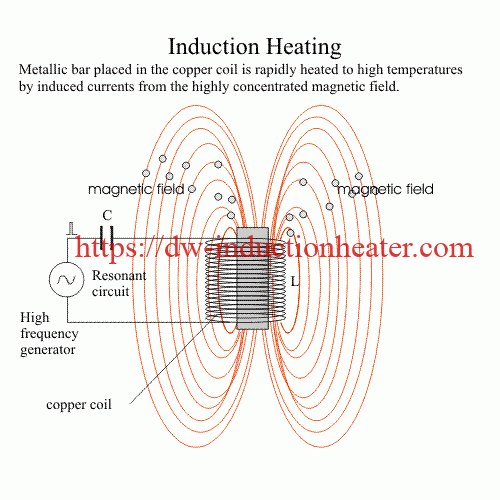
 induction_heating_principle[/caption]
How Induction Heating Work?
An induction heater (for any process) consists of an induction coil (or electromagnet), through which a high-frequency alternating current (AC) is passed. Heat may also be generated by magnetic hysteresis losses in materials that have significant relative permeability. The frequency of AC used depends on the object size, material type, coupling (between the work coil and the object to be heated) and the penetration depth.High Frequency Induction heating is a process which is used to bond, harden or soften metals or other conductive materials. For many modern manufacturing processes, induction heating offers an attractive combination of speed, consistency and control.
What's Induction Heating Applications
Induction heating is a rapid ,clean, non-polluting heating form which can be used to heat metals or change the conductive material’s properties. The coil itself does not get hot and the heating effect is under controlled. The solid state transistor technology has made induction heating much easier,cost-effective heating for applications including soldering andinduction brazing ,induction heat treating, induction melting,induction forging etc.
induction_heating_principle[/caption]
How Induction Heating Work?
An induction heater (for any process) consists of an induction coil (or electromagnet), through which a high-frequency alternating current (AC) is passed. Heat may also be generated by magnetic hysteresis losses in materials that have significant relative permeability. The frequency of AC used depends on the object size, material type, coupling (between the work coil and the object to be heated) and the penetration depth.High Frequency Induction heating is a process which is used to bond, harden or soften metals or other conductive materials. For many modern manufacturing processes, induction heating offers an attractive combination of speed, consistency and control.
What's Induction Heating Applications
Induction heating is a rapid ,clean, non-polluting heating form which can be used to heat metals or change the conductive material’s properties. The coil itself does not get hot and the heating effect is under controlled. The solid state transistor technology has made induction heating much easier,cost-effective heating for applications including soldering andinduction brazing ,induction heat treating, induction melting,induction forging etc.
2023年11月12日星期日
What Is Induction Heating?
What Is Induction Heating?
Induction heating is the process of heating an electrically conducting object (usually a metal) by electromagnetic induction, where eddy currents (also called Foucault currents) are generated within the metal and resistance leads to Joule heating of the metal.Induction heating is a form of non-contact heating,when alternating current flows in the induced coil, varying electromagnetic field is set up around the coil, circulating current(induced, current, eddy current) is generated in the workpiece(conductive material), heat is produced as the eddy current flows against the resitivity of the material.The basic principles of induction heating have been understood and applied to manufacturing since the 1920s. During World War II, the technology developed rapidly to meet urgent wartime requirements for a fast, reliable process to harden metal engine parts. More recently, the focus on lean manufacturing techniques and emphasis on improved quality control have led to a rediscovery of induction technology, along with the development of precisely controlled, all solid state induction power supplies.
[caption id="attachment_143" align="alignright" width="500"] induction_heating_principle[/caption]
How Induction Heating Work?
An induction heater (for any process) consists of an induction coil (or electromagnet), through which a high-frequency alternating current (AC) is passed. Heat may also be generated by magnetic hysteresis losses in materials that have significant relative permeability. The frequency of AC used depends on the object size, material type, coupling (between the work coil and the object to be heated) and the penetration depth.High Frequency Induction heating is a process which is used to bond, harden or soften metals or other conductive materials. For many modern manufacturing processes, induction heating offers an attractive combination of speed, consistency and control.
What's Induction Heating Applications
Induction heating is a rapid ,clean, non-polluting heating form which can be used to heat metals or change the conductive material’s properties. The coil itself does not get hot and the heating effect is under controlled. The solid state transistor technology has made induction heating much easier,cost-effective heating for applications including soldering andinduction brazing ,induction heat treating, induction melting,induction forging etc.
induction_heating_principle[/caption]
How Induction Heating Work?
An induction heater (for any process) consists of an induction coil (or electromagnet), through which a high-frequency alternating current (AC) is passed. Heat may also be generated by magnetic hysteresis losses in materials that have significant relative permeability. The frequency of AC used depends on the object size, material type, coupling (between the work coil and the object to be heated) and the penetration depth.High Frequency Induction heating is a process which is used to bond, harden or soften metals or other conductive materials. For many modern manufacturing processes, induction heating offers an attractive combination of speed, consistency and control.
What's Induction Heating Applications
Induction heating is a rapid ,clean, non-polluting heating form which can be used to heat metals or change the conductive material’s properties. The coil itself does not get hot and the heating effect is under controlled. The solid state transistor technology has made induction heating much easier,cost-effective heating for applications including soldering andinduction brazing ,induction heat treating, induction melting,induction forging etc.

2023年11月11日星期六
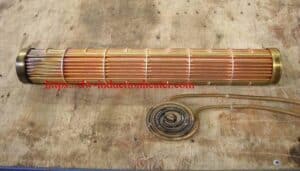
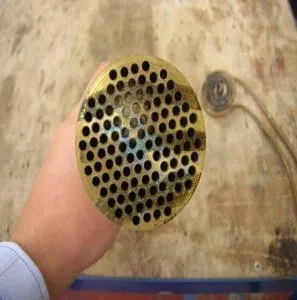
Induction Soldering Brass Heating Exchanger
Induction Soldering Brass Heating Exchanger Of a Series Copper Pipe
Objective To solder a brass end cap to a series of copper tubes
Material Preassembled heat exchanger with copper tubes and 2 brass end caps 2.36” (60mm) OD, 0.08” to 0.12” (2 to 3mm) thick at both ends, liquid solder
Temperature 302ºF (150ºC)
482ºF (250ºC)
Frequency 237kHz
Equipment • DW-UHF-20kW induction heating system, equipped with a remote workhead containing one 1.0μF capacitor
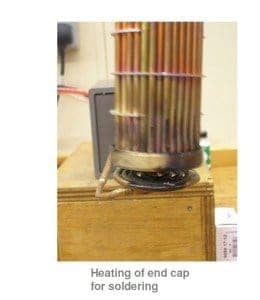
• An induction heating coil designed and developed specifically for this application.
Process A dual four turn pancake coil is used to solder 2 brass caps per cycle. Liquid solder is squirted onto the end cap and is heated for 18 seconds at 302ºF (150ºC) to burn off the flux. Then the
heat is increased to 482ºF (250ºC) for 15 seconds to solder the parts.
Results
Induction heating provides:
• Even distribution of heating
• Compared to hot plate, induction heating is able to heat two parts in 30 seconds vs. one part in 60 seconds
• Increased production
• No discoloration with the slow heating process


2023年11月8日星期三
What Is Induction Melting?
What Is Induction Melting?
Induction melting is a process where metal is melted into liquid form in an induction furnace's crucible. The molten metal is then poured from the crucible, usually into a cast.
What are the benefits?
Induction melting is extremely fast, clean and uniform. When correctly performed, induction melting is so clean that it is possible to skip the purification stage necessary with other methods. The uniform heat induced in the metal also contributes to a high-quality end result. DaWei Induction melting furnace have advanced ergonomic features. They not only make workplaces safer, they increase productivity by making the melting process faster and more comfortable. Where is it used? DaWei Induction melting systems are used in foundries, universities, laboratories and research centers. The systems melt everything from ferrous and non-ferrous metals to nuclear material and medical/dental alloys.
What equipment/furnace is available?
DaWei Induction Heating Machine Co offers many different induction furnace ranges to suit a wide variety of melting needs: single-axis tiltpour, dual-axis tilt-pour, moving coil, rollover and laboratory.
Induction Aluminum Brazing Process
Induction Aluminum Brazing Process
Induction aluminum brazing is becoming more and more common in industry. A typical example is brazing various pipes to an automotive heat exchanger body. Aluminum requires a lot of energy to heat using induction and its thermal conductivity is 60% compared to copper. Coil design and time for the heat to flow is critical in a successful induction brazing process for aluminum parts. Recent advances in lower temperature aluminum braze materials have allowed induction to effectively replace flame and furnace heating in high volume brazing of aluminum assemblies.
Successful Induction brazing of aluminum parts requires the correct braze filler material for the aluminum alloy used in the parts and the correct flux for the braze alloy. Braze filler manufacturers have their own proprietary aluminum braze alloys and flux materials that work with their alloys.
2023年11月7日星期二
Induction Brazing Aluminum Pipes
Induction Brazing Aluminum Pipes
Objective: Brazing two aluminum pipes simultaneously to an aluminum evaporator core
Material 2 aluminum pipes 0.72" (18.3mm) diameter, evaporator core 9.88" x 10.48" x 1.5" thick (251mm x 266.3mm x 38mm), braze rings
Temperature 610 ºF (321 ºC)
Frequency 250 kHz
Equipment • DW-UHF-20KW induction heating system, equipped with a remote workhead containing two 1.5μF capacitors for a total of 0.75μF • An induction heating coil designed and developed specifically for this application.
Process A four turn helical pancake coil is used to heat the 2 pipes simultaneously. Three braze rings are placed on each joint and power is applied for 90-100 seconds to create a leak proof joint on both pipes. Narrative • Customer is requiring a 40 seconds heat time for both brazes. In order to meet this requirement 3 units will be utilized to braze 2 joints each for a total of 6 joints in 90-100 seconds. The customer is currently using a flame process which can burn away the thin flange at the joint area and create scrap parts. By switching to induction for this application the customer is decreasing their scrap parts and also increasing their quality and production rate.
Results/Benefits Induction heating provides:
• Repeatable leak free joints
• Increased part quality, less scrap
• Hands-free heating that involves no operator skill for manufacturing
• Even distribution of heating
2023年11月6日星期一
High Frequency Heating Steel Pipe
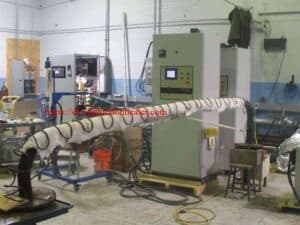
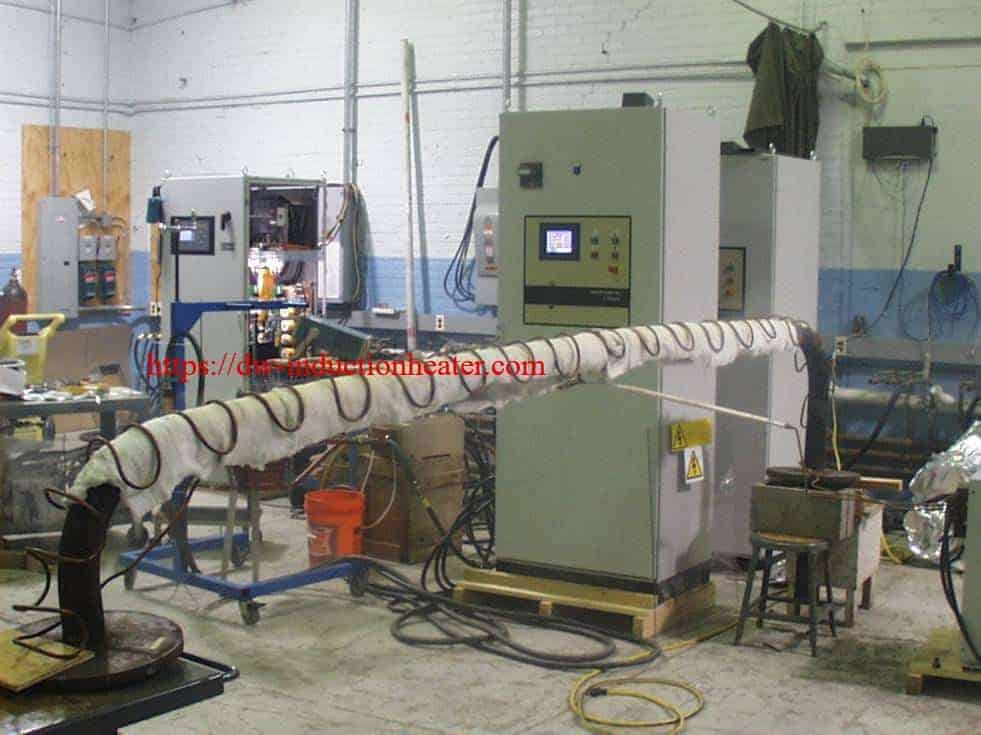
High Frequency Heating Steel Pipe With Induction Heating Equipment
Objective To heat a steel pipe to 1100ºF (593ºC) to transport melted magnesium
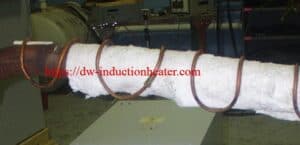
Material Steel pipe 14.5’ (4.42m) long with a 3.5” (88.9mm)OD
Temperature 1100ºF (593ºC)
Frequency 9 kHz
Equipment • DW-MF-160kW induction heating system, equipped with a remote workhead containing one 25μF capacitor.
• An induction heating coil designed and developed specifically for this application.
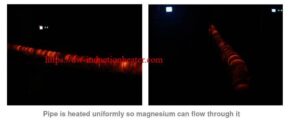
Process A specially designed double U channel coil the length of the pipe is used in this application. The pipe is placed inside the coil and power is supplied. The voltage is set and the power output is 100kW. As the part reaches the Currie point the power drops to 80kW and the voltage must be increased to achieve the 140kW. The pipe reaches 1100ºF (593ºC) in 20 minutes.
Results/Benefits Induction heating provides:
• Controllable and repeatable heat pattern that keeps
material in liquid form
• Environmentally friendly
• Even distribution of heating
• Movable workhead that can be located away from the power supply


Brazing Thin Copper Tube With Induction
Brazing Thin Copper Tube With Induction
Objective: To braze a thin copper oval tube to a brass fitting at 1400 º F and to cap the other end of the copper tube with a brass plate.
Material: Brass fitting - 0.875 in2 and 2.5 in long (22mm2 x 64mm) Copper tube 0.01 in (0.254mm) wall Brass plate 0.10 in (2.54mm) thick and 0.5 in X 0.25 inch Braze alloy shim and white flux
Temperature: 1400 ºF (760 °C)
Frequency: 300 kHz
Equipment: DW-UHF-10KW induction power supply equipped with a remote heat station using two 1.32μF capacitors (total 0.66 μF) Two custom-designed induction heating coils. Process A split, f our-turn induction coil is used to deliver the heat energy into the brass fitting (Fig. 1). To prevent over heating of the edges of the brass fitting and the thin copper tube, a smaller coil diameter (Fig. 2) was added to deliver heat into the brass fitting. A braze shim preform is placed at the joint area, and is then covered with white flux. The height of the coil is adjusted to deliver proportional heat to the assembly. This setting raises the temperature of the thicker brass piece and the thin copper tube at the same rate enabling a uniform flow of the braze shim preform. The other end of the copper tube is brazed successfully using a 2-turn helical coil (Fig.3.)
Results/Benefits • Preservation of the copper's mechanical properties • Minimized heat migration along both ends of the tube • Reduced heat-up time (under 60 sec.)
2023年11月5日星期日
Brazing Copper to Brass Pipe With Induction
Brazing Copper to Brass Pipe With Induction
Objective: Brazing several brass and copper assemblies used in water faucets Material braze, white flux
Temperature 1350 °F 730°C
Frequency 200 or 280 kHz (coil dependant)
Equipment DW-UHF-10KW induction heating system, remote work head with two 1μF capacitors and a 3-turn helical coil
Process: Three helical coils are used separately to braze a range of provided parts. Parts are assembled with flux and a braze alloy and then heated. The heat time varies from part to part with large parts taking less than 3 minutes and, the smaller parts heated in less than 20 seconds. After heating the parts are quench-cooled.
Results/Benefits
Repeatability: the inherent precision of induction heating supports a process which is highly repeatable.
Economy: the process allows for the use of higher temperature braze alloy than a flame process
2023年11月3日星期五
Induction Brazing Principle-Theory
Induction Brazing Technology
Induction Brazing Principle|Theory Brazing and soldering are processes of joining similar or dissimilar materials using a compatible a filler material. Filler metals include lead, tin, copper, silver, nickel and their alloys. Only the alloy melts and solidifies during these processes to join the work piece base materials. The filler metal is pulled into the joint by capillary action. Soldering processes are conducted below 840°F (450°C) while brazing applications are conducted at temperatures above 840°F (450°C) up to 2100°F (1150°C).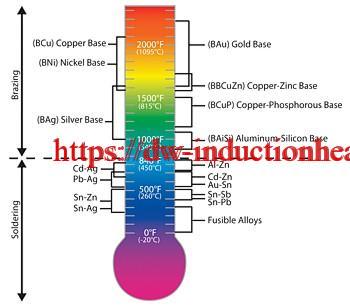 The success of these processes depends upon the assembly’s design, clearance between the surfaces to be joined, cleanliness, process control and the correct selection of equipment needed to perform a repeatable process.
Cleanliness is ordinarily obtained by introducing a flux which covers and dissolves dirt or oxides displacing them from the braze joint.
Many operations are now conducted in a controlled atmosphere with a blanket of inert gas or combination of inert / active gasses to shield the operation and eliminate the need for a flux. These methods have been proven on a wide variety of material and part configurations replacing or complimenting atmosphere furnace technology with a just in time - single piece flow process.
Brazing Filler Materials
Brazing filler metals can come in a variety of forms, shapes, sizes and alloys depending on their intended use. Ribbon, preformed rings, paste, wire and preformed washers are just a few of the shapes and forms alloys that can be found.
The success of these processes depends upon the assembly’s design, clearance between the surfaces to be joined, cleanliness, process control and the correct selection of equipment needed to perform a repeatable process.
Cleanliness is ordinarily obtained by introducing a flux which covers and dissolves dirt or oxides displacing them from the braze joint.
Many operations are now conducted in a controlled atmosphere with a blanket of inert gas or combination of inert / active gasses to shield the operation and eliminate the need for a flux. These methods have been proven on a wide variety of material and part configurations replacing or complimenting atmosphere furnace technology with a just in time - single piece flow process.
Brazing Filler Materials
Brazing filler metals can come in a variety of forms, shapes, sizes and alloys depending on their intended use. Ribbon, preformed rings, paste, wire and preformed washers are just a few of the shapes and forms alloys that can be found.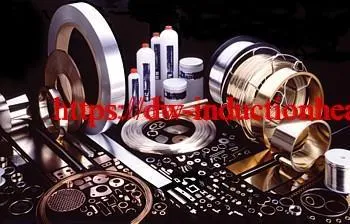 The decision to use a particular alloy and/or shape is largely dependent on the parent materials to be joined, placement during processing and the service environment for which the final product is intended.
Clearance Affects Strength
Clearance between the faying surfaces to be joined determines the amount of braze alloy, capillary action / penetration of the alloy and subsequently the strength of the finished joint. The best fit up condition for conventional silver brazing applications are 0.002 inches (0.050 mm) to 0.005 inches (0.127 mm) total clearance. Aluminum is typically 0.004 inches (0.102 mm) to 0.006 inches (0.153 mm). Larger clearances up to 0.015 inches (0.380 mm) usually lack sufficient capillary action for a successful braze.
Brazing with copper (above 1650°F / 900°C) requires the joint tolerance kept to an absolute minimum and in some cases press fit at ambient temperatures to assure minimum joint tolerances while at the brazing temperature.
Induction Heating Theory
Induction systems provide a convenient and precise way to quickly and efficiently heat a selected area of an assembly. Consideration must be given to the selection of power supply operating frequency, power density (kilowatt applied per square inch), heating time, and induction coil design to provide the required depth of heating in a specific braze joint.
Induction heating is non-contact heating by means of transformer theory. The power supply is an AC source to the induction coil that becomes the primary windings of the transformer while the part to be heated is the transformer’s secondary. The work piece heats by the base materials’ inherent electrical resistivity to the induced current flowing in the assembly.
The decision to use a particular alloy and/or shape is largely dependent on the parent materials to be joined, placement during processing and the service environment for which the final product is intended.
Clearance Affects Strength
Clearance between the faying surfaces to be joined determines the amount of braze alloy, capillary action / penetration of the alloy and subsequently the strength of the finished joint. The best fit up condition for conventional silver brazing applications are 0.002 inches (0.050 mm) to 0.005 inches (0.127 mm) total clearance. Aluminum is typically 0.004 inches (0.102 mm) to 0.006 inches (0.153 mm). Larger clearances up to 0.015 inches (0.380 mm) usually lack sufficient capillary action for a successful braze.
Brazing with copper (above 1650°F / 900°C) requires the joint tolerance kept to an absolute minimum and in some cases press fit at ambient temperatures to assure minimum joint tolerances while at the brazing temperature.
Induction Heating Theory
Induction systems provide a convenient and precise way to quickly and efficiently heat a selected area of an assembly. Consideration must be given to the selection of power supply operating frequency, power density (kilowatt applied per square inch), heating time, and induction coil design to provide the required depth of heating in a specific braze joint.
Induction heating is non-contact heating by means of transformer theory. The power supply is an AC source to the induction coil that becomes the primary windings of the transformer while the part to be heated is the transformer’s secondary. The work piece heats by the base materials’ inherent electrical resistivity to the induced current flowing in the assembly.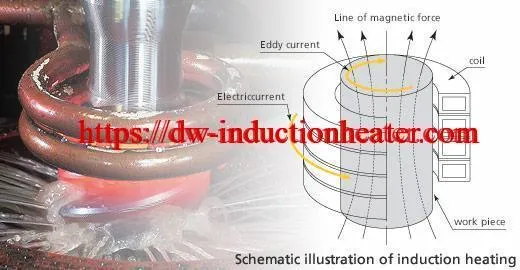 Current passing through an electrical conductor (the workpiece) results in heating as current meets resistance to its flow. These losses are low in current flowing through aluminum, copper and their alloys. These non-ferrous materials require additional power to heat than their carbon steel counterpart.
The alternating current tends to flow on the surface. The relationship between the frequency of the alternating current and the depth it penetrates the part is known as the reference depth of heating. Part diameter, material type and wall thickness can have an effect on heating efficiency based on the reference depth.
Current passing through an electrical conductor (the workpiece) results in heating as current meets resistance to its flow. These losses are low in current flowing through aluminum, copper and their alloys. These non-ferrous materials require additional power to heat than their carbon steel counterpart.
The alternating current tends to flow on the surface. The relationship between the frequency of the alternating current and the depth it penetrates the part is known as the reference depth of heating. Part diameter, material type and wall thickness can have an effect on heating efficiency based on the reference depth.
Induction Shrink Fitting Assemblies
Induction Shrink Fitting Assemblies
Objective To use induction to prepare cast iron assemblies for shrink fit assembly
Material Customer supplied cast iron rocker arms of varying sizes
Temperature 450 ºF (232 °C)
Process Time 20 seconds
Frequency 148 kHz
Equipment DW-UHF-5.0 kW, 150-400 kHz solid state induction heating system, equipped with a remote heat station containing one 1.0μF capacitor
An induction heating coil designed and developed specifically for this application.
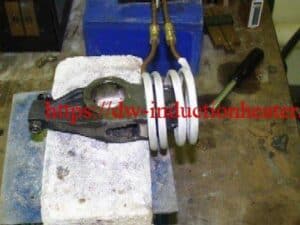
Process A four-turn helical coil heats the ring at one end of the assembly. The coil is designed to concentrate the field towards the center of the assembly where the thermal mass is greatest.
Across the heated ring, the coil presents a lighter field. After heating, a pin is place within the ring and the assembly is water quenched.
The heat time varies from part to part but is less than 20 seconds.
Results/Benefits Induction heating satisfies the needs of this process for:
• rapid part heating
• flexibility for parts of differing geometries
• individual, series part heating, suitable for automation
• a clean source of heat
• even heat distribution

2023年11月2日星期四
Induction Soldering Circuit Board
Induction Soldering Circuit Board With IGBT heating system
Objective To heat post, lead or lead-free solder preforms for various circuit board soldering applications.
Material Upper and lower circuit boards, small and large lead or lead free preforms.
Temperature < 700 ºF (371ºC) depending on the preform used
Frequency Three turn coil 364 kHz
Small two turn coil 400 kHz
Large two turn coil 350 kHz
Equipment • DW-UHF-4.5 kW induction heating system, equipped with a remote workhead containing two 0.66μF capacitors for a total of 1.32 μF
• An induction heating coil, designed and developed specifically for this application.
Process Three individual coils are used to heat the various locations on the circuit board depending upon if the location is a single application or a group application. The time varies from 1.8 to 7.5 seconds depending upon location. In production the heat stations and coils are moved into position over the post for automation purposes. Either lead or lead free solder preforms are used. The process time on the lead free solder is slightly longer.
Results/Benefits Induction heating provides:
• Hands-free heating that involves no operator skill for manufacturing, lends itself well to automation.
• Solder controlled by preforms, no excess left on board.
• Good solder flow without over heating the board and damaging adjacent circuits and components.
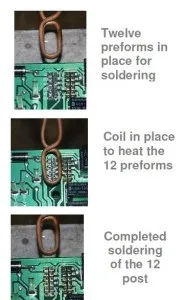
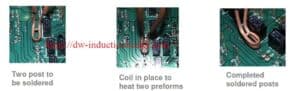
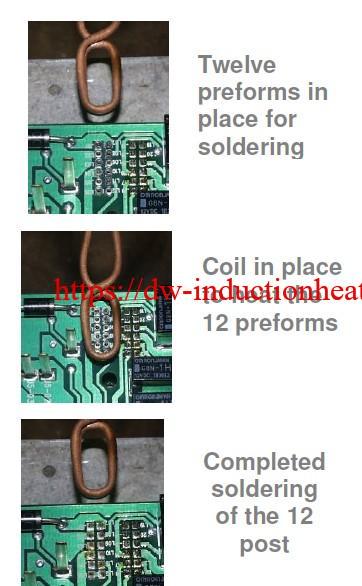
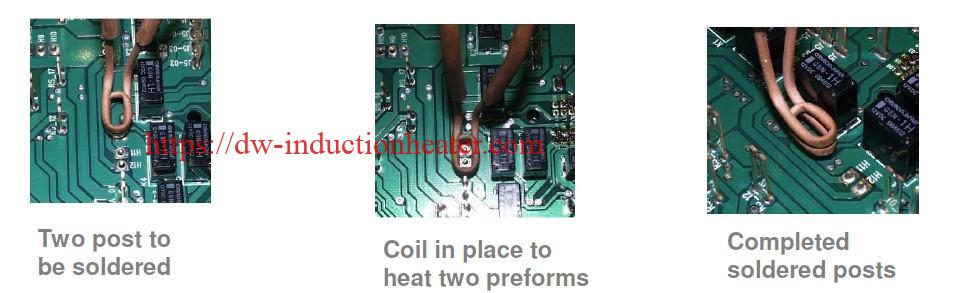
Brazing Copper Tube with Induction
Brazing Copper Tube with Induction
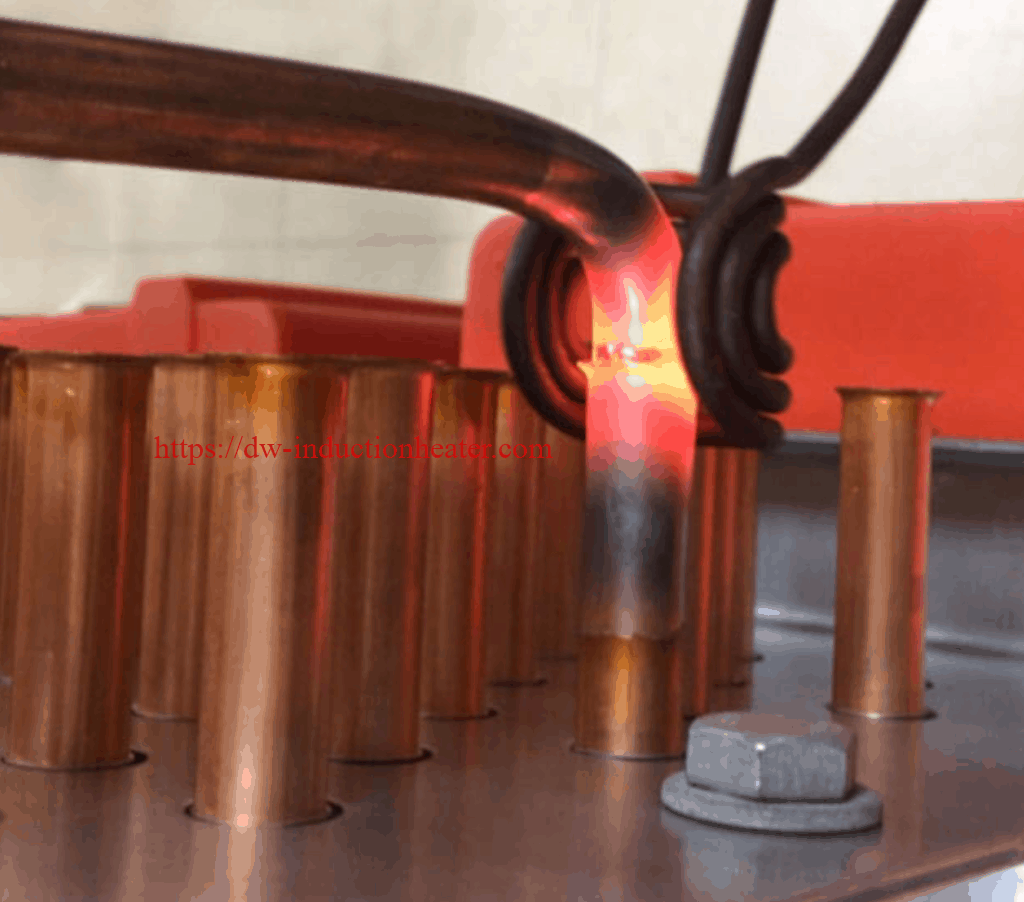
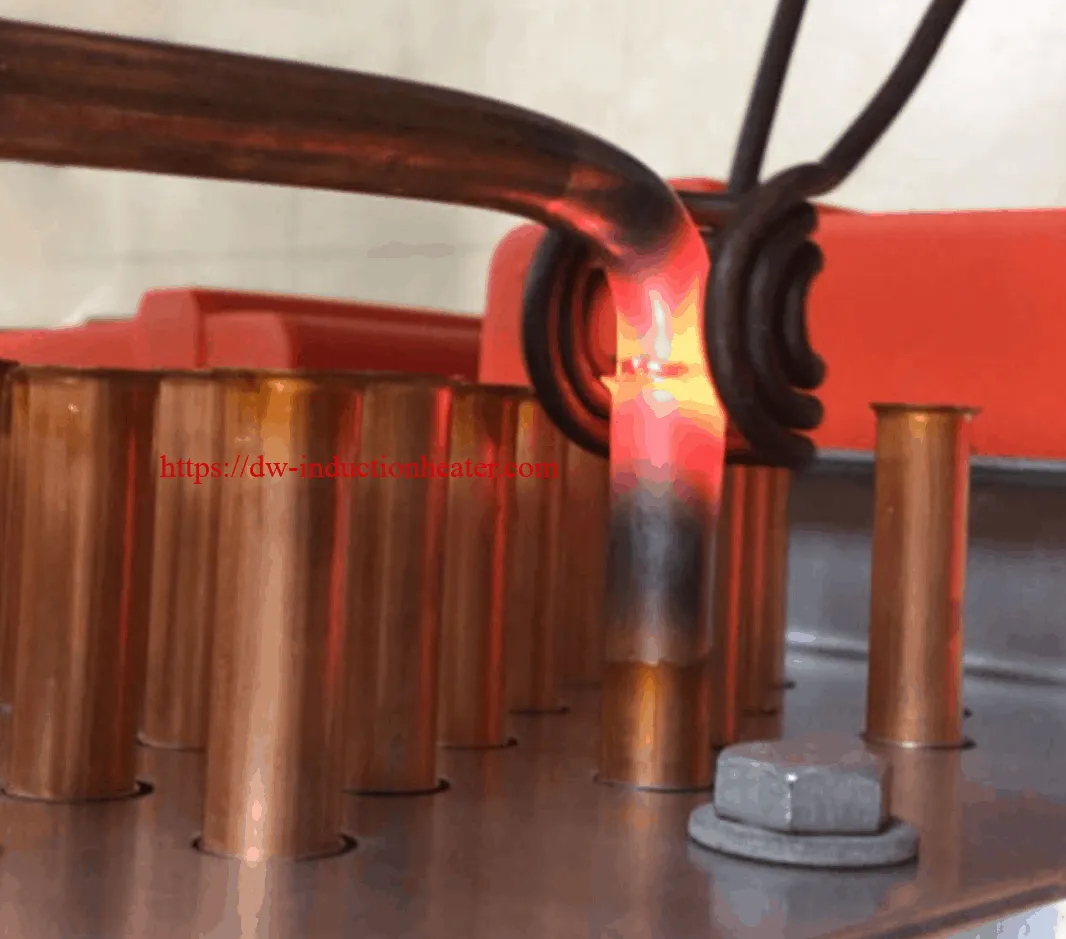
Objective: To braze a copper tube ( 3/8" OD by 2-4" long) into a 3/8" fitting in less than 10 seconds. Heating must take place in a channel type coil to allow for easy loading of parts.
Material Copper Tubing and Fitting with Braze and Stay Silv White Flux
Temperature 1300°F
Frequency 215 kHz
Equipment DW-UHF-10kw output solid state induction power supply equipped with a standard heat station containing eight 0.33 μF capacitors for a total of 0.66μF, a step down transformer, and a specifically designed induction heating coil.
Process DW-UHF-10kw solid state induction power supply was setup to achieve the following results: · 2.0 kW of power was directly loaded into the copper tube resulting in a heating time of 7.2 seconds to reach the necessary 13000F for brazing.
Results& Processing ease was achieved through the design of a unique channel type coil comprised of three turns of 1/8" copper.
2023年11月1日星期三
2023年10月31日星期二
Induction Brazing Principle-Theory
Induction Brazing Technology
Induction Brazing Principle|Theory Brazing and soldering are processes of joining similar or dissimilar materials using a compatible a filler material. Filler metals include lead, tin, copper, silver, nickel and their alloys. Only the alloy melts and solidifies during these processes to join the work piece base materials. The filler metal is pulled into the joint by capillary action. Soldering processes are conducted below 840°F (450°C) while brazing applications are conducted at temperatures above 840°F (450°C) up to 2100°F (1150°C).
The success of these processes depends upon the assembly’s design, clearance between the surfaces to be joined, cleanliness, process control and the correct selection of equipment needed to perform a repeatable process.
Cleanliness is ordinarily obtained by introducing a flux which covers and dissolves dirt or oxides displacing them from the braze joint.
Many operations are now conducted in a controlled atmosphere with a blanket of inert gas or combination of inert / active gasses to shield the operation and eliminate the need for a flux. These methods have been proven on a wide variety of material and part configurations replacing or complimenting atmosphere furnace technology with a just in time - single piece flow process.
Brazing Filler Materials
Brazing filler metals can come in a variety of forms, shapes, sizes and alloys depending on their intended use. Ribbon, preformed rings, paste, wire and preformed washers are just a few of the shapes and forms alloys that can be found.
The decision to use a particular alloy and/or shape is largely dependent on the parent materials to be joined, placement during processing and the service environment for which the final product is intended.
Clearance Affects Strength
Clearance between the faying surfaces to be joined determines the amount of braze alloy, capillary action / penetration of the alloy and subsequently the strength of the finished joint. The best fit up condition for conventional silver brazing applications are 0.002 inches (0.050 mm) to 0.005 inches (0.127 mm) total clearance. Aluminum is typically 0.004 inches (0.102 mm) to 0.006 inches (0.153 mm). Larger clearances up to 0.015 inches (0.380 mm) usually lack sufficient capillary action for a successful braze.
Brazing with copper (above 1650°F / 900°C) requires the joint tolerance kept to an absolute minimum and in some cases press fit at ambient temperatures to assure minimum joint tolerances while at the brazing temperature.
Induction Heating Theory
Induction systems provide a convenient and precise way to quickly and efficiently heat a selected area of an assembly. Consideration must be given to the selection of power supply operating frequency, power density (kilowatt applied per square inch), heating time, and induction coil design to provide the required depth of heating in a specific braze joint.
Induction heating is non-contact heating by means of transformer theory. The power supply is an AC source to the induction coil that becomes the primary windings of the transformer while the part to be heated is the transformer’s secondary. The work piece heats by the base materials’ inherent electrical resistivity to the induced current flowing in the assembly.
Current passing through an electrical conductor (the workpiece) results in heating as current meets resistance to its flow. These losses are low in current flowing through aluminum, copper and their alloys. These non-ferrous materials require additional power to heat than their carbon steel counterpart.
The alternating current tends to flow on the surface. The relationship between the frequency of the alternating current and the depth it penetrates the part is known as the reference depth of heating. Part diameter, material type and wall thickness can have an effect on heating efficiency based on the reference depth.
2023年10月30日星期一
Brazing Aluminum to Copper Tubes with Induction
Brazing Aluminum to Copper Tubes with Induction
Objective: To heat an aluminum manifold to 1050 ºF (566 ºC) for a brazing application:
Material :
- Cu tubes (3/4"/19mm)
- Cu tubes (5/8"/15.8mm)
- AI tubes (3/8"/9.5mm)
- AI manifold (5/8"/15.8mm)
- AI manifold (3/4"/19mm)
- Lucas-Milhaupt Handy One alloy 30-832
- Braze wire
- A two-turn oval helical induction heating coil designed and developed specifically for the aluminum assembly
- A five-turn helical induction heating coil designed and developed specifically for brazing the Cu tubes to AI joint assembly
- The client wanted more precise and repeatable heating than a torch could deliver, which induction was able to achieve .
- Temperature control: Induction allows for superior temperature control when compared to other methods, including a torch, which the client desired
2023年10月29日星期日
Brazing Wire to Copper Bar With Induction
Brazing Wire to Copper Bar With Induction
Objective: To heat a compacted litz wire bundle for wire stripping then braze the litz wire bundle to a copper block for use in an automotive motor.
Material: Compacted litz wire bundle 0.388” (9.85mm) wide, 0.08” (2.03mm) thick copper bar 0.5” (12.7mm) wide, 0.125” (3.17mm) thick and 1.5” (38.1mm) long braze wire & white flux
Temperature 1400 ºF (760 ºC)
Frequency 300 kHz
Equipment • DW-UHF-10 kW induction heating system, equipped with a remote workhead containing two 1.5μF capacitors for a total of 0.75μF
• An induction heating coil designed and developed specifically for this application.
Process: A three turn helical coil is used for the wire stripping process.The litz wire bundle is placed in the coil for 3 seconds to strip the lacquer 0.75” (19mm) from the end of the bundle. The wire bundle is then scraped with a metal brush to remove the burnt lacquer. For the brazing process a two turn channel coil is used. The litz wire and copper assembly are placed in the coil and the braze wire is fed by hand. The braze is completed in 45-60 seconds.
Results/Benefits Induction heating provides:
• Consistent, repeatable results
• Faster process time, increased production
• Even distribution of heating
Annealing Metal Stamp With Induction
Annealing Metal Stamp With Induction
Objective: Induction Heating the opposite end of a metal stamp so that it mushrooms instead of cracks/splits when struck by a hammer.
Material S-7 steel of varying rectangular cross sectional sizes
Temperature 1400-1800 ºF (760-982) ºC
Frequency 300 kHz
Equipment DW-UHF-10KW, induction heating system, equipped with a remote heat station containing two 1.5 μF capacitors for a total of 0.75 μF and three different induction heating coils designed and developed specifically for this application.
Process One five-turn and two four-turn helical coils are used to heat the end of stamps to the required temperature. Two part sizes can be run in each of coils, using the same machine settings except for cycle time. Cycle rates dependent upon the crosssection size. The 3/8" (0.9525 cm) square size is has a rate of below 10 seconds. The rate for the middle size, ½" – 1 ½ " (1.27 - 3.81 cm) is 30 to 60 seconds. A 1" (2.54 cm) square part takes approximately two minutes. Fixturing can influence the length of the cycle time required. For shorter heat times a larger power supply may be used.
Results/Benefits Precise heat only to the area that needs annealing is more efficient and repeatable than heating with a torch.
2023年10月28日星期六
induction sealing glass
Induction sealing glass to enclose resistors with high frequency induction heating system
Objective Provide a hermetic seal of glass enclosed resistor to a lead
Material Resistor Kovar rings, 0.1 inch (0.254cm) diameter Glass tube slightly larger than 0.1 inch (0.254cm) diameter, 0.5 (1.27) inch length
Metal lead
Temperature 900 ºF (482) ºC
Frequency 324 kHz
Equipment • DW-UHF-6kW-III induction heating system, equipped with a remote workhead containing two (2) 1.5 μF capacitors (for a total of 0.75 μF).
• An induction heating coil designed and developed specifically for this application.
Process A three turn concentrator plate coil is used to heat the Kovar ring for 500 milliseconds. This causes the glass to melt and seal one side of the resistor. The resistor is then turned over
and the process is repeated to seal the other side using a second Kovar ring.
Results/Benefits Induction heating provides precise, consistent heat to very small parts resulting in repeatable, quality seals.
By heating with medium frequency, arcing (which occurs at high frequencies) is avoided.
2023年10月27日星期五
Brazing Cutting Tool with Induction
Brazing Cutting Tools with Induction
Objective: To braze cone and shaft for a cutting tool
Material Customer supplied parts
Temperature indicating paint Braze preforms
Temperature 1300 - 1400 ºF (704 – 760 °C)
Frequency 400 kHz
Equipment: DW-UHF-6kw-I, 250-600 kHz induction heating system, including remote heat station using two 0.66 μF capacitors (total 1.32 μF) A two-position, two-turn induction heating coil designed and developed specifically for this application.
Process: Two sets of parts are placed in the individual coils. Braze preforms are placed on the cone at the joint. The assembled part is placed inside the induction heating coil and heated until the braze melts.
Results/Benefits: efficient coil design enables simultaneous heating of two parts on the single 2kW system. dual braze is accomplished within required process time, increasing process throughput
2023年10月25日星期三
Brazing Silver To Copper With Induction
Brazing Silver To Copper With Induction
Objective: Heat silver contacts and brass/copper bus for brazing application
Material: Silver contact .75 (19mm) diameter, brass and copper bus 2” x 1” (50.8 x 25.4mm), braze shims, white flux
Temperature 1300 ºF (704 ºC)
Frequency 300 kHz
Equipment • DW-UHF-10kW induction heating system, equipped with a remote workhead containing two 1.0μF capacitors for a total of 0.5 μF
• An induction heating coil designed and developed specifically for this application.
Process A five turn split helical coil is used to heat the assembly. The parts are placed 90º to the coil between the top turn and second turn with braze shims and flux. The parts reach 1300ºF (704 ºC) in less than 40 seconds to braze the parts together.
Results/Benefits Induction heating provides:
• Hands-free heating that involves no operator skill for manufacturing
• Better joint quality
• Faster heating cycles, more consistent results
• Even distribution of heating
订阅:
博文 (Atom)
我的简介

- HLQ induction heating machine
- HLQ induction heating machine manufacturer provides the service of induction brazing,melting,hot forming,hardening surface,annealing,shrink fitting,PWHT,etc.