2021年12月4日星期六

Induction Shrink Fitting Shaft Gears

Induction Shrink Fitting Shaft Gears  With IGBT High Frequency Heating Units

Objective To heat aluminum and steel camshaft gears to over 500°F within 4 minutes for a shrink fitting application. Material 6” diameter, 2” thick steel and aluminum camshaft gears, “K” type thermocouple, digital thermometer Temperature 518° for the steel gear; 320°F for the aluminum gear Frequency 151 kHz for the steel gear; 158 kHz for the aluminum gear Equipment DW-UHF-3.5, 5 and 7.5 kW power supplies, remote heat station with one 0.66 μF capacitor and a specially designed induction coil. Process Best results were achieved with the DW-UHF-3.5 kW power supply. Heating times of 3 minutes for the steel gear and 4 minutes for the aluminum gear resulted in uniform expansion of the gears for effective shrink fitting. The shafts dropped easily into the gears after the heat cycle. The shafts were gripped tightly after 30 seconds, resulting in total heat cycle times of 3.5 minutes for steel and 4.5 minutes for aluminum. Results A synopsis of the results of the application; include benefits enjoyed by the customer, process, times, etc induction shrink fitting shafts and gears

high frequency induction soldering wire to connector

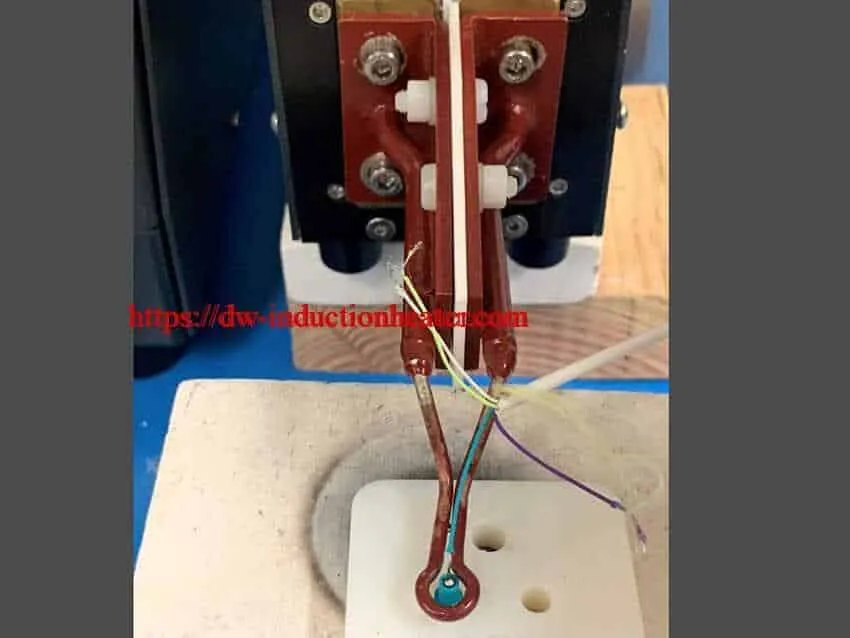
Objective The purpose of this test is to demonstrate the induction soldering wire to connector Recommended Equipment The recommended equipment for this test is the with the customized induction heating coil.  DW-UHF-6KW-I handheld induction heater
Key Parameters Power: Up to 0.48 kW Temperature: 392°F (200°C) Time: 1.5 seconds
Process and Results: This induction soldering wire to connector process was quick yet effective. The unit was run at 985 kHz, the reason for using such a high frequency was to couple into the small diameter of the wires. The whole process from the heat being turned on to the hardening of the solder took 1.5 seconds. Previously a soldering iron was being used to complete this task, however induction soldering was proven to be much faster and more efficient. The process can now be automated on an assembly line, because the system can remotely be turned on.

Induction Shrink Fitting Bearings

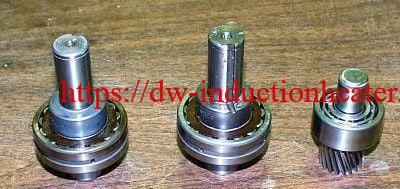
Induction Shrink Fitting Bearings With IGBT High Frequency Heating Units Objective To heat a roller bearing assembly for a shrink fitting application Material Steel bearings, diameters 1” to 3.5” (25.4 to 89mm) Temperature 300ºF (150ºC) Frequency 180 kHz Equipment DW-UHF-6kW solid-state induction power supply equipped with a remote heat station containing two 0.1 μF capacitors (total 0.2 μF), an induction-heating coil designed and developed specifically for this application. Process A multi-turn helical coil is used to generate the required heat pattern. The bearing is placed inside the induction-heating coil, its axis perpendicular to the axis of the coil to deliver uniform heat to the various size rings of the bearing. This ensures proper growth of the bearing assembly for subsequent shrinking on the steel shafts. (A full range of bearing sizes can be heated with a single coil design.) Temperature-indicating paints verify temperature uniformity and time needed to reach temperature. The bearing assemblies heat well and reach 300-350ºF (150-175°C) in 30-60 seconds. Once heated, the bearings are easily shrunk onto the shafts without the use of external force. Results/Benefits A multi-turn helical coil delivers uniform heat to the entire range of the bearing sizes in the transverse mode. Use of this singlephase power supply greatly simplifies installation and promotes portability: the induction system can be placed on a cart and moved to the manufacturing areas requiring the heat for shrink-fitting. Induction shrink fitting bearing

2021年12月3日星期五

induction curing

What is induction curing?

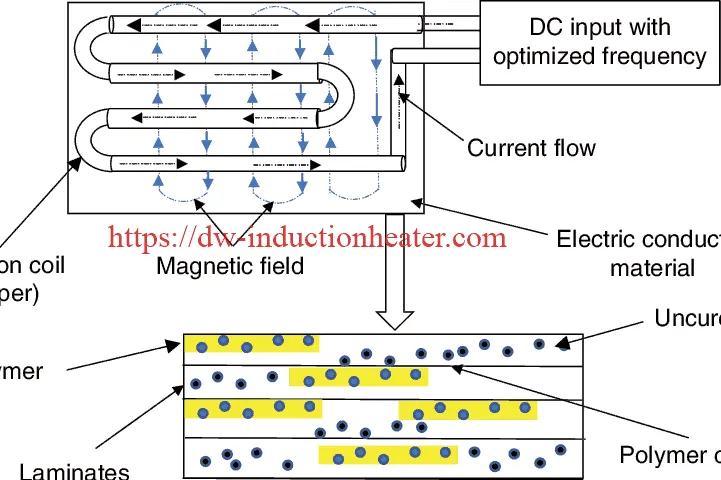
How does induction curing work? Simply put, line power is converted to alternating current and delivered to a work coil which creates an electromagnetic field within the coil. The piece with the epoxy on it can be metal or a semiconductor such as carbon or graphite. To cure epoxy on non-conductive substrates such as glass, an electrically conductive susceptor can be used to transfer the heat to the non-conductive material. [caption id="attachment_6981" align="alignnone" width="721"] induction curing principle-theory[/caption]
What are the benefits of induction curing?

Single component epoxy adhesives that are heat cured can use heat from various sources. The most typical is an oven but heat air guns, bake plates and induction curing are also used. Induction curing can greatly reduce the amount of time required to cure the epoxy and minimize the effects of heat on surrounding components as induction heating delivers heat precisely to the adhesive area.

Is induction curing a good option for my application?

Providing your induction heating equipment specialist and your epoxy adhesive manufacturer information on the following topics will help them to make the best recommendation. 1. Materials or substrates being bonded – Understanding what the substrates are will help determine the heating rate and power needed to cure the adhesive. For example iron heats with less power than is needed to heat aluminium. 2. Size of the components being bonded – Smaller parts require a higher frequency for efficient heating. Larger areas benefit from a lower frequency. 3. Epoxy requirements – There is a min/max threshold for curing epoxy. The minimum temperature required to effect cure and the maximum temperature allowed prior to the breakdown of the epoxy.

Induction Curing for Bonding of Quartz Chip to a Steel Cylinder

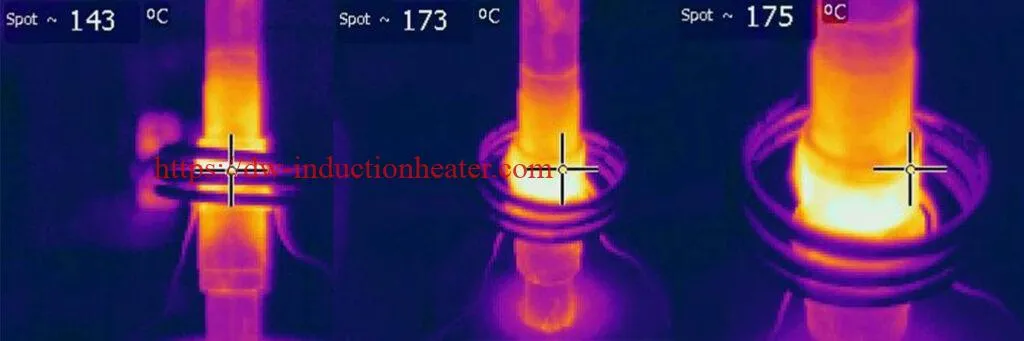
A company in the Automotive industry is looking for an induction heating system that can reach the temperature of 175° C (347°F) and hold it within the tight tolerance of +/- 3 C. Induction heating will heat a steel cylinder to cure an adhesive for bonding of a quartz chip. Induction heating is a preferred method because it provides faster, controlled and more uniform heating. Industry: Automotive Equipment: DW-UHF-10kW induction heating system is recommended for this curing application to ramp up and hold the desired temperature. Process: The goal of this induction curing application is to heat two sides of a steel cylinder which is 1.064” (2.70 cm) OD, 7.25” (18.41 cm) long with a 1” (2.54 cm) heat zone up to 175 C (347°F) and hold that temperature for 60 seconds in order to perform bonding application. The desired temperature was reached in 13 seconds. A K-type temperature controller was used to measure the temperature. [caption id="attachment_6979" align="alignnone" width="1024"] induction curing process[/caption] Induction Curing for Bonding of Quartz Chip to a Steel Cylinder

Induction Heating Shrink Steel Flange

Induction Heating Shrink Steel Flange With IGBT Heating Fitting Units Objective To heat steel flange for heat shrink application. Reaching the desired temperature results in adequate expansion to allow for placing of the flange over a graphite seal. Material Graphite seal 1” (25.4mm) diameter steel flange Temperature indicating paint Temperature 700°F (370°C) Frequency 206 kHz Equipment DW-UHF-4.5kW, 150-400 kHz solid state induction power supply, equipped with a remote heat station containing one 0.66 μF capacitor. A three-turn helical induction heating coil designed and developed specifically for this application. Process The part is placed inside the induction heating coil and power is supplied to the coil until the steel heats. This is done to determine the time-to-temperature and the heating pattern on the part. The composite assembly heats uniformly and reaches 700 F (370°C) in 10-12 seconds. Results/Benefits When the steel reaches the desired temperature it easily slips on to the graphite. Benefits include uniform, precise heat with quick heat up cycles. induction-heating-shrink-flange

Induction Curing Heating of Organic Coating

Induction Curing Heating of Organic Coating

Induction Heating is used to cure organic coating such as paint on metallic substrates by generating heat with in the subtract .By this mean curing occurs from within minimizing the tendency for formation of coating defects . A typical is application is drying of paint on sheet metal. Induction heating of metal parts to adhesive induction curing temperatures is utilized in a many automotive processes, such as the use of thermosetting adhesives to produce clutch plates, brake shoes and auto bumper components. Shafts are typically bonded to the squirrel cage rotors in the manufacture of small motors. In copying machines, plastic components are adhesively bonded to aluminum rotors; a thermoplastic glue is used to hold foam rollers on metal shafts. Once the rollers wear out, the shaft is heated and the foam replaced. Modern induction heating can solve many of these problems. Heating with induction provides reliable, repeatable, non-contact and energy-efficient heat in a minimal amount of time, so that the curing process can be completed with minimal energy and time. Improved temperature ramping cycles can be achieved with computer control of the solid state power supply. To eliminate extra steps for loading and unloading ovens, induction heat stations can be incorporated into a production line. Finally, induction heating can be performed in extremely clean environments, vacuum conditions or special atmospheres, allowing for unique curing solutions. Although induction heating is normally used with metals or other conductive materials, plastics and other non-conductive materials can often be heated very effectively by using a conductive metal susceptor to transfer the heat. Typical RF power supplies for induction curing applications range from 4 to 60kW, depending on the parts and application requirements.

Pipe-Tube Heating Systems With Induction

Pipe-Tube Heating Systems With Induction Pipe&Tube Induction Heating is the most energy-efficient and controllable method for applying heat during the production of tubular products.The induction heating precessing of pipe&tube includes drilling, threading, welding and other types of mechanical deformation which may require heat treatment to harden the metal or to eliminate residual stresses. In addition, tube&pipe ends are often heated and then upset (formed) to increase or decrease the diameter or wall thickness to allow pipes to be joined end-to-end. DAWEI Induction pipe&tube heating systems are designed for a variety of these applications including:
  • Heat Treat Quench and Temper of Tubing and Pipe
  • Upset Processing for Heat Treating
  • Pre-heating for Upsetting
  • Heating Rod Upsetting
  • Swedge End Stress Relieving
  • Preheating Tool Joint
  • Curing & Pre-heating of Coatings
  • Swivel Joint Bending
  • Pipe Bending
  • De-Bonding of Rubber
  • Continues Coiled Tube Processing
  • Seamless Mill Billet Pre-heaters
  • Seamless Finishing Taper Re-heaters
  • Solution Annealing
  • Bright Annealing
  • Hot Reduction
  • Hybrid Gas/Induction lines
 

关注者

我的简介

我的照片
HLQ induction heating machine manufacturer provides the service of induction brazing,melting,hot forming,hardening surface,annealing,shrink fitting,PWHT,etc.