
2021年12月3日星期五
Induction Annealing Stainless Steel Tubes
Induction Annealing Stainless Steel Tubes With High Frequency Heating Equipment
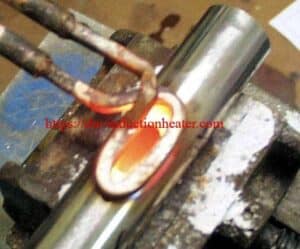
Objective To anneal a ¼” area around an oval cutout on a stainless steel tube prior to extrusion
Material .75” (19mm), 1.5” (38.1mm) and 4” (101.6mm) diameter steel tubes
Temperature 1900 ºF ( 1038 ºC)
Frequency 300 kHz
Equipment • DW-UHF-20kW induction heating system, equipped with a remote workhead containing one 1.0μF capacitor.
• An induction heating coil designed and developed specifically for this application.
Process A single turn helical coil is used on the 4” (101.6mm) diameter tubes and a two turn helical coil is used on the smaller diameters. The coil is placed over the oval cutout and power is
supplied for 15 seconds to anneal a .25 (6.35mm) diameter around the cutout.
Results/Benefits Induction heating provides:
• Precise and controllable placement of heat to anneal only the required area
• Faster process than flame
• Repeatable results
• Hands-free heating that involves no operator skill for manufacturing

Induction Preheating
What is induction preheating?
Induction preheating is a process where materials or workpieces are heated by induction prior to further processing. The reasons for pre-heating vary. In the cable and wire industry, cable cores are pre-heated before insulation extrusion. Steels strips are pre-heated prior to pickling and zinc coating. Induction preheating also softens metals before bending, and prepares tubes and pipes for welding. Mobile preheating solutions facilitate onsite repairs of bearing assemblies. What are the benefits? DAWEI Induction preheating systems are extremely efficient, resulting in major energy savings. When preheating steel strips and cable and wire, diode rectifiers ensure a constant power factor of 0.95, thus eliminating reactive power costs. Cycle times are short, too. And continuous automatic matching means a single coil can handle wide production ranges. Induction preheating systems are compact and easy to integrate into existing or planned production lines. Where is it used? Induction preheating is employed in the automotive, mechanical, aeronautical, electrotechnical, white goods and shipbuilding industries. A major area of use is preheating for welding. Our MYD series air cooling induction heating systems are used in the offshore sector for onsite weld preheating. MYD series air cooling heating units are also frequently flown to oil platforms and airports to perform repairs and maintenance. What equipment is available? The MYD air cooling induction heating systems are primary used for preheating weld heating treatment process.
2021年12月2日星期四
Induction Heating Aluminum Pipe
Induction Heating Aluminum Pipe For End Forming With High Frequency Induction Heater
Objective Through heating the top 2” (50.8mm) of aluminum oxygen tank to form a rounded end with a hole for oxygen valve
Material Aluminum oxygen tank with open end 2.25” (57.15mm) diameter, 0.188” (4.8mm) wall thickness
Temperature 700 ºF (371 ºC)
Frequency 71 kHz
Equipment • DW-HF-45kW induction heating system, equipped with a remote workhead containing two 1.5μF capacitors for a total of 0.75μF
• An induction heating coil designed and developed specifically for this application.
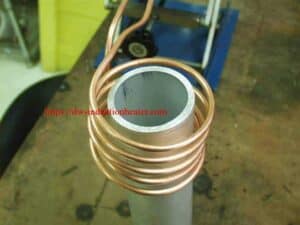
Process A five turn helical coil is used to heat the open end of the oxygen tank. The tank is heated for 24 seconds to reach 700ºF (371 ºC).
Results/Benefits Induction heating provides:
• Uniform through heating
• Fast, energy-efficient heat
• Fast, controllable and repeatable process
• Hands-free heating that involves no operator skill for manufacturing

Induction Preheating Welding Automotive Parts
Induction Preheating Welding Automotive Parts With Induction Heating Equipment
Objective To pre-heat the seam of a truck axle to over 300°F within 15 seconds for a welding application and maintain temperature within the welding zone for 15 seconds after the power is
turned off.
Material Steel truck axle; 350° and 400°F temperature indicating paint;350°, 375°and 400°F temperature indicating “crayons”
Temperature 350°F
Frequency 75 kHz
Equipment DW-HF-35kW power supply, remote heat station with four 1.2 μF capacitors and a specially designed pancake induction coil.
Process A fixture was constructed to rotate the axle 400° in 15 seconds and the induction coil was placed above the axle. The circumference of the axle (beneath the coil) was painted with 350° and 400°F temperature indicating paint. While the axle was being rotated, RF power was applied for 15 seconds. All
of the paint melted, confirming that the axle temperature was above 400°F. The RF power was shut off and the temperature “crayons” were immediately placed against the axle to monitor temperature. The 400°F crayon did not melt; the 375°F crayon melted for 15 seconds; the 350°F crayon melted for 30
seconds.
Results The steel axle was heated to over 400°F within 15 seconds and temperatures above 350°F were maintained for 30 seconds after power was turned off, meeting the requirements of the welding application.
Why choose Induction Brazing?
Why choose Induction Brazing?
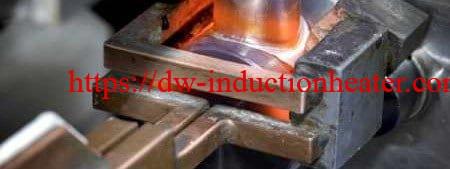
Induction heating technology is steadily displacing open flames and ovens as the preferred heat source in brazing. Seven key reasons explain this growing popularity:
1. Speedier solution
Induction heating transfers more energy per square millimeter than an open flame. Put simply, induction can braze more parts per hour than alternative processes.
2. Quicker throughput
Induction is ideal for in-line integration. Batches of parts no longer have to be taken aside or sent out for brazing. Electronic controls and customized coils let us integrate the brazing process into seamless production processes.
3. Consistent performance
Induction heating is controllable and repeatable. Enter your desired process parameters into the induction equipment, and it will repeat heating cycles with only negligible deviations.
4. Unique controllability
Induction lets operators view the brazing process, something that is difficult with flames. This and precise heating minimize the risk of overheating, which causes weak joints.
5. More productive environment
Open flames create uncomfortable working environments. Operator morale and productivity suffer as a result. Induction is silent. And there is virtually no increase in ambient temperature.
6. Put your space to work
DAWEI Induction brazing equipment has a small footprint. Induction stations slot easily into production cells and existing layouts. And our compact, mobile systems let you work on hard-to-access parts.
7. No-contact process
Induction produces heat within the base metals — and nowhere else. It’s a no-contact process; the base metals never come into contact with flames. This protects the base metals from warping, which in turn increases yield and product quality.

Induction Preheating Blades And Knives
Induction Preheating Blades And Knives With High Frequency Induction Heating Units
Objective Preheating various size blades and knives for garden tools
Material Steel pieces of various size 0.16” (4mm) thick
Temperature 1562 ºF (850 ºC)
Frequency 57-80 kHz
Equipment • DW-HF-15kW induction heating system, equipped with a remote workhead containing six 1.0 μF capacitors for a total of 6.0 μF
• An induction heating coil, designed and developed specifically for this application.
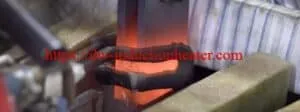
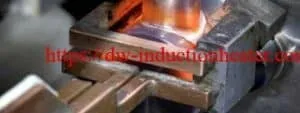
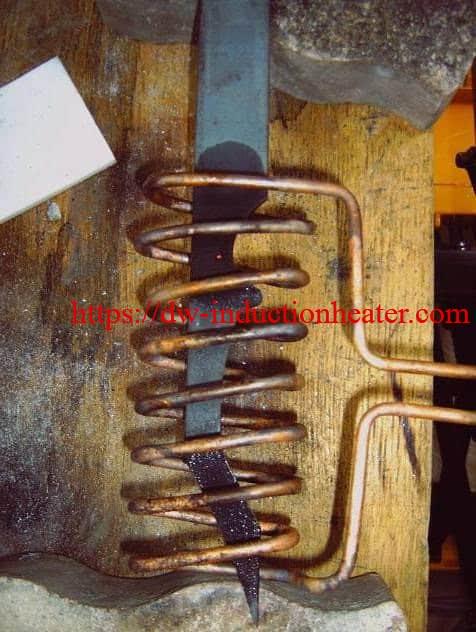
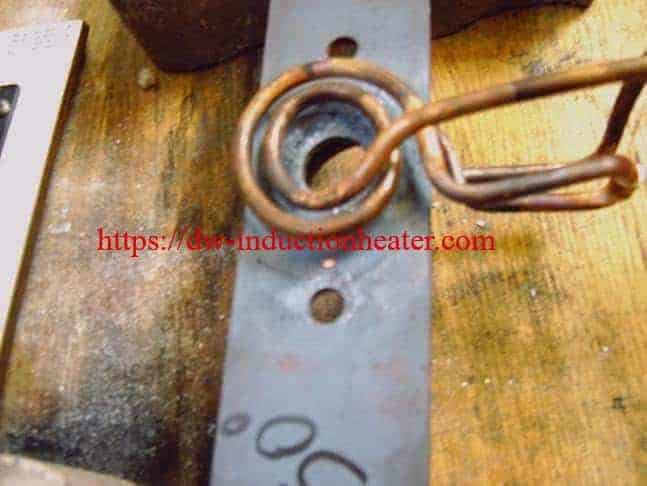
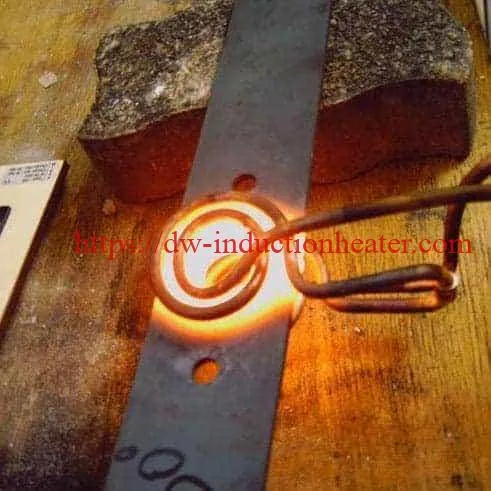
Process Three different coils are used for this heating application
• A two turn pancake coil for the blade
• A eight turn rectangular helical coil for the knives
Pieces are placed in their specific coil for heating. For the blades, the center hole must be heated to 1562 ºF (850 ºC) and for the knife 2/3 of the blade must be heated. Depending on the piece, the steel reaches 1562 ºF (850 ºC) in 13-19 seconds. After the metal is preheated it is press stamped.
Results/Benefits Induction heating provides:
• Hands-free heating that involves no operator skill for manufacturing
• Configurable heating profiles
• Faster process times
• Even distribution of heating



Induction Heating Steel Pin
Induction Heating Steel Pin For Loosening With RF Induction Heater
Objective Heat steel tie downs on containers to loosen steel pin so pin can rotate
Material Steel tie-down assembly with a 2.5” (63.5mm) dia. flange, 1” (25.4mm) dia. rod and pin ring approx 4” (101.6mm) OD and 0.75” (19.05) thick steel
Temperature 1000ºF (538ºC)
Frequency 282 kHz
Equipment •DW-UHF-20kW induction heating system, equipped with a remote workhead containing two 1.5μF capacitors for a total of 0.75μF
• An induction heating coil designed and developed specifically for this application.
Process A single turn helical coil is used to heat the assembly. The coil is placed around the pin and power is applied for 120 seconds. After heating, a steel rod is inserted in the pin ring, pressure is
applied and the pin ring spins freely.
Results/Benefits Induction heating provides:
• Precise and accurate placement of heat without affecting surrounding areas
• Much faster process time, from hours to minutes
• Repeatable and consistent results
• Even distribution of heating

订阅:
博文 (Atom)
我的简介

- HLQ induction heating machine
- HLQ induction heating machine manufacturer provides the service of induction brazing,melting,hot forming,hardening surface,annealing,shrink fitting,PWHT,etc.