显示标签为“inductionpreheating”的博文。显示所有博文

2024年6月3日星期一

Induction Preheating Welding Steel Pipe

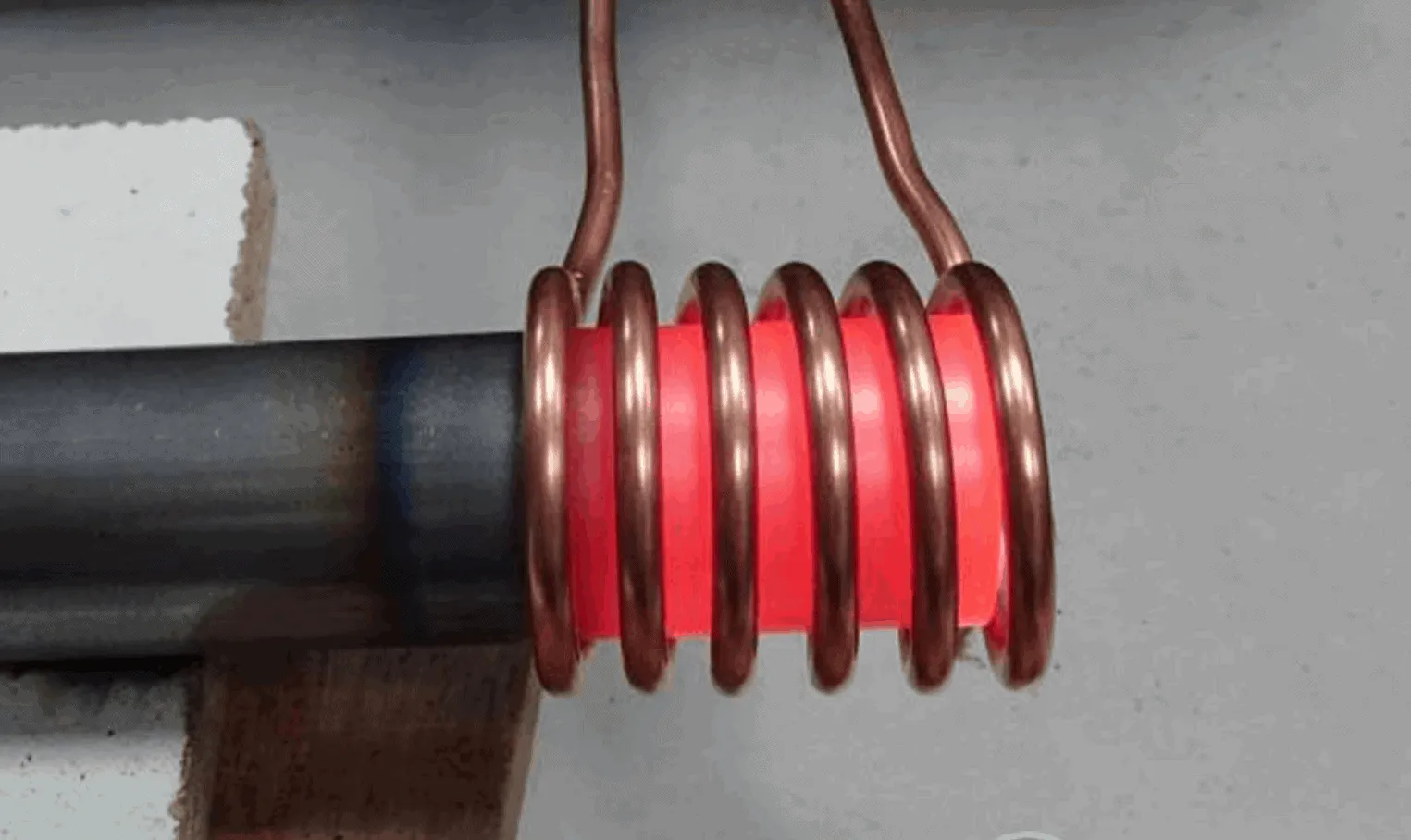
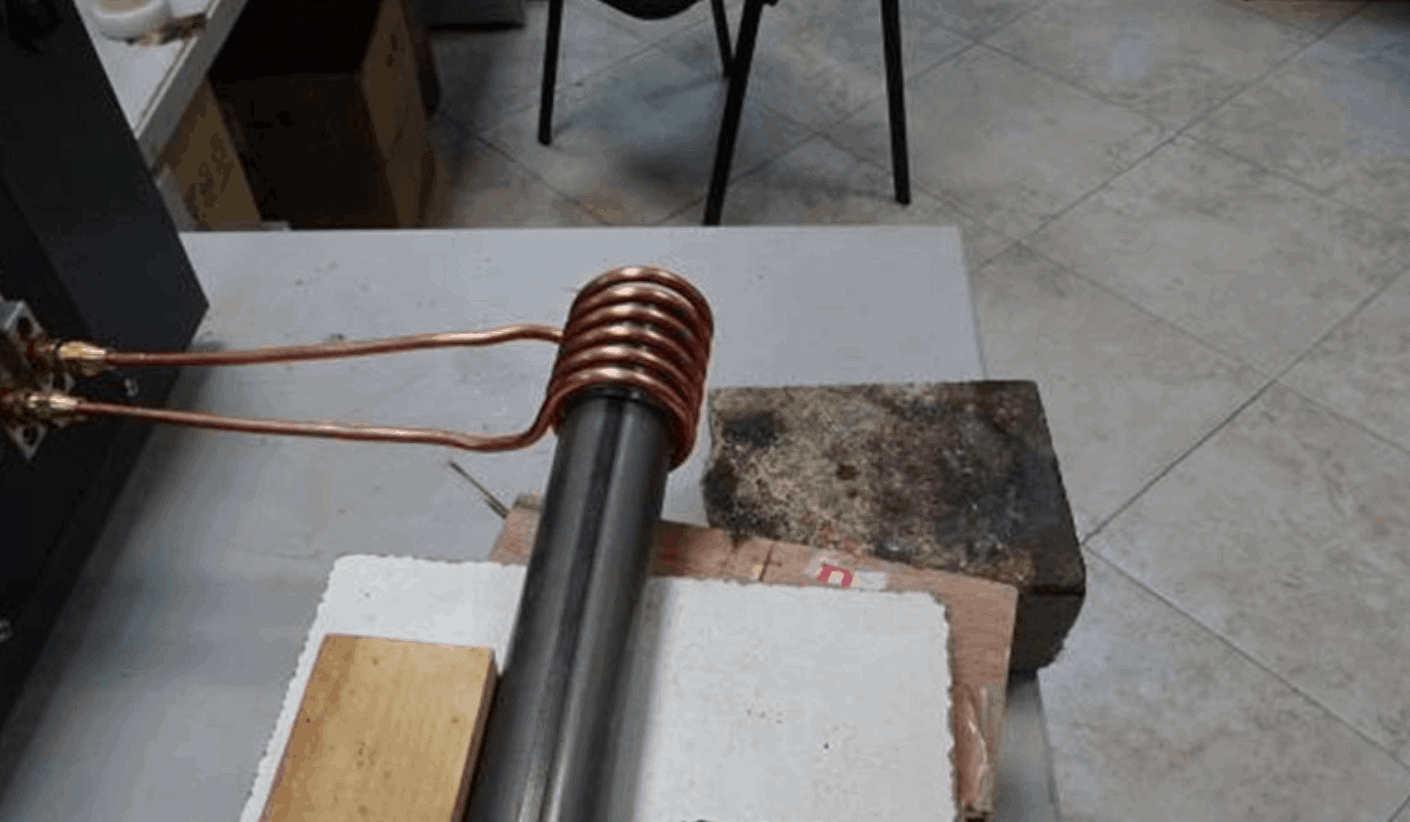
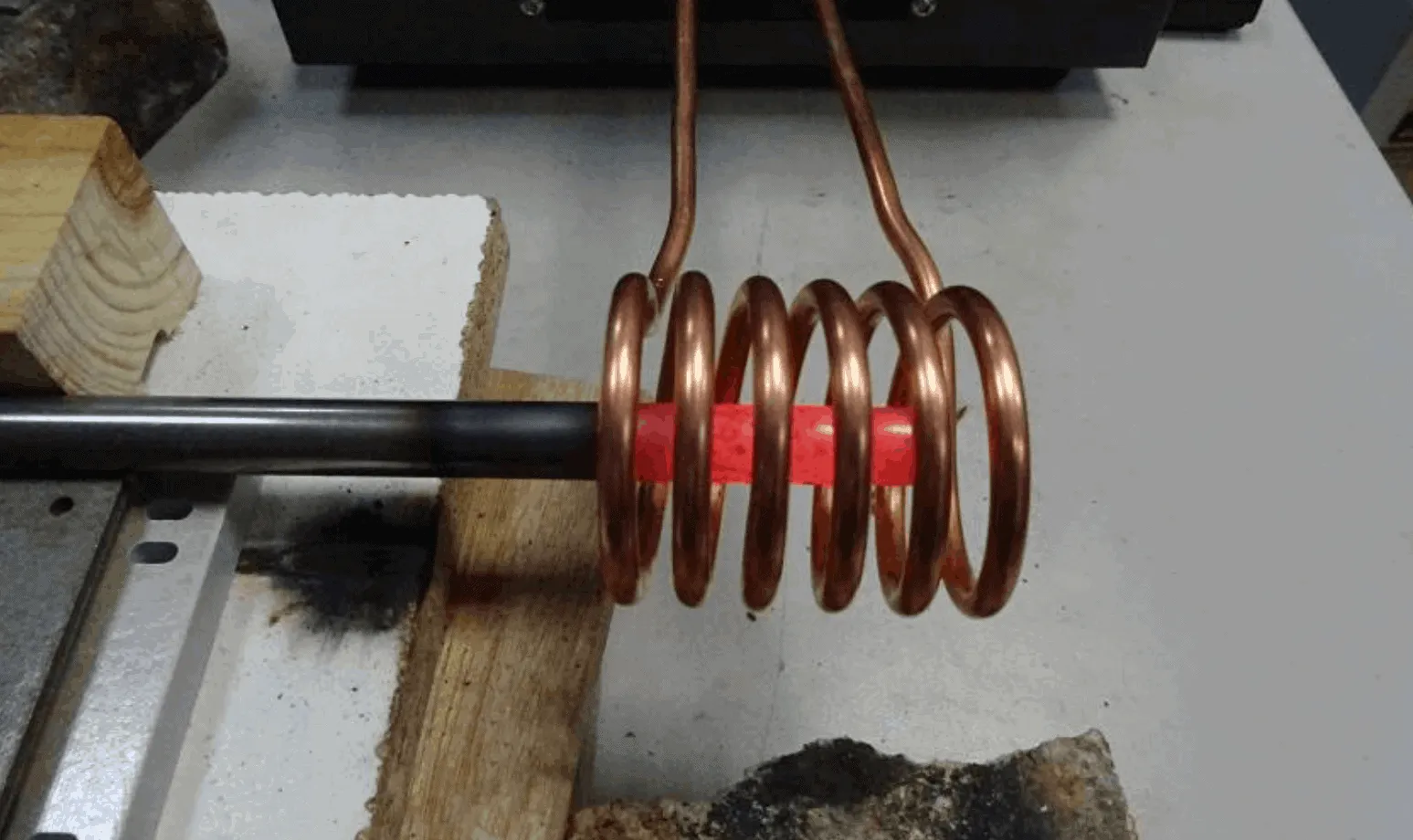
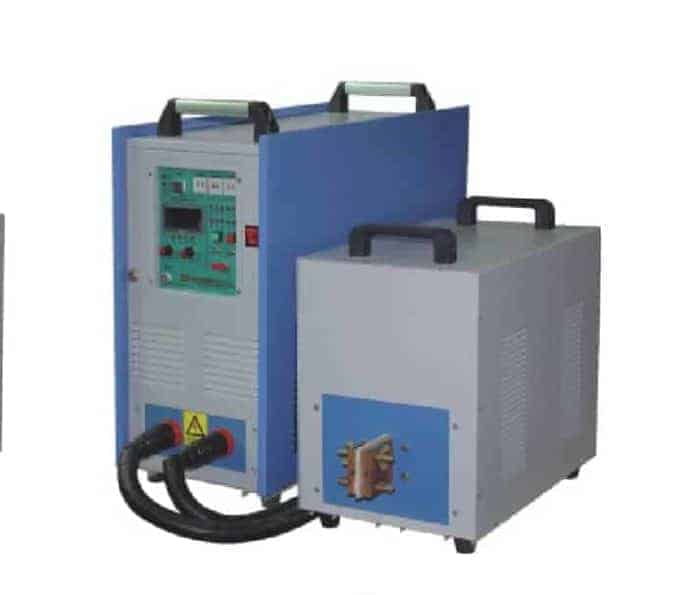
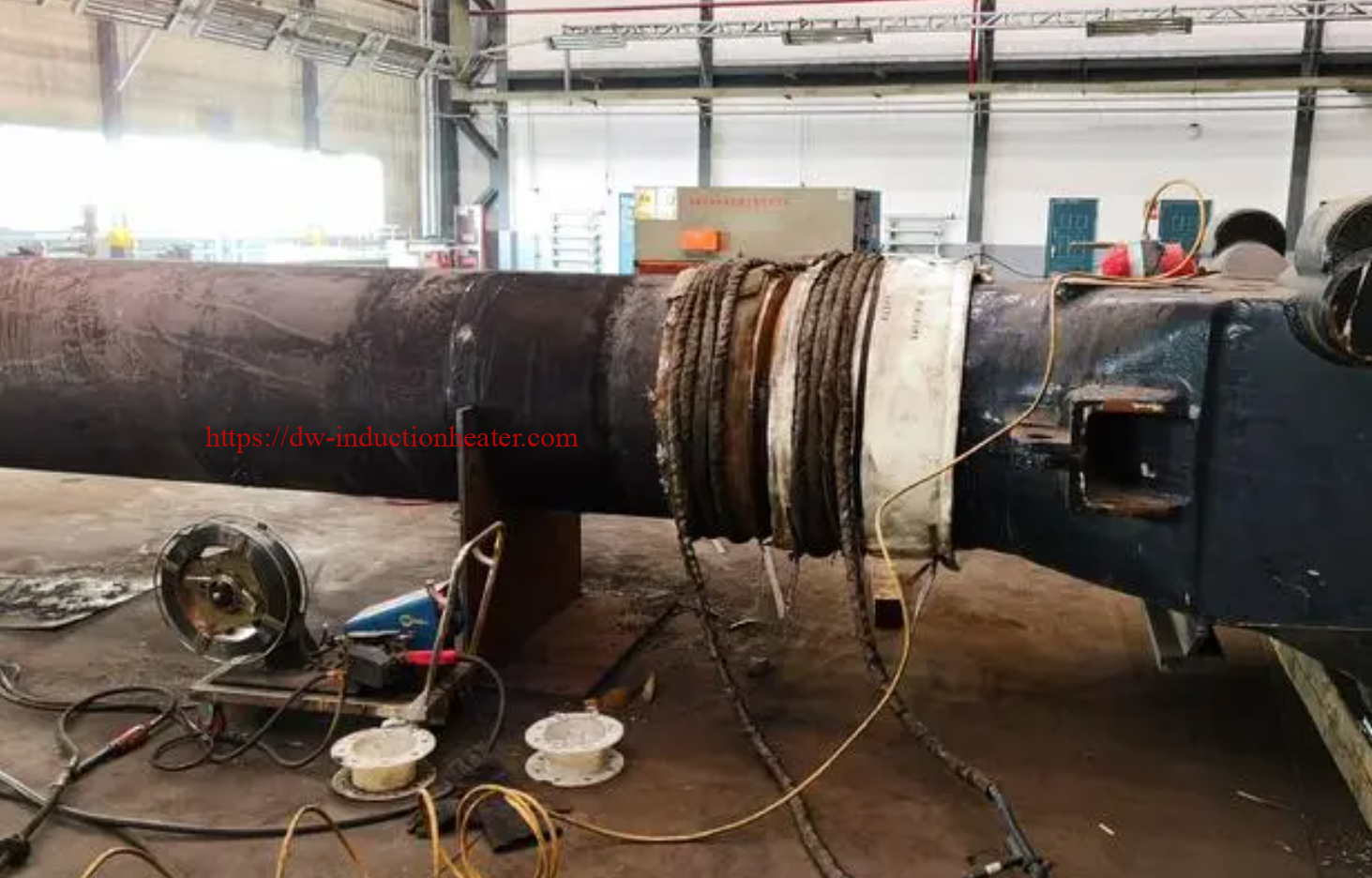
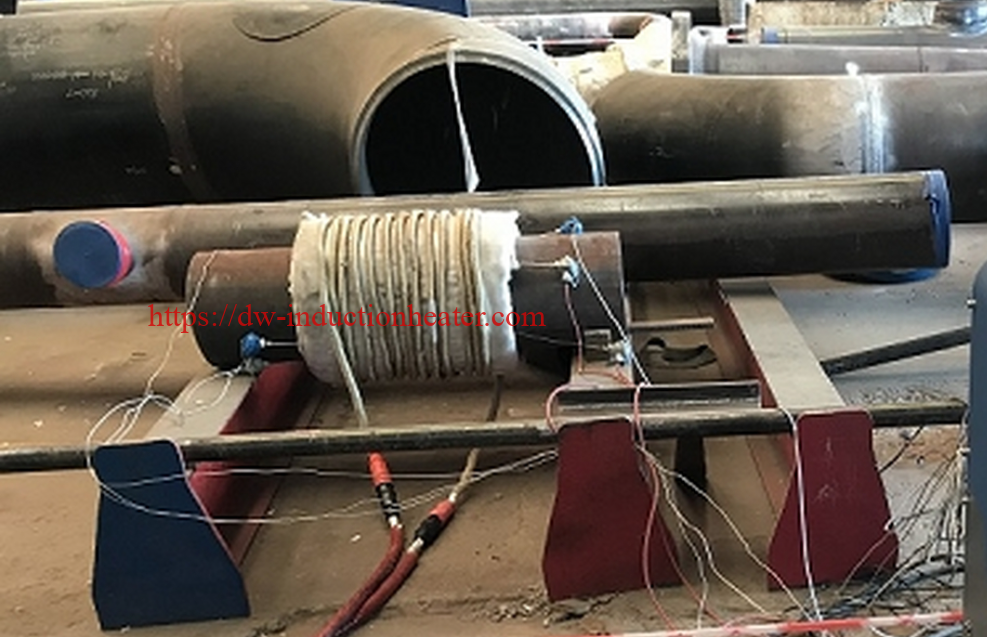
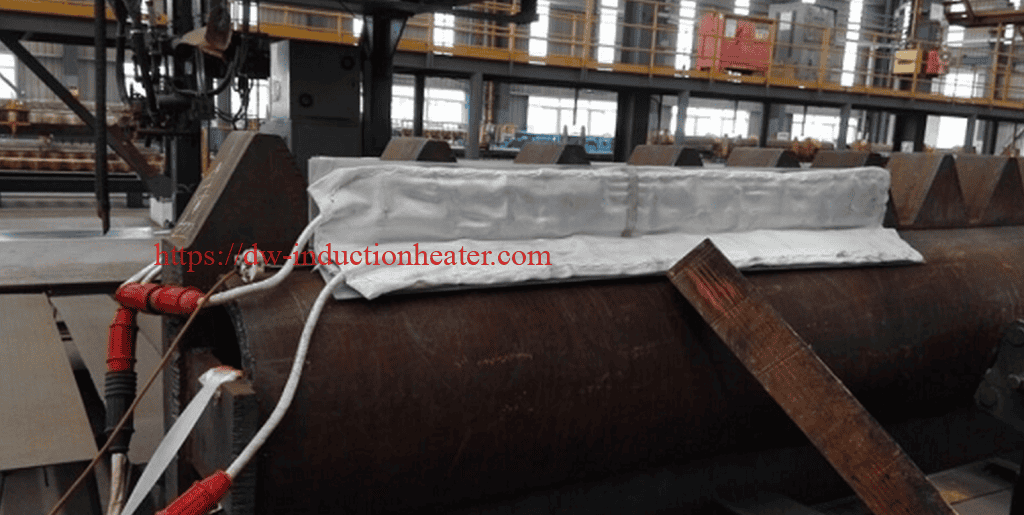
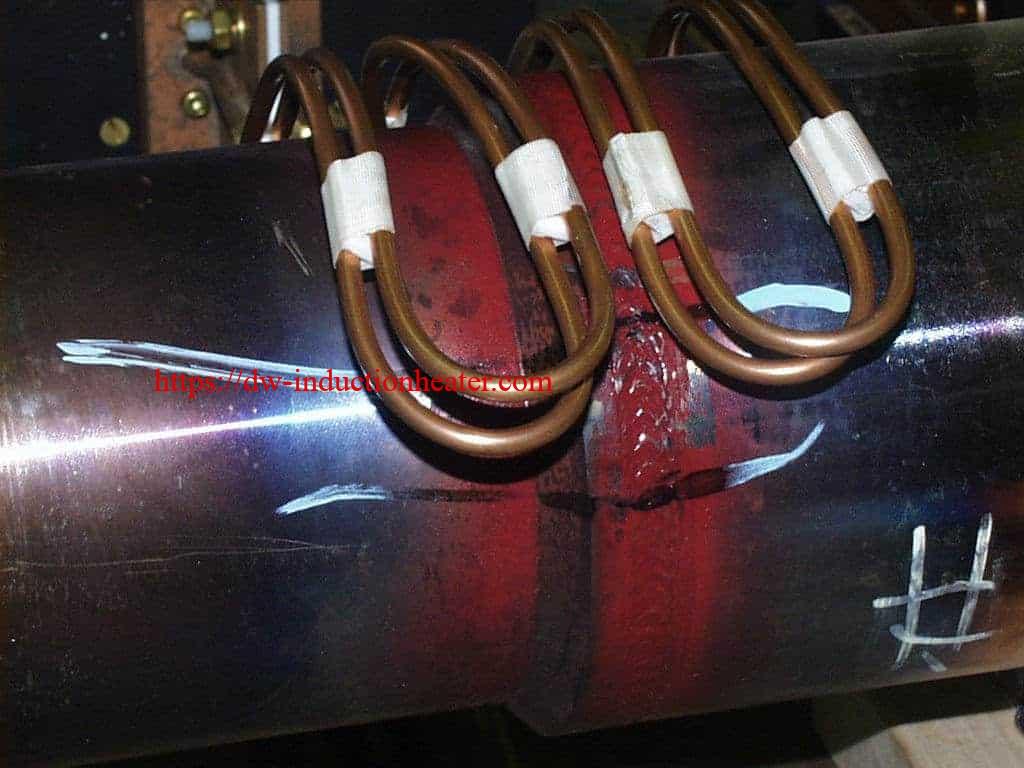
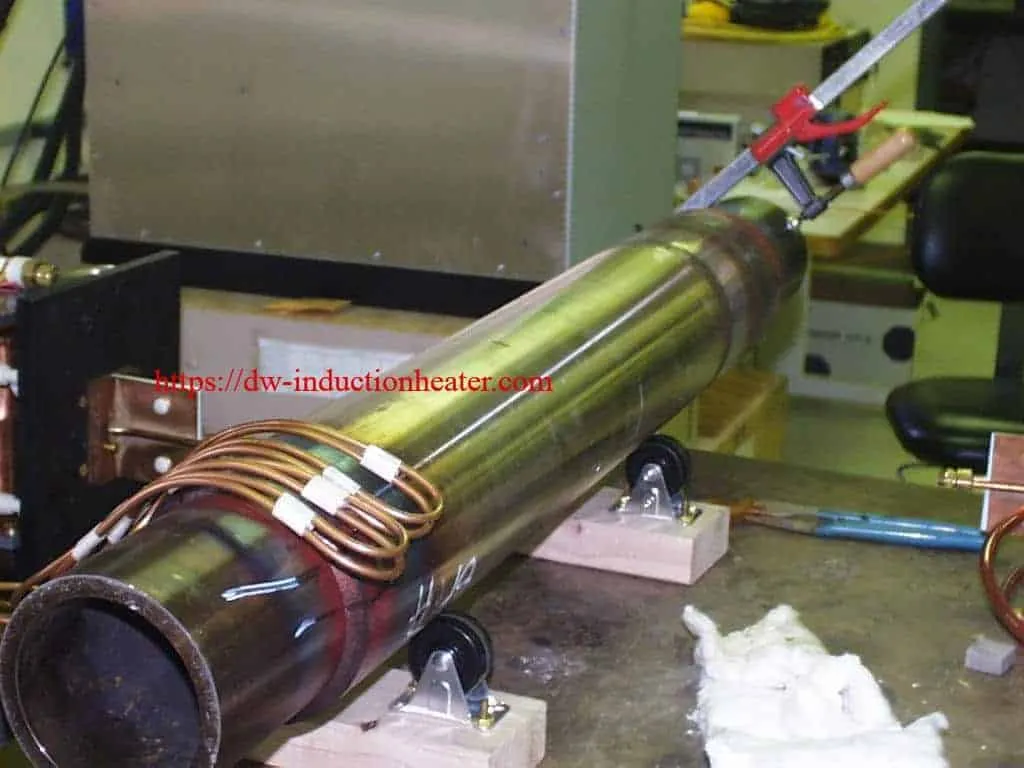
Induction Preheating Welding Steel Pipe With High Frequency Heating System Objective To preheat a steel pipe to 500ºF (260ºC) before welding. Material Steel shaft assembly 5” to 8” OD (127-203.2mm) with a 2” (50.8mm) heat zone. Temperature 500ºF (260ºC), if higher temperatures are required, heat time can be increased. Frequency 60 kHz Equipment • DW-HF-60kW induction heating system, equipped with a remote workhead containing eight 1.0 μF capacitors for a total of 8 μF. • An induction heating coil designed and developed specifically for this application. Process A multi-turn two position channel “C” coil, adjustable on a busbar is used to heat the desired heat zone. The coil is adjustable to fit various diameter pipes. The shaft is rotated in a fixture and heated for 3 minutes to achieve a temperature of 500ºF (260ºC). Results/Benefits Induction heating provides: • Preheating prevents shock to shaft which eliminates cracking in the welding phase. • Hands-free heating that involves no operator skill for manufacturing. • Even distribution of heating between the shank and the  sleeve. induction preheating welding steel pipe             induction preheating steel pipe before welding https://dw-inductionheater.com/induction-preheating-welding-steel-pipe.html?feed_id=248453&_unique_id=665d970cc2908

2024年5月27日星期一

Induction Preheating Hot Heading

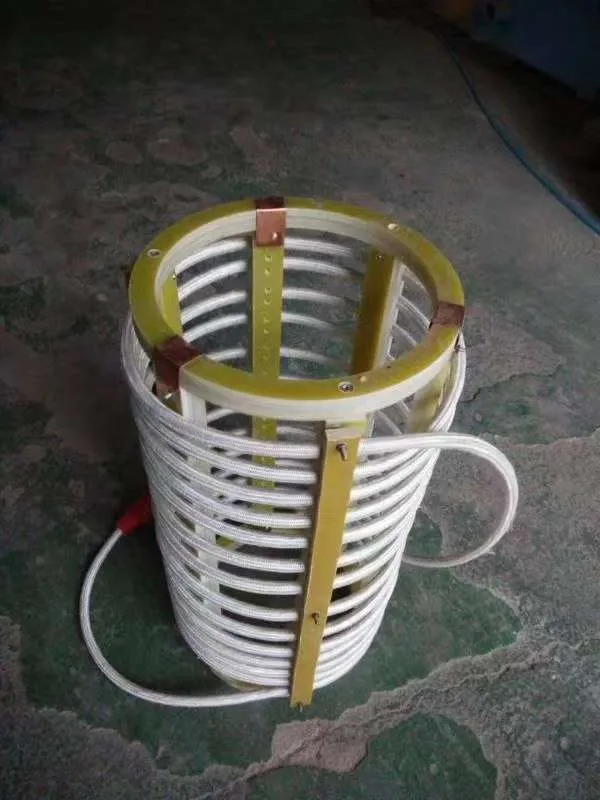
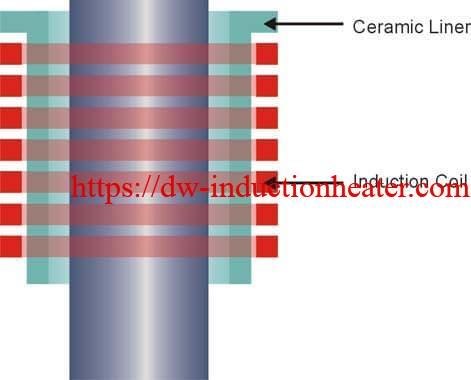
Induction Preheating Hot Heading For Single Rod With IGBT Induction Heater Objective Heat a waspaloy rod to 1500ºF (815.5ºC) for hot heading application Material Waspaloy rod 0.5” (12.7mm)OD, 1.5” (38.1mm) length, ceramic liner Temperature 1500 ºF (815.5ºC) Frequency 75 kHz Equipment • DW-HF-45KW induction heating system, equipped with a remote workhead containing two 1.32μF capacitors for a total of .66μF • An induction heating coil designed and developed specifically for this application. Process A seven turn helical coil is used to heat the rod. The rod is placed inside the coil and power is applied for two seconds providing enough heat to penetrate the inner core. An optical pyrometer is used for close loop temperature control and a ceramic liner is used so the rod does not touch the coil. Results/Benefits Induction heating provides: • Low pressure and minimal residual stress • Better grain flow and microstructure • Even distribution of heating • Improved production rates with minimal defects induction preheating hot heading https://dw-inductionheater.com/induction-preheating-hot-heading.html?feed_id=247542&_unique_id=66550501c3368

2024年5月3日星期五

Induction Preheating Hot Rod Heading

Induction Preheating Hot Rod Heading With IGBT Heating Units Objective Heat a waspaloy rod to 1500ºF (815.5ºC) for hot heading application Material Waspaloy rod 0.5” (12.7mm)OD, 1.5” (38.1mm) length, ceramic liner Temperature 1500 ºF (815.5ºC) Frequency 75 kHz Equipment • DW-HF- 20 kW induction heating system, equipped with a remote workhead containing two 1.32μF capacitors for a total of .66μF • An induction heating coil designed and developed specifically for this application. Process A seven turn helical coil is used to heat the rod. The rod is placed inside the coil and power is applied for two seconds providing enough heat to penetrate the inner core. An optical pyrometer is used for close loop temperature control and a ceramic liner is used so the rod does not touch the coil. Results/Benefits Induction heating provides: • Low pressure and minimal residual stress • Better grain flow and microstructure • Even distribution of heating • Improved production rates with minimal defects Preheating Hot Rod Heading https://dw-inductionheater.com/induction-preheating-hot-rod-heading.html?feed_id=244236&_unique_id=6635996cba754

2024年2月20日星期二

Induction Preheating Steel Tubes

Induction Preheating Steel Tubes

Objective Induction preheating steel tubes with diameters of 14mm, 16mm, and 42mm (0.55”, 0.63”, and 1.65”). A 50mm (2″) length of the tube much be heated to 900°C (1650°F) in under 30 seconds.
Equipment DW-UHF-6KW-III handheld induction heater Materials • Steel tubes with ODs: 14mm, 16mm and 42mm (0.55”, 0.63”, and 1.65”) • Wall thicknesses: 1mm, 2mm, and 2mm (0.04″, 0.08″, 0.08″) Key Parameters Power: 5 kW for 42mm tube, 3 kW for 14 and 16 mm tubes Temperature: 1740°F (950°C) Time: 26 sec.
Process:
  1. Insert steel tube into the coil.
  2. Apply induction heat for 26 seconds.
  3. Remove the tube from the coil.
Results/Benefits: The desired preheating temperature was achieved for less than 30 seconds for the three different steel tubes. Our 5 kW induction system can be used for successfully preheating of steel tubes with different diameters and thicknesses.
https://dw-inductionheater.com/induction-preheating-steel-tubes.html?feed_id=234430&_unique_id=65d53192df241

2024年2月14日星期三

induction preheating copper rod

high frequency induction preheating copper rod and connector for an epoxy curing application

induction preheating copper rod and connector for an epoxy curing application Objective: To preheat a portion of the copper rod and a rectangular connector to temperature prior to epoxy curing during a manufacturing process for electrical turnbuckles Material : Customer supplied plated copper rod (12” x 2” x 1”/305mm x 51mm x 102 mm) and connector Temperature :302 ºF (150 ºC) Frequency :25 kHz Induction Heating Equipment: -DW-HF-60kW 15-45 kHz induction heating system equipped with a remote workhead containing four 21 μF capacitors high frequency induction heating equipment - A single position seven-turn helical induction heating coil designed and developed specifically for this application Induction Heating Process The copper rod and connector were placed inside the induction heating coil and the power was turned on. The part heated to temperature within 55 seconds. After being heated to temperature, the part was moved and an epoxy curing/molding process took place. The client was using a large oven to preheat these rods, which was cost inefficient. Induction offers a faster and more costefficient heating method. Results/Benefits - Speed: Induction heated the part to temperature quickly - Efficiency: Induction is a far more efficient method of heating these parts to temperature when compared to their large oven - Precision: Induction made it possible to heat only the parts of the rod that required heating https://dw-inductionheater.com/induction-preheating-copper-rod.html?feed_id=234073&_unique_id=65cd5697b7df2

2024年2月13日星期二

induction preheating copper bars

induction preheating copper bars to temperature

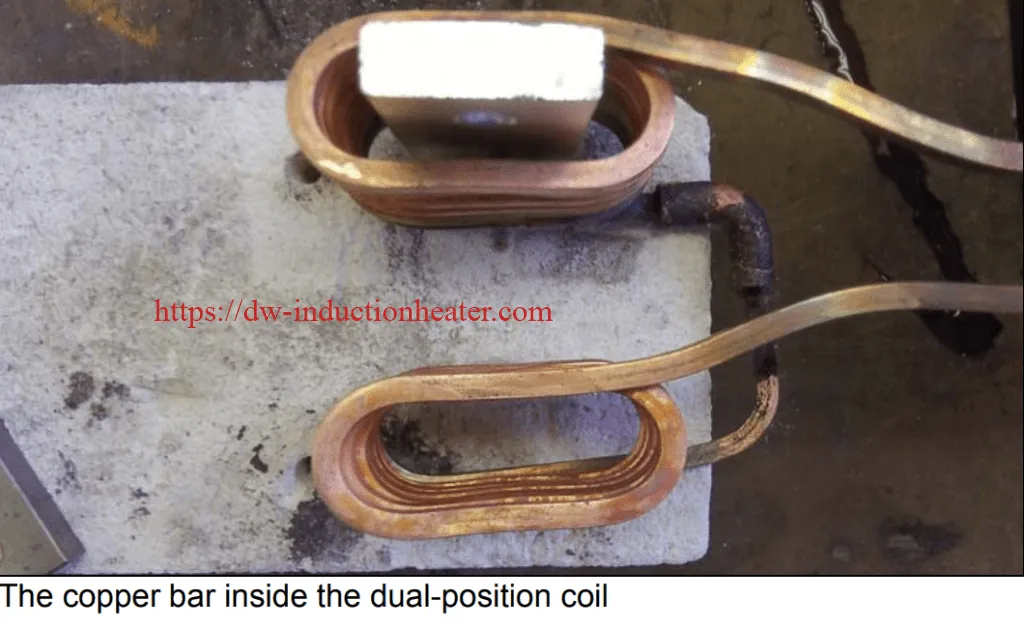
Objective: To preheat two copper bars to temperature within 30 seconds; the client is looking to replace a competitor’s 5kW induction heating system that is delivering unsatisfactory results Material:  Copper bars (1.25” x 0.375” x 3.5”/31mm x 10mm x 89mm ) - Thermal indicating paint Temperature: 750 ºF (399 ºC) Frequency: 61 kHz Equipment : DW-HF- 15kW, 50-150 kHz induction heating power supply with a remote workhead containing two 1.0 μF capacitors - A dual-position, multi-turn helical coil designed and developed for this heating application Induction Heating Process: A thermal indicating paint was applied to the face of the copper bar, and the bar was placed inside the coil. The part was heated for 30 seconds and it reached temperature. The next step in the process was to heat two parts in a dual-position coil. The parts were inserted into the coil and heated to temperature within 30 seconds. In order to heat four parts to temperature within the same time period, two power supplies and two dual-position coils are required. Results/Benefits -- Speed: Induction was able to meet their time requirements. -- Process development: The HLQ lab team was able to help the client develop a new heating process that achieved better results than what they saw with their old, inferior induction heating system -- Process efficiency: With induction and the right induction partner, a time, energy and space efficient system was designed https://dw-inductionheater.com/induction-preheating-copper-bars.html?feed_id=233983&_unique_id=65cb3208986eb

2024年1月28日星期日

induction preheating before welding steel pipe

Induction Preheating Before Welding Steel Pipe

This induction heating application shows the preheating of steel pipe before welding with 30kW air-cooled induction power supply and air-cooled coil. Inductively preheating of the pipe section to be welded ensures faster welding time and a better quality of the welding joint. Industry: Manufacturing Equipment: HLQ 30kw air cooled induction heater Time: 300 secs. Temperature: Required from ambient temperature 600 ° C +/- 10 °C (1112° F/ +/- 50°F) Materials: Steel pipe Details for butt-welded steel pipe: Total length: 300 mm (11.8 inch) DIA: 152.40 mm (5.9 inch) Thickness: 18.26 mm (0.71 inch) Heating length: 30-45 mm from middle (1.1 – 1.7 inch) Details for butt welded steel plate. Total size: 300 mm (11.8 inch) X 300 mm (11.8 inch) Thickness: 10 mm (0.39 inch) Heating length: 20-30 mm (0.7-1.1 inch) from middle. Fixture details for butt welded steel pipe: Material: Mica. Total Size: 300 mm (11.8 inch) X 60 mm (2.3 inch) Thickness: 20 mm (0.7 inch) Withstands temperature of 900 °C (1652°F) Process: We are using our mobile air-cooled 30kW induction heating system which allows us to easily move the system and the heating coil to various welding locations, without the need to provide additional water cooling systems or hoses. Induction heating provides consistent heat throughout the process. The preheat temperatures can be easily measured with temperature monitoring tools. The induction heating method is very efficient because it minimizes the heat loss that often occurs during other heating methods. https://dw-inductionheater.com/induction-preheating-before-welding-steel-pipe.html?feed_id=233086&_unique_id=65b67c835eaf5

2024年1月26日星期五

steel plate-shovels hot forming with induction preheating

Steel plate-shovels hot forming with induction preheating system

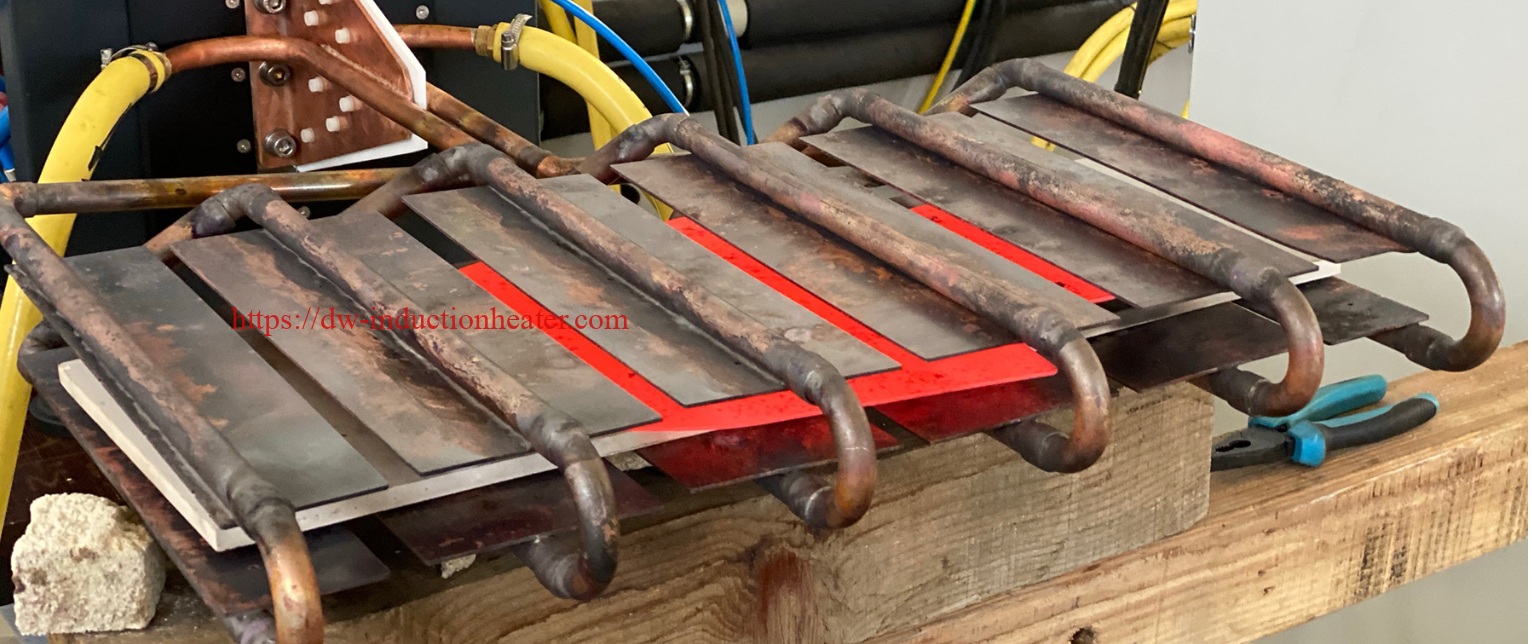
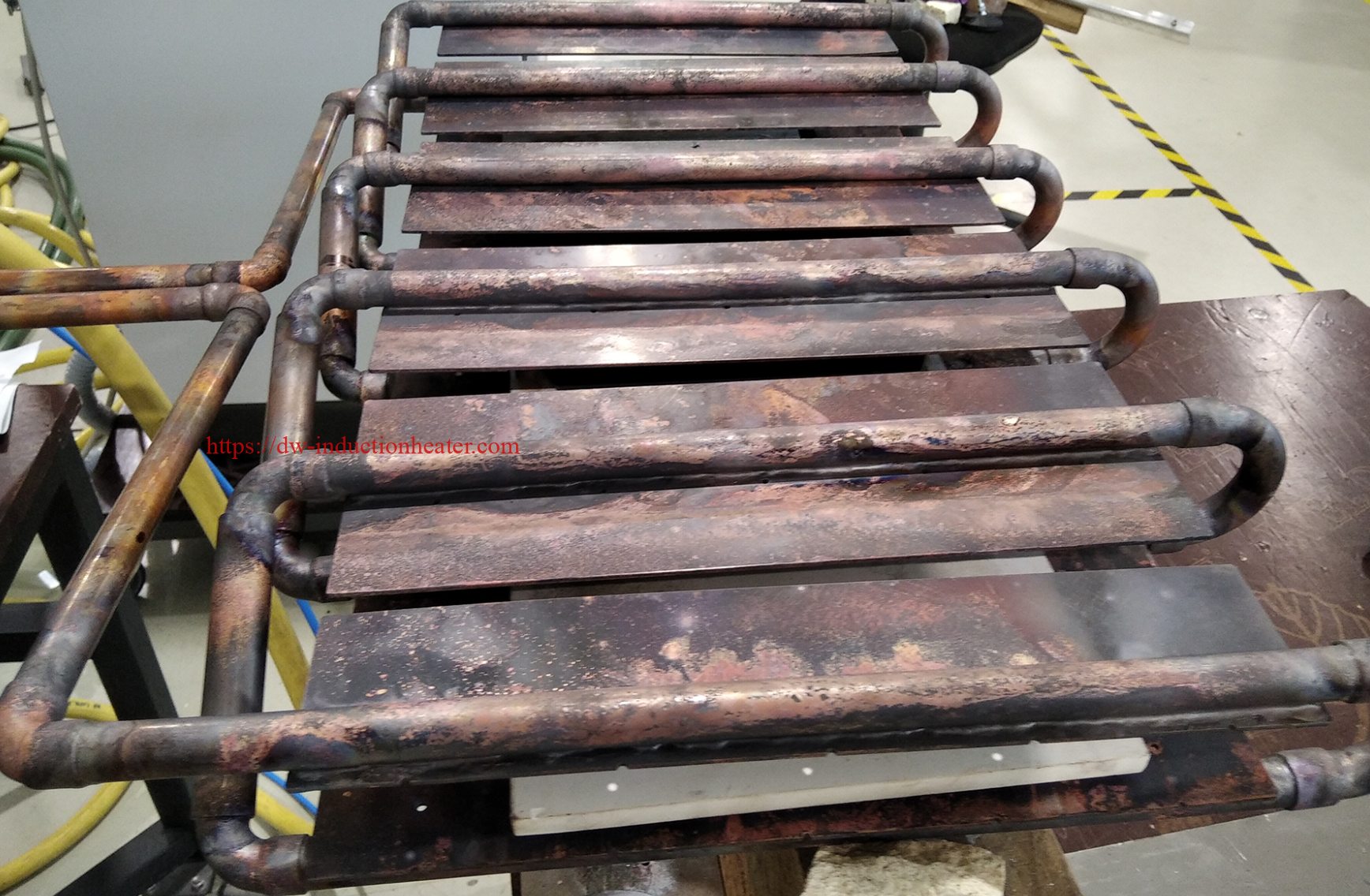
What is induction pre-heating? Induction preheating is a process where materials or workpieces are heated by induction prior to further processing. The reasons for pre-heating vary. In the cable and wire industry, cable cores are pre-heated before insulation extrusion. Steels strips are pre-heated prior to pickling and zinc coating. Induction pre-heating also softens metals before bending, and prepares tubes and pipes for welding. Mobile pre-heating solutions facilitate onsite repairs of bearing assemblies. The induction preheating process is an efficient means of preheating steel plate-shovels for hot forming. This involves bending or shaping a metal billet after being heated to a temperature at which there is less resistance to forming. Induction Heating Objective: A steel shovel manufacturer is looking for an induction heating solution to replace a gas furnace and achieve temperature uniformity, repeatability, and fast heat cycles. Induction Heating Equipment: High Frequency Induction Heater DW-HF-45KW is the recommended induction heating equipment for this induction preheating application. With this induction heating generator, the customer heats the steel shovel molds sustainably and achieves faster heat cycles, especially for the bigger samples. Induction Heating Process: This application aims to preheat 4 steel plate sheets to 1742 F/950 C before posting them in a press to form them as shovels. The goal is for the shovel to reach the desired temperature in less than 5 seconds. Benefits: Implementing induction heating has significant advantages:
  • Greater thermal efficiency, resulting in substantial decrease in energy consumption.
  • Shorter heating times
  • Improved uniformity
  • Improved working conditions
https://dw-inductionheater.com/steel-plate-shovels-hot-forming-with-induction-preheating.html?feed_id=232996&_unique_id=65b4584045c27

2024年1月13日星期六

Why Induction Preheating is Essential for Welding

Why Induction Preheating is Essential for Welding: Benefits and Techniques.
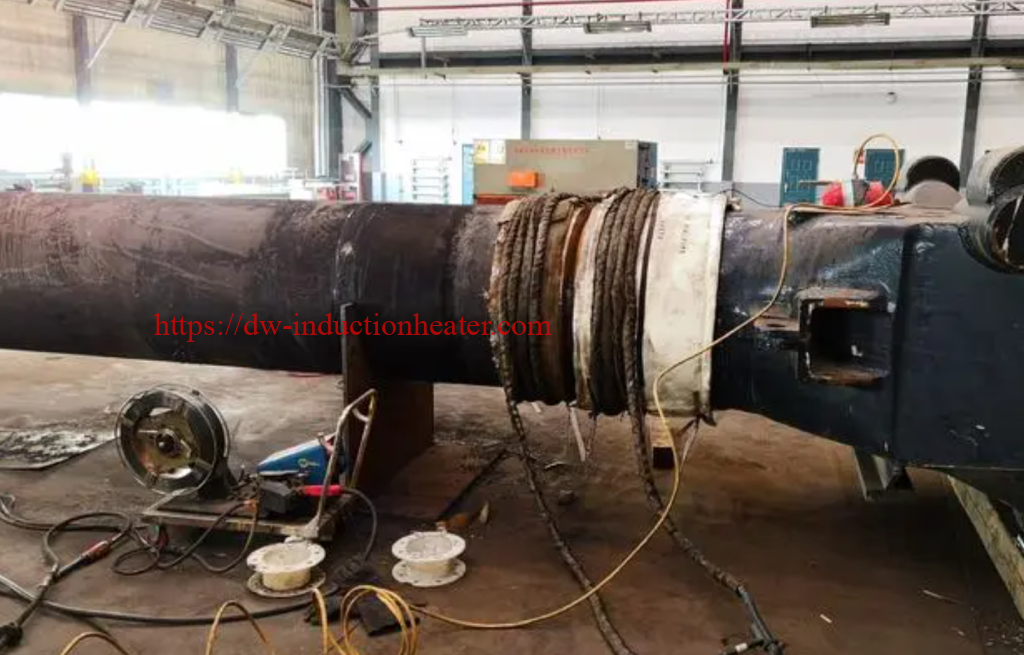
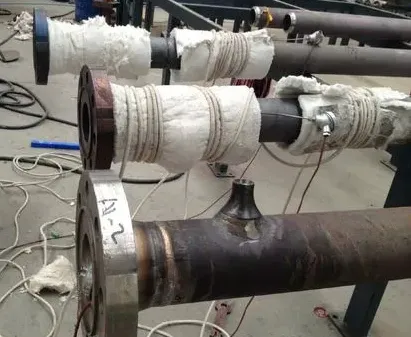
Induction preheating is a process in which an electrically conductive material is heated by inducing an electrical current in it. The heat is produced by the resistance of the material to the current flow. Induction preheating is widely used in the welding industry for enhancing the quality of welds. This paper explores the benefits of induction preheating before welding, the process involved, and the effect it has on the welded joint.

Benefits of induction preheating before welding

Induction preheating offers numerous benefits, including: 1. Stress Relief Induction preheating reduces the residual stress in the weld joint by expanding the base material before welding. As the material is heated, it expands, and when it cools, it contracts. This expansion and contraction reduce the residual stress in the weld joint, leading to a stronger and more durable joint. 2. Improved Weld Quality Induction preheating helps to improve the quality of the weld by reducing the likelihood of porosity and cracking. The process reduces the amount of hydrogen in the weld pool, reducing the risk of porosity. Additionally, the heating process helps to improve the fusion of the weld, making it stronger and more durable. 3. Increased Efficiency Induction preheating increases the efficiency of the welding process by improving the heat distribution in the workpiece. The process ensures that the heat is evenly distributed, reducing the welding time and improving the overall productivity.
Process of Induction Preheating before Welding

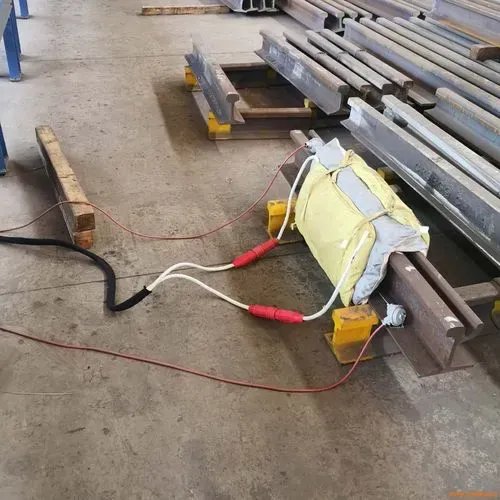
The process of induction preheating before welding involves the following steps: 1.How to choose the right induction heater for your welding project While choosing an induction heater for your welding project, there are many factors to consider. First of all, you need to determine the size of the heater you require. This will depend on the size and thickness of the metal you are welding. You should also make sure that the heater is compatible with the type of metal you are working with. Different metals have different melting points, so it's important to choose a heater that can handle the heat required. Additionally, you should consider the type of power source the heater requires, as well as the cost of operating it. Some induction heaters require a lot of power and can be expensive to run, so it's important to consider these factors before making a purchase. Finally, you should consider the brand and reputation of the manufacturer. You want to make sure that you are purchasing a high-quality heater that is built to last. By considering these factors, you can choose the right induction heater for your welding project and ensure that your project is a success. 2. Positioning the Workpiece The next step is to position the workpiece correctly. The workpiece should be positioned so that the induction coil can be placed close to the welding area. 3. Applying the Induction Coil The induction coil is then applied to the workpiece, and a high-frequency AC current is passed through it. As the current passes through the workpiece, it heats it up, preheating it before welding. 4. Welding Once the workpiece is preheated, the welding process can begin. The preheated material reduces heat input and welding time, which leads to a stronger and more durable joint.
Effect of Induction Preheating on the Welded Joint

Induction preheating has a significant effect on the welded joint. The preheating process reduces the residual stress in the joint and improves the quality of the weld. The modifications in the metal structure after preheating lead to reduced hardening in the heat-affected zone (HAZ). Overall, the preheating process leads to improved weld quality and durability.

Types of induction heaters for preheating

While the topic of becoming a better man is a broad one, it is important to focus on the transformative steps that can be taken to achieve this goal. One step that can be taken is to invest in high-quality tools that can help you in your journey. Induction heaters are one such tool that can be incredibly helpful, especially when it comes to preheating materials. There are several different types of induction heaters available, each of which has its own unique benefits. For example, some induction heaters are designed to be portable and easy to move around, while others are more stationary and designed to be used in a shop or garage setting. Similarly, some induction heaters are designed to be used with smaller materials, while others are more powerful and can be used with larger materials. When choosing an induction heater for preheating, it is important to consider your specific needs and choose a model that is designed to meet those needs. With the right tool in hand, you can take the first transformative step towards becoming a better man.

Conclusion

Induction preheating before welding is an essential process in the welding industry. The process has numerous benefits, including stress relief, improved welding quality, and increased efficiency. The process involves selecting the right equipment, positioning the workpiece, applying the induction coil, and welding. Induction preheating leads to a stronger and more durable joint and reduces the risk of porosity and cracking. Therefore, induction preheating is recommended for all welding applications.   https://dw-inductionheater.com/why-induction-preheating-is-essential-for-welding.html?feed_id=232138&_unique_id=65a27dd63a363
2023年10月11日星期三

Induction Preheating Welding Steel Pipe

Induction Preheating Welding Steel Pipe With High Frequency Heating System Objective To preheat a steel pipe to 500ºF (260ºC) before welding. Material Steel shaft assembly 5” to 8” OD (127-203.2mm) with a 2” (50.8mm) heat zone. Temperature 500ºF (260ºC), if higher temperatures are required, heat time can be increased. Frequency 60 kHz Equipment • DW-HF-60kW induction heating system, equipped with a remote workhead containing eight 1.0 μF capacitors for a total of 8 μF. • An induction heating coil designed and developed specifically for this application. Process A multi-turn two position channel “C” coil, adjustable on a busbar is used to heat the desired heat zone. The coil is adjustable to fit various diameter pipes. The shaft is rotated in a fixture and heated for 3 minutes to achieve a temperature of 500ºF (260ºC). Results/Benefits Induction heating provides: • Preheating prevents shock to shaft which eliminates cracking in the welding phase. • Hands-free heating that involves no operator skill for manufacturing. • Even distribution of heating between the shank and the  sleeve. induction preheating welding steel pipe             induction preheating steel pipe before welding https://dw-inductionheater.com/induction-preheating-welding-steel-pipe.html?feed_id=228846&_unique_id=6526f3569c2da
2023年10月5日星期四

Induction Preheating Hot Heading

Induction Preheating Hot Heading For Single Rod With IGBT Induction Heater Objective Heat a waspaloy rod to 1500ºF (815.5ºC) for hot heading application Material Waspaloy rod 0.5” (12.7mm)OD, 1.5” (38.1mm) length, ceramic liner Temperature 1500 ºF (815.5ºC) Frequency 75 kHz Equipment • DW-HF-45KW induction heating system, equipped with a remote workhead containing two 1.32μF capacitors for a total of .66μF • An induction heating coil designed and developed specifically for this application. Process A seven turn helical coil is used to heat the rod. The rod is placed inside the coil and power is applied for two seconds providing enough heat to penetrate the inner core. An optical pyrometer is used for close loop temperature control and a ceramic liner is used so the rod does not touch the coil. Results/Benefits Induction heating provides: • Low pressure and minimal residual stress • Better grain flow and microstructure • Even distribution of heating • Improved production rates with minimal defects induction preheating hot heading https://dw-inductionheater.com/induction-preheating-hot-heading.html?feed_id=228431&_unique_id=651e619d1d0a8

2023年9月11日星期一

Induction Preheating Hot Rod Heading

Induction Preheating Hot Rod Heading With IGBT Heating Units Objective Heat a waspaloy rod to 1500ºF (815.5ºC) for hot heading application Material Waspaloy rod 0.5” (12.7mm)OD, 1.5” (38.1mm) length, ceramic liner Temperature 1500 ºF (815.5ºC) Frequency 75 kHz Equipment • DW-HF- 20 kW induction heating system, equipped with a remote workhead containing two 1.32μF capacitors for a total of .66μF • An induction heating coil designed and developed specifically for this application. Process A seven turn helical coil is used to heat the rod. The rod is placed inside the coil and power is applied for two seconds providing enough heat to penetrate the inner core. An optical pyrometer is used for close loop temperature control and a ceramic liner is used so the rod does not touch the coil. Results/Benefits Induction heating provides: • Low pressure and minimal residual stress • Better grain flow and microstructure • Even distribution of heating • Improved production rates with minimal defects Preheating Hot Rod Heading https://dw-inductionheater.com/induction-preheating-hot-rod-heading.html?feed_id=227111&_unique_id=64fef3dacce34
2023年8月2日星期三

induction preheating copper rod

high frequency induction preheating copper rod and connector for an epoxy curing application

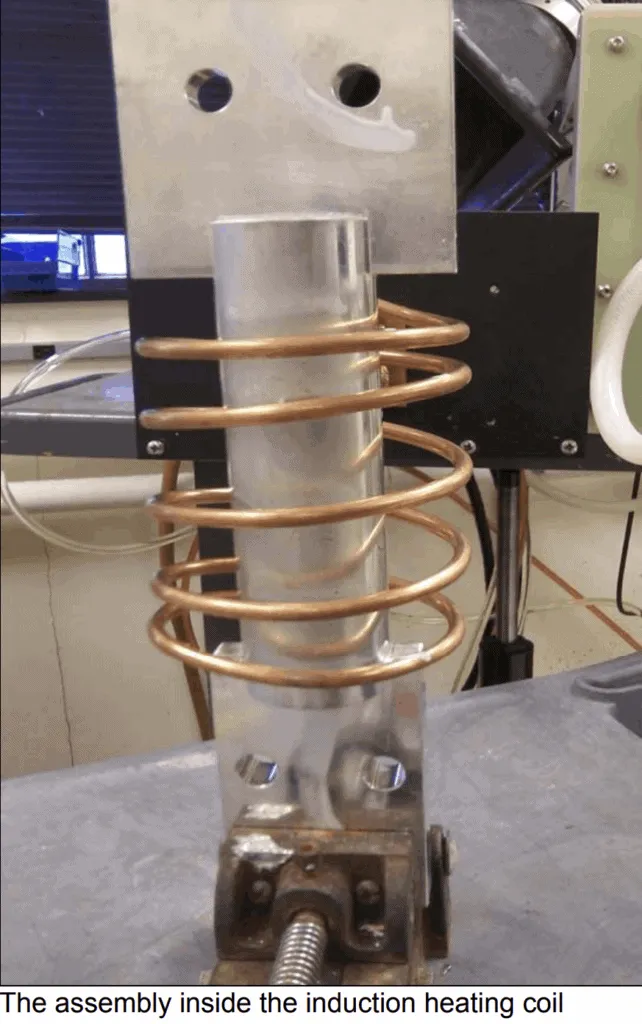
induction preheating copper rod and connector for an epoxy curing application Objective: To preheat a portion of the copper rod and a rectangular connector to temperature prior to epoxy curing during a manufacturing process for electrical turnbuckles Material : Customer supplied plated copper rod (12” x 2” x 1”/305mm x 51mm x 102 mm) and connector Temperature :302 ºF (150 ºC) Frequency :25 kHz Induction Heating Equipment: -DW-HF-60kW 15-45 kHz induction heating system equipped with a remote workhead containing four 21 μF capacitors high frequency induction heating equipment - A single position seven-turn helical induction heating coil designed and developed specifically for this application Induction Heating Process The copper rod and connector were placed inside the induction heating coil and the power was turned on. The part heated to temperature within 55 seconds. After being heated to temperature, the part was moved and an epoxy curing/molding process took place. The client was using a large oven to preheat these rods, which was cost inefficient. Induction offers a faster and more costefficient heating method. Results/Benefits - Speed: Induction heated the part to temperature quickly - Efficiency: Induction is a far more efficient method of heating these parts to temperature when compared to their large oven - Precision: Induction made it possible to heat only the parts of the rod that required heating
2023年7月30日星期日

induction preheating copper bars

induction preheating copper bars to temperature

Objective: To preheat two copper bars to temperature within 30 seconds; the client is looking to replace a competitor’s 5kW induction heating system that is delivering unsatisfactory results Material:  Copper bars (1.25” x 0.375” x 3.5”/31mm x 10mm x 89mm ) - Thermal indicating paint Temperature: 750 ºF (399 ºC) Frequency: 61 kHz Equipment : DW-HF- 15kW, 50-150 kHz induction heating power supply with a remote workhead containing two 1.0 μF capacitors - A dual-position, multi-turn helical coil designed and developed for this heating application Induction Heating Process: A thermal indicating paint was applied to the face of the copper bar, and the bar was placed inside the coil. The part was heated for 30 seconds and it reached temperature. The next step in the process was to heat two parts in a dual-position coil. The parts were inserted into the coil and heated to temperature within 30 seconds. In order to heat four parts to temperature within the same time period, two power supplies and two dual-position coils are required. Results/Benefits -- Speed: Induction was able to meet their time requirements. -- Process development: The HLQ lab team was able to help the client develop a new heating process that achieved better results than what they saw with their old, inferior induction heating system -- Process efficiency: With induction and the right induction partner, a time, energy and space efficient system was designed

2023年6月29日星期四

Induction Preheating Steel Tubes

Induction Preheating Steel Tubes

Objective Induction preheating steel tubes with diameters of 14mm, 16mm, and 42mm (0.55”, 0.63”, and 1.65”). A 50mm (2″) length of the tube much be heated to 900°C (1650°F) in under 30 seconds.
Equipment DW-UHF-6KW-III handheld induction heater Materials • Steel tubes with ODs: 14mm, 16mm and 42mm (0.55”, 0.63”, and 1.65”) • Wall thicknesses: 1mm, 2mm, and 2mm (0.04″, 0.08″, 0.08″) Key Parameters Power: 5 kW for 42mm tube, 3 kW for 14 and 16 mm tubes Temperature: 1740°F (950°C) Time: 26 sec.
Process:
  1. Insert steel tube into the coil.
  2. Apply induction heat for 26 seconds.
  3. Remove the tube from the coil.
Results/Benefits: The desired preheating temperature was achieved for less than 30 seconds for the three different steel tubes. Our 5 kW induction system can be used for successfully preheating of steel tubes with different diameters and thicknesses.
https://dw-inductionheater.com/induction-preheating-steel-tubes.html?feed_id=216661&_unique_id=649db9b93f46b

关注者

我的简介

我的照片
HLQ induction heating machine manufacturer provides the service of induction brazing,melting,hot forming,hardening surface,annealing,shrink fitting,PWHT,etc.