显示标签为“inductiontempering”的博文。显示所有博文

2024年5月3日星期五

What is induction tempering?

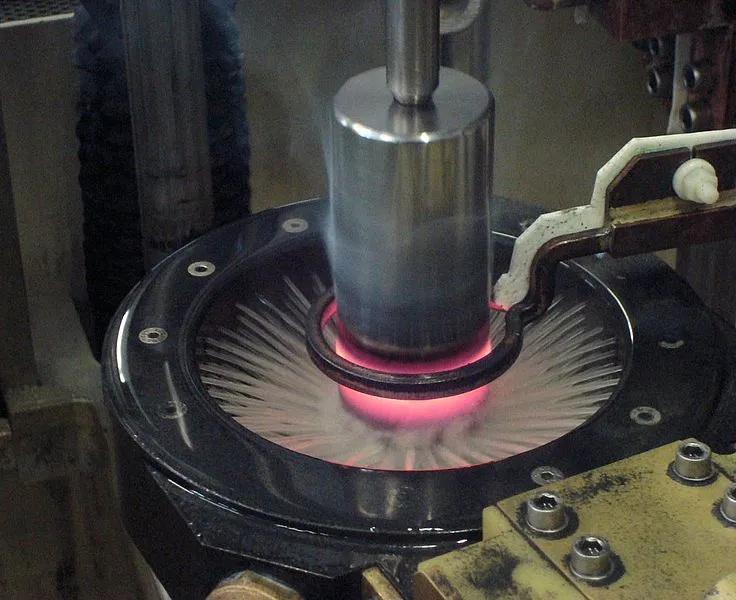
What is induction tempering? Induction tempering is a heating process that optimizes mechanical properties such as toughness and ductility in workpieces that have already been hardened. What are the benefits? The main advantage of induction over furnace tempering is speed. Induction can temper workpieces in minutes, sometimes even seconds. Furnaces typically take hours. And as induction tempering is perfect for inline integration, it minimizes the number of components in process. Induction tempering facilitates quality control of individual workpieces. Integrated induction temper stations also save valuable floor space. Where is it used? Induction tempering is widely employed in the automotive industry to temper surface-hardened components such as shafts, bars and joints. The process is also used in the tube and pipe industry to temper throughhardened workpieces. Induction tempering is sometimes performed in the hardening station, sometimes in one or several separate temper stations. What equipment is available? Complete HardLine systems are ideal for many tempering applications. The chief benefit of such systems is that hardening and tempering are performed by one machine. This delivers significant time and cost savings in a small footprint compared to alternative technologies. With furnaces, for example, one furnace often first hardens the workpieces, with a separate furnace then being used for tempering. Solid state DAWEI Induction Heating Systems are also used for tempering applications. induction tempering system https://dw-inductionheater.com/what-is-induction-tempering.html?feed_id=244168&_unique_id=6634e27f2971f
2024年2月10日星期六

Induction Hardening and tempering

Induction Hardening and tempering Surface Process

Induction Hardening

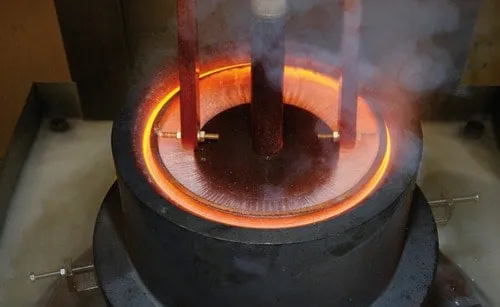
Induction Hardening is a process of heating followed by cooling generally fast for increase hardness and mechanical strength of steel. To this end, the steel is heated to a temperature slightly higher than the upper critical (between 850-900ºC) and then cooled more or less quickly (depending on the characteristics of steel) in a medium such as oil, air, water, water mixed with soluble polymers, etc. There are different methods for heating such as electric oven, gas cooker, salt, flame, induction, etc. The steels that are normally used in induction hardening contain from 0.3% to 0.7% carbon (hypoeutectic steels).

Induction heating advantages:

  • It treats a specific part of the piece (hardening profile)
  • Frequency Control and heating times
  • Cooling control
  • Energy saving
  • No physical contact
  • Control and located heat
  • Can be integrated in production lines
  • Increase performance and saves space
Induction hardening can be done in two different ways:
  • Static: consists of setting the part in front of the inductor and carrying out the operation without moving either the part or the inductor. This type of operation is very fast, requires only simple mechanics and enables a very accurate localisation of the treated area, even with parts with complicated geometry.
  • Progressive (by scanning): consists of going over the part with a continuous operation, moving either the part or the inductor. This kind of operation means that parts with large surfaces and large sizes can be treated.
For the same kind of part the scanning treatment requires less power with longer treatment time in compare to static treatment.

Induction Tempering

Induction Tempering is a process able to decrease the hardness, strength and increases the toughness of hardened steels, while removes the tensions created in the temple, leaving the steel with the required hardness. The traditional tempering system consists of heating the parts at relatively low temperatures (from 150ºC to 500°C, always below the lineAC1) for a while and then let them cool slowly.

Induction heating advantages:

  • Shorter times in the process
  • Temperature control
  • Integration in production lines
  • Energy saving
  • Immediate availability of parts
  • Saves floor space
  • Improved environmental conditions
The process of hardening and tempering is a treatment for various components in many industrial sectors.  
https://dw-inductionheater.com/induction-hardening-and-tempering.html?feed_id=233836&_unique_id=65c856f96ed5b

2023年10月14日星期六

Induction Tempering Spring

Induction Tempering Spring with High Frequency Induction Heating Equipment Objective Temper a spring by heating it to 300°C (570°F) in 2 – 4 seconds Material Stainless steel AISI 302 springs- different length from 60 to 110 mm - outer diameters 8 mm.- wire diameter from 0.3 to 0.6 mm Temperature 300°C (570°F) Frequency 326 kHz Equipment • DW-UHF-10kW induction heating system • remote workhead, two 0.33μF capacitors (total 0.66μF) • multi-turn C-channel coil developed for this application Process Springs are mounted on non-metallic mandrels to facilitate loading and unloading and are placed inside the coil (picture). Power is applied for 2 – 4 seconds, completing the tempering process. The C-channel distributes the heating evenly and enables the convenient staging and removal of the springs. Results/Benefits Efficiency: Energy is applied directly to the springs only;surrounding air and fixturing are not heated. Precision: temperature and duration of process are controlled Convenience: method integrates into a continuous process   https://dw-inductionheater.com/induction-tempering-spring.html?feed_id=229026&_unique_id=652b3c22ebdfb

2023年9月30日星期六

Induction Hardening and tempering

Induction Hardening and tempering Surface Process

Induction Hardening

Induction Hardening is a process of heating followed by cooling generally fast for increase hardness and mechanical strength of steel. To this end, the steel is heated to a temperature slightly higher than the upper critical (between 850-900ºC) and then cooled more or less quickly (depending on the characteristics of steel) in a medium such as oil, air, water, water mixed with soluble polymers, etc. There are different methods for heating such as electric oven, gas cooker, salt, flame, induction, etc. The steels that are normally used in induction hardening contain from 0.3% to 0.7% carbon (hypoeutectic steels).

Induction heating advantages:

  • It treats a specific part of the piece (hardening profile)
  • Frequency Control and heating times
  • Cooling control
  • Energy saving
  • No physical contact
  • Control and located heat
  • Can be integrated in production lines
  • Increase performance and saves space
Induction hardening can be done in two different ways:
  • Static: consists of setting the part in front of the inductor and carrying out the operation without moving either the part or the inductor. This type of operation is very fast, requires only simple mechanics and enables a very accurate localisation of the treated area, even with parts with complicated geometry.
  • Progressive (by scanning): consists of going over the part with a continuous operation, moving either the part or the inductor. This kind of operation means that parts with large surfaces and large sizes can be treated.
For the same kind of part the scanning treatment requires less power with longer treatment time in compare to static treatment.

Induction Tempering

Induction Tempering is a process able to decrease the hardness, strength and increases the toughness of hardened steels, while removes the tensions created in the temple, leaving the steel with the required hardness. The traditional tempering system consists of heating the parts at relatively low temperatures (from 150ºC to 500°C, always below the lineAC1) for a while and then let them cool slowly.

Induction heating advantages:

  • Shorter times in the process
  • Temperature control
  • Integration in production lines
  • Energy saving
  • Immediate availability of parts
  • Saves floor space
  • Improved environmental conditions
The process of hardening and tempering is a treatment for various components in many industrial sectors.  

2023年9月26日星期二

Induction Tempering Spring

Induction Tempering Spring with High Frequency Induction Heating Equipment Objective Temper a spring by heating it to 300°C (570°F) in 2 – 4 seconds Material Stainless steel AISI 302 springs- different length from 60 to 110 mm - outer diameters 8 mm.- wire diameter from 0.3 to 0.6 mm Temperature 300°C (570°F) Frequency 326 kHz Equipment • DW-UHF-10kW induction heating system • remote workhead, two 0.33μF capacitors (total 0.66μF) • multi-turn C-channel coil developed for this application Process Springs are mounted on non-metallic mandrels to facilitate loading and unloading and are placed inside the coil (picture). Power is applied for 2 – 4 seconds, completing the tempering process. The C-channel distributes the heating evenly and enables the convenient staging and removal of the springs. Results/Benefits Efficiency: Energy is applied directly to the springs only;surrounding air and fixturing are not heated. Precision: temperature and duration of process are controlled Convenience: method integrates into a continuous process  

2023年9月17日星期日

What is induction tempering?

What is induction tempering? Induction tempering is a heating process that optimizes mechanical properties such as toughness and ductility in workpieces that have already been hardened. What are the benefits? The main advantage of induction over furnace tempering is speed. Induction can temper workpieces in minutes, sometimes even seconds. Furnaces typically take hours. And as induction tempering is perfect for inline integration, it minimizes the number of components in process. Induction tempering facilitates quality control of individual workpieces. Integrated induction temper stations also save valuable floor space. Where is it used? Induction tempering is widely employed in the automotive industry to temper surface-hardened components such as shafts, bars and joints. The process is also used in the tube and pipe industry to temper throughhardened workpieces. Induction tempering is sometimes performed in the hardening station, sometimes in one or several separate temper stations. What equipment is available? Complete HardLine systems are ideal for many tempering applications. The chief benefit of such systems is that hardening and tempering are performed by one machine. This delivers significant time and cost savings in a small footprint compared to alternative technologies. With furnaces, for example, one furnace often first hardens the workpieces, with a separate furnace then being used for tempering. Solid state DAWEI Induction Heating Systems are also used for tempering applications. induction tempering system

2023年9月15日星期五

Induction Tempering Spring

Induction Tempering Spring with High Frequency Induction Heating Equipment Objective Temper a spring by heating it to 300°C (570°F) in 2 – 4 seconds Material Stainless steel AISI 302 springs- different length from 60 to 110 mm - outer diameters 8 mm.- wire diameter from 0.3 to 0.6 mm Temperature 300°C (570°F) Frequency 326 kHz Equipment • DW-UHF-10kW induction heating system • remote workhead, two 0.33μF capacitors (total 0.66μF) • multi-turn C-channel coil developed for this application Process Springs are mounted on non-metallic mandrels to facilitate loading and unloading and are placed inside the coil (picture). Power is applied for 2 – 4 seconds, completing the tempering process. The C-channel distributes the heating evenly and enables the convenient staging and removal of the springs. Results/Benefits Efficiency: Energy is applied directly to the springs only;surrounding air and fixturing are not heated. Precision: temperature and duration of process are controlled Convenience: method integrates into a continuous process  

2023年9月10日星期日

What is induction tempering?

What is induction tempering? Induction tempering is a heating process that optimizes mechanical properties such as toughness and ductility in workpieces that have already been hardened. What are the benefits? The main advantage of induction over furnace tempering is speed. Induction can temper workpieces in minutes, sometimes even seconds. Furnaces typically take hours. And as induction tempering is perfect for inline integration, it minimizes the number of components in process. Induction tempering facilitates quality control of individual workpieces. Integrated induction temper stations also save valuable floor space. Where is it used? Induction tempering is widely employed in the automotive industry to temper surface-hardened components such as shafts, bars and joints. The process is also used in the tube and pipe industry to temper throughhardened workpieces. Induction tempering is sometimes performed in the hardening station, sometimes in one or several separate temper stations. What equipment is available? Complete HardLine systems are ideal for many tempering applications. The chief benefit of such systems is that hardening and tempering are performed by one machine. This delivers significant time and cost savings in a small footprint compared to alternative technologies. With furnaces, for example, one furnace often first hardens the workpieces, with a separate furnace then being used for tempering. Solid state DAWEI Induction Heating Systems are also used for tempering applications. induction tempering system https://dw-inductionheater.com/what-is-induction-tempering.html?feed_id=227086&_unique_id=64fe3d8f466e8
2023年7月16日星期日

Induction Hardening and tempering

Induction Hardening and tempering Surface Process

Induction Hardening

Induction Hardening is a process of heating followed by cooling generally fast for increase hardness and mechanical strength of steel. To this end, the steel is heated to a temperature slightly higher than the upper critical (between 850-900ºC) and then cooled more or less quickly (depending on the characteristics of steel) in a medium such as oil, air, water, water mixed with soluble polymers, etc. There are different methods for heating such as electric oven, gas cooker, salt, flame, induction, etc. The steels that are normally used in induction hardening contain from 0.3% to 0.7% carbon (hypoeutectic steels).

Induction heating advantages:

  • It treats a specific part of the piece (hardening profile)
  • Frequency Control and heating times
  • Cooling control
  • Energy saving
  • No physical contact
  • Control and located heat
  • Can be integrated in production lines
  • Increase performance and saves space
Induction hardening can be done in two different ways:
  • Static: consists of setting the part in front of the inductor and carrying out the operation without moving either the part or the inductor. This type of operation is very fast, requires only simple mechanics and enables a very accurate localisation of the treated area, even with parts with complicated geometry.
  • Progressive (by scanning): consists of going over the part with a continuous operation, moving either the part or the inductor. This kind of operation means that parts with large surfaces and large sizes can be treated.
For the same kind of part the scanning treatment requires less power with longer treatment time in compare to static treatment.

Induction Tempering

Induction Tempering is a process able to decrease the hardness, strength and increases the toughness of hardened steels, while removes the tensions created in the temple, leaving the steel with the required hardness. The traditional tempering system consists of heating the parts at relatively low temperatures (from 150ºC to 500°C, always below the lineAC1) for a while and then let them cool slowly.

Induction heating advantages:

  • Shorter times in the process
  • Temperature control
  • Integration in production lines
  • Energy saving
  • Immediate availability of parts
  • Saves floor space
  • Improved environmental conditions
The process of hardening and tempering is a treatment for various components in many industrial sectors.  

2023年6月30日星期五

What is induction tempering?

What is induction tempering? Induction tempering is a heating process that optimizes mechanical properties such as toughness and ductility in workpieces that have already been hardened. What are the benefits? The main advantage of induction over furnace tempering is speed. Induction can temper workpieces in minutes, sometimes even seconds. Furnaces typically take hours. And as induction tempering is perfect for inline integration, it minimizes the number of components in process. Induction tempering facilitates quality control of individual workpieces. Integrated induction temper stations also save valuable floor space. Where is it used? Induction tempering is widely employed in the automotive industry to temper surface-hardened components such as shafts, bars and joints. The process is also used in the tube and pipe industry to temper throughhardened workpieces. Induction tempering is sometimes performed in the hardening station, sometimes in one or several separate temper stations. What equipment is available? Complete HardLine systems are ideal for many tempering applications. The chief benefit of such systems is that hardening and tempering are performed by one machine. This delivers significant time and cost savings in a small footprint compared to alternative technologies. With furnaces, for example, one furnace often first hardens the workpieces, with a separate furnace then being used for tempering. Solid state DAWEI Induction Heating Systems are also used for tempering applications. induction tempering system
2023年6月19日星期一

Induction Hardening and tempering

Induction Hardening and tempering Surface Process

Induction Hardening

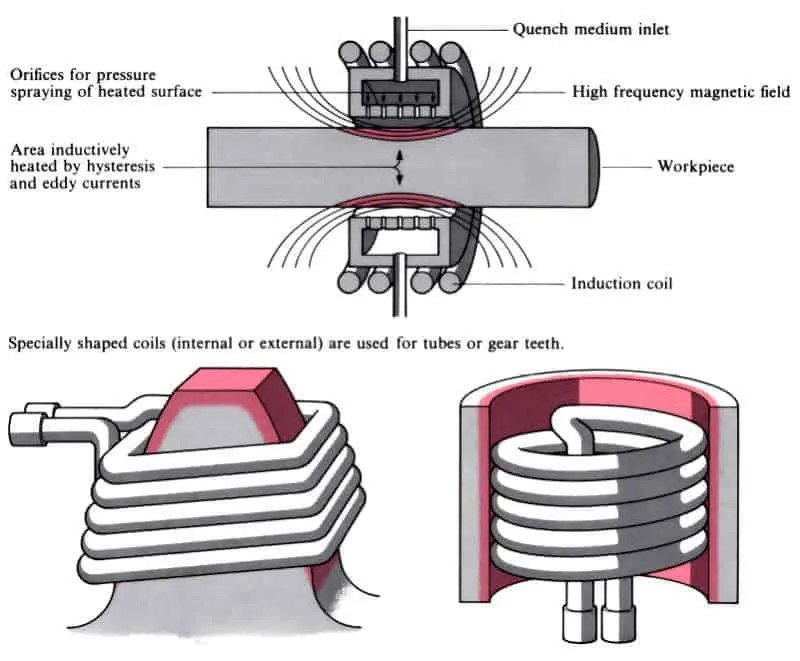
Induction Hardening is a process of heating followed by cooling generally fast for increase hardness and mechanical strength of steel. To this end, the steel is heated to a temperature slightly higher than the upper critical (between 850-900ºC) and then cooled more or less quickly (depending on the characteristics of steel) in a medium such as oil, air, water, water mixed with soluble polymers, etc. There are different methods for heating such as electric oven, gas cooker, salt, flame, induction, etc. The steels that are normally used in induction hardening contain from 0.3% to 0.7% carbon (hypoeutectic steels).

Induction heating advantages:

  • It treats a specific part of the piece (hardening profile)
  • Frequency Control and heating times
  • Cooling control
  • Energy saving
  • No physical contact
  • Control and located heat
  • Can be integrated in production lines
  • Increase performance and saves space
Induction hardening can be done in two different ways:
  • Static: consists of setting the part in front of the inductor and carrying out the operation without moving either the part or the inductor. This type of operation is very fast, requires only simple mechanics and enables a very accurate localisation of the treated area, even with parts with complicated geometry.
  • Progressive (by scanning): consists of going over the part with a continuous operation, moving either the part or the inductor. This kind of operation means that parts with large surfaces and large sizes can be treated.
For the same kind of part the scanning treatment requires less power with longer treatment time in compare to static treatment.

Induction Tempering

Induction Tempering is a process able to decrease the hardness, strength and increases the toughness of hardened steels, while removes the tensions created in the temple, leaving the steel with the required hardness. The traditional tempering system consists of heating the parts at relatively low temperatures (from 150ºC to 500°C, always below the lineAC1) for a while and then let them cool slowly.

Induction heating advantages:

  • Shorter times in the process
  • Temperature control
  • Integration in production lines
  • Energy saving
  • Immediate availability of parts
  • Saves floor space
  • Improved environmental conditions
The process of hardening and tempering is a treatment for various components in many industrial sectors.  
https://dw-inductionheater.com/induction-hardening-and-tempering.html?feed_id=214561&_unique_id=6490dd0e137d3

2023年6月15日星期四

Induction Hardening and tempering

Induction Hardening and tempering Surface Process

Induction Hardening

Induction Hardening is a process of heating followed by cooling generally fast for increase hardness and mechanical strength of steel. To this end, the steel is heated to a temperature slightly higher than the upper critical (between 850-900ºC) and then cooled more or less quickly (depending on the characteristics of steel) in a medium such as oil, air, water, water mixed with soluble polymers, etc. There are different methods for heating such as electric oven, gas cooker, salt, flame, induction, etc. The steels that are normally used in induction hardening contain from 0.3% to 0.7% carbon (hypoeutectic steels).

Induction heating advantages:

  • It treats a specific part of the piece (hardening profile)
  • Frequency Control and heating times
  • Cooling control
  • Energy saving
  • No physical contact
  • Control and located heat
  • Can be integrated in production lines
  • Increase performance and saves space
Induction hardening can be done in two different ways:
  • Static: consists of setting the part in front of the inductor and carrying out the operation without moving either the part or the inductor. This type of operation is very fast, requires only simple mechanics and enables a very accurate localisation of the treated area, even with parts with complicated geometry.
  • Progressive (by scanning): consists of going over the part with a continuous operation, moving either the part or the inductor. This kind of operation means that parts with large surfaces and large sizes can be treated.
For the same kind of part the scanning treatment requires less power with longer treatment time in compare to static treatment.

Induction Tempering

Induction Tempering is a process able to decrease the hardness, strength and increases the toughness of hardened steels, while removes the tensions created in the temple, leaving the steel with the required hardness. The traditional tempering system consists of heating the parts at relatively low temperatures (from 150ºC to 500°C, always below the lineAC1) for a while and then let them cool slowly.

Induction heating advantages:

  • Shorter times in the process
  • Temperature control
  • Integration in production lines
  • Energy saving
  • Immediate availability of parts
  • Saves floor space
  • Improved environmental conditions
The process of hardening and tempering is a treatment for various components in many industrial sectors.  

2023年6月6日星期二

Induction Tempering Spring

Induction Tempering Spring with High Frequency Induction Heating Equipment Objective Temper a spring by heating it to 300°C (570°F) in 2 – 4 seconds Material Stainless steel AISI 302 springs- different length from 60 to 110 mm - outer diameters 8 mm.- wire diameter from 0.3 to 0.6 mm Temperature 300°C (570°F) Frequency 326 kHz Equipment • DW-UHF-10kW induction heating system • remote workhead, two 0.33μF capacitors (total 0.66μF) • multi-turn C-channel coil developed for this application Process Springs are mounted on non-metallic mandrels to facilitate loading and unloading and are placed inside the coil (picture). Power is applied for 2 – 4 seconds, completing the tempering process. The C-channel distributes the heating evenly and enables the convenient staging and removal of the springs. Results/Benefits Efficiency: Energy is applied directly to the springs only;surrounding air and fixturing are not heated. Precision: temperature and duration of process are controlled Convenience: method integrates into a continuous process  

2023年5月1日星期一

Induction Hardening and tempering

Induction Hardening and tempering Surface Process

Induction Hardening

Induction Hardening is a process of heating followed by cooling generally fast for increase hardness and mechanical strength of steel. To this end, the steel is heated to a temperature slightly higher than the upper critical (between 850-900ºC) and then cooled more or less quickly (depending on the characteristics of steel) in a medium such as oil, air, water, water mixed with soluble polymers, etc. There are different methods for heating such as electric oven, gas cooker, salt, flame, induction, etc. The steels that are normally used in induction hardening contain from 0.3% to 0.7% carbon (hypoeutectic steels).

Induction heating advantages:

  • It treats a specific part of the piece (hardening profile)
  • Frequency Control and heating times
  • Cooling control
  • Energy saving
  • No physical contact
  • Control and located heat
  • Can be integrated in production lines
  • Increase performance and saves space
Induction hardening can be done in two different ways:
  • Static: consists of setting the part in front of the inductor and carrying out the operation without moving either the part or the inductor. This type of operation is very fast, requires only simple mechanics and enables a very accurate localisation of the treated area, even with parts with complicated geometry.
  • Progressive (by scanning): consists of going over the part with a continuous operation, moving either the part or the inductor. This kind of operation means that parts with large surfaces and large sizes can be treated.
For the same kind of part the scanning treatment requires less power with longer treatment time in compare to static treatment.

Induction Tempering

Induction Tempering is a process able to decrease the hardness, strength and increases the toughness of hardened steels, while removes the tensions created in the temple, leaving the steel with the required hardness. The traditional tempering system consists of heating the parts at relatively low temperatures (from 150ºC to 500°C, always below the lineAC1) for a while and then let them cool slowly.

Induction heating advantages:

  • Shorter times in the process
  • Temperature control
  • Integration in production lines
  • Energy saving
  • Immediate availability of parts
  • Saves floor space
  • Improved environmental conditions
The process of hardening and tempering is a treatment for various components in many industrial sectors.  

2023年4月24日星期一

Induction Tempering Spring

Induction Tempering Spring with High Frequency Induction Heating Equipment Objective Temper a spring by heating it to 300°C (570°F) in 2 – 4 seconds Material Stainless steel AISI 302 springs- different length from 60 to 110 mm - outer diameters 8 mm.- wire diameter from 0.3 to 0.6 mm Temperature 300°C (570°F) Frequency 326 kHz Equipment • DW-UHF-10kW induction heating system • remote workhead, two 0.33μF capacitors (total 0.66μF) • multi-turn C-channel coil developed for this application Process Springs are mounted on non-metallic mandrels to facilitate loading and unloading and are placed inside the coil (picture). Power is applied for 2 – 4 seconds, completing the tempering process. The C-channel distributes the heating evenly and enables the convenient staging and removal of the springs. Results/Benefits Efficiency: Energy is applied directly to the springs only;surrounding air and fixturing are not heated. Precision: temperature and duration of process are controlled Convenience: method integrates into a continuous process  

2023年4月7日星期五

Induction Tempering Spring

Induction Tempering Spring with High Frequency Induction Heating Equipment Objective Temper a spring by heating it to 300°C (570°F) in 2 – 4 seconds Material Stainless steel AISI 302 springs- different length from 60 to 110 mm - outer diameters 8 mm.- wire diameter from 0.3 to 0.6 mm Temperature 300°C (570°F) Frequency 326 kHz Equipment • DW-UHF-10kW induction heating system • remote workhead, two 0.33μF capacitors (total 0.66μF) • multi-turn C-channel coil developed for this application Process Springs are mounted on non-metallic mandrels to facilitate loading and unloading and are placed inside the coil (picture). Power is applied for 2 – 4 seconds, completing the tempering process. The C-channel distributes the heating evenly and enables the convenient staging and removal of the springs. Results/Benefits Efficiency: Energy is applied directly to the springs only;surrounding air and fixturing are not heated. Precision: temperature and duration of process are controlled Convenience: method integrates into a continuous process  

2023年3月27日星期一

Induction Tempering Spring

Induction Tempering Spring with High Frequency Induction Heating Equipment Objective Temper a spring by heating it to 300°C (570°F) in 2 – 4 seconds Material Stainless steel AISI 302 springs- different length from 60 to 110 mm - outer diameters 8 mm.- wire diameter from 0.3 to 0.6 mm Temperature 300°C (570°F) Frequency 326 kHz Equipment • DW-UHF-10kW induction heating system • remote workhead, two 0.33μF capacitors (total 0.66μF) • multi-turn C-channel coil developed for this application Process Springs are mounted on non-metallic mandrels to facilitate loading and unloading and are placed inside the coil (picture). Power is applied for 2 – 4 seconds, completing the tempering process. The C-channel distributes the heating evenly and enables the convenient staging and removal of the springs. Results/Benefits Efficiency: Energy is applied directly to the springs only;surrounding air and fixturing are not heated. Precision: temperature and duration of process are controlled Convenience: method integrates into a continuous process  

2023年3月12日星期日

Induction Hardening and tempering

Induction Hardening and tempering Surface Process


Induction Hardening


Induction Hardening is a process of heating followed by cooling generally fast for increase hardness and mechanical strength of steel.


To this end, the steel is heated to a temperature slightly higher than the upper critical (between 850-900ºC) and then cooled more or less quickly (depending on the characteristics of steel) in a medium such as oil, air, water, water mixed with soluble polymers, etc.

There are different methods for heating such as electric oven, gas cooker, salt, flame, induction, etc.

The steels that are normally used in induction hardening contain from 0.3% to 0.7% carbon (hypoeutectic steels).

Induction heating advantages:


  • It treats a specific part of the piece (hardening profile)

  • Frequency Control and heating times

  • Cooling control

  • Energy saving

  • No physical contact

  • Control and located heat

  • Can be integrated in production lines

  • Increase performance and saves space


Induction hardening can be done in two different ways:

  • Static: consists of setting the part in front of the inductor and carrying out the operation without moving either the part or the inductor. This type of operation is very fast, requires only simple mechanics and enables a very accurate localisation of the treated area, even with parts with complicated geometry.


  • Progressive (by scanning): consists of going over the part with a continuous operation, moving either the part or the inductor. This kind of operation means that parts with large surfaces and large sizes can be treated.


For the same kind of part the scanning treatment requires less power with longer treatment time in compare to static treatment.

Induction Tempering


Induction Tempering is a process able to decrease the hardness, strength and increases the toughness of hardened steels, while removes the tensions created in the temple, leaving the steel with the required hardness.

The traditional tempering system consists of heating the parts at relatively low temperatures (from 150ºC to 500°C, always below the lineAC1) for a while and then let them cool slowly.

Induction heating advantages:


  • Shorter times in the process

  • Temperature control

  • Integration in production lines

  • Energy saving

  • Immediate availability of parts

  • Saves floor space

  • Improved environmental conditions


The process of hardening and tempering is a treatment for various components in many industrial sectors.


2023年3月11日星期六

Induction Hardening and tempering

Induction Hardening and tempering Surface Process

Induction Hardening

Induction Hardening is a process of heating followed by cooling generally fast for increase hardness and mechanical strength of steel. To this end, the steel is heated to a temperature slightly higher than the upper critical (between 850-900ºC) and then cooled more or less quickly (depending on the characteristics of steel) in a medium such as oil, air, water, water mixed with soluble polymers, etc. There are different methods for heating such as electric oven, gas cooker, salt, flame, induction, etc. The steels that are normally used in induction hardening contain from 0.3% to 0.7% carbon (hypoeutectic steels).

Induction heating advantages:

  • It treats a specific part of the piece (hardening profile)
  • Frequency Control and heating times
  • Cooling control
  • Energy saving
  • No physical contact
  • Control and located heat
  • Can be integrated in production lines
  • Increase performance and saves space
Induction hardening can be done in two different ways:
  • Static: consists of setting the part in front of the inductor and carrying out the operation without moving either the part or the inductor. This type of operation is very fast, requires only simple mechanics and enables a very accurate localisation of the treated area, even with parts with complicated geometry.
  • Progressive (by scanning): consists of going over the part with a continuous operation, moving either the part or the inductor. This kind of operation means that parts with large surfaces and large sizes can be treated.
For the same kind of part the scanning treatment requires less power with longer treatment time in compare to static treatment.

Induction Tempering

Induction Tempering is a process able to decrease the hardness, strength and increases the toughness of hardened steels, while removes the tensions created in the temple, leaving the steel with the required hardness. The traditional tempering system consists of heating the parts at relatively low temperatures (from 150ºC to 500°C, always below the lineAC1) for a while and then let them cool slowly.

Induction heating advantages:

  • Shorter times in the process
  • Temperature control
  • Integration in production lines
  • Energy saving
  • Immediate availability of parts
  • Saves floor space
  • Improved environmental conditions
The process of hardening and tempering is a treatment for various components in many industrial sectors.  

2023年3月7日星期二

Induction Tempering Spring

Induction Tempering Spring with High Frequency Induction Heating Equipment Objective Temper a spring by heating it to 300°C (570°F) in 2 – 4 seconds Material Stainless steel AISI 302 springs- different length from 60 to 110 mm - outer diameters 8 mm.- wire diameter from 0.3 to 0.6 mm Temperature 300°C (570°F) Frequency 326 kHz Equipment • DW-UHF-10kW induction heating system • remote workhead, two 0.33μF capacitors (total 0.66μF) • multi-turn C-channel coil developed for this application Process Springs are mounted on non-metallic mandrels to facilitate loading and unloading and are placed inside the coil (picture). Power is applied for 2 – 4 seconds, completing the tempering process. The C-channel distributes the heating evenly and enables the convenient staging and removal of the springs. Results/Benefits Efficiency: Energy is applied directly to the springs only;surrounding air and fixturing are not heated. Precision: temperature and duration of process are controlled Convenience: method integrates into a continuous process  

关注者

我的简介

我的照片
HLQ induction heating machine manufacturer provides the service of induction brazing,melting,hot forming,hardening surface,annealing,shrink fitting,PWHT,etc.