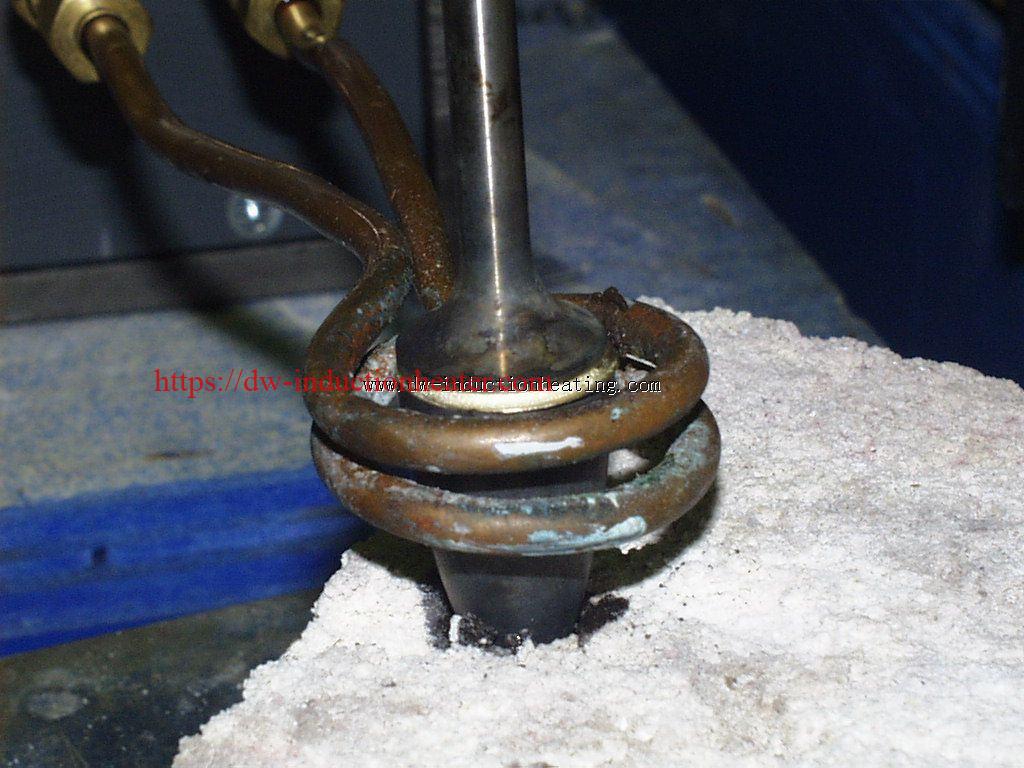
 Induction Brazing Carbide File
Objective: Induction Brazing carbide rotary file assemblies with uniform concentricity in an aerospace application
Material • Carbide blank • High speed steel shank • Temperature indicating paint • Braze shim and black flux
Temperature 1400°F (760°C)
Frequency 550 kHz
Equipment: DW-UHF-4.5kw induction heating system, equipped with a remote heat station containing two 0.33 μF capacitors (total 0.66 μF) An induction heating coil designed and developed specifically for this application.
Process A multi-turn helical coil is used. The part is heated to determine the time required to reach the desired temperature and required heat pattern. It takes approximately 30 - 45 seconds to reach 1400°F (760°C) depending on the various part sizes. Flux is applied to the entire part. A braze shim is sandwiched between the steel shank and carbide. Induction heating power is applied until the braze flows. With proper fixturing, concentricity of the part can be achieved.
Results/Benefits • Repeatable, consistent precise heat.
https://dw-inductionheater.com/induction-brazing-carbide-file.html?feed_id=253337&_unique_id=668d6f6a2c054
Induction Brazing Carbide File
Objective: Induction Brazing carbide rotary file assemblies with uniform concentricity in an aerospace application
Material • Carbide blank • High speed steel shank • Temperature indicating paint • Braze shim and black flux
Temperature 1400°F (760°C)
Frequency 550 kHz
Equipment: DW-UHF-4.5kw induction heating system, equipped with a remote heat station containing two 0.33 μF capacitors (total 0.66 μF) An induction heating coil designed and developed specifically for this application.
Process A multi-turn helical coil is used. The part is heated to determine the time required to reach the desired temperature and required heat pattern. It takes approximately 30 - 45 seconds to reach 1400°F (760°C) depending on the various part sizes. Flux is applied to the entire part. A braze shim is sandwiched between the steel shank and carbide. Induction heating power is applied until the braze flows. With proper fixturing, concentricity of the part can be achieved.
Results/Benefits • Repeatable, consistent precise heat.
https://dw-inductionheater.com/induction-brazing-carbide-file.html?feed_id=253337&_unique_id=668d6f6a2c054
2024年7月9日星期二
Induction Brazing Carbide
Induction Brazing Carbide File
Objective: Induction Brazing carbide rotary file assemblies with uniform concentricity in an aerospace application
Material • Carbide blank • High speed steel shank • Temperature indicating paint • Braze shim and black flux
Temperature 1400°F (760°C)
Frequency 550 kHz
Equipment: DW-UHF-4.5kw induction heating system, equipped with a remote heat station containing two 0.33 μF capacitors (total 0.66 μF) An induction heating coil designed and developed specifically for this application.
Process A multi-turn helical coil is used. The part is heated to determine the time required to reach the desired temperature and required heat pattern. It takes approximately 30 - 45 seconds to reach 1400°F (760°C) depending on the various part sizes. Flux is applied to the entire part. A braze shim is sandwiched between the steel shank and carbide. Induction heating power is applied until the braze flows. With proper fixturing, concentricity of the part can be achieved.
Results/Benefits • Repeatable, consistent precise heat.
https://dw-inductionheater.com/induction-brazing-carbide-file.html?feed_id=253337&_unique_id=668d6f6a2c054

2024年7月8日星期一
High Frequency Induction Brazing Diamond Inserts
 High Frequency Induction Brazing Diamond Inserts
Objective: Induction Brazing diamond inserts to a steel drilling ring
Material : • steel ring and diamond inserts • Braze shim preform • Flux
Temperature :1300 – 1350 (700 – 730) °F (°C)
Frequency :78 kHz
Equipment: DW-HF-15kW, induction heating system, equipped with a remote heat station containing two 0.5 μF capacitors (total 0.25 μF) An induction heating coil designed and developed specifically for this application.
Process: A multi-turn, internal-external helical coil (A) is used to generate the required heating pattern. Initial tests on the ring alone determine system tuning. Flux is applied to the part and the braze shims are inserted into the counter-bored holes (B). This is followed by the synthetic diamonds. The part is loaded into the coil and weight is placed onto the diamonds (C). RF Induction Heating power is applied until the braze flows. The power is turned off and the part air cools to room temperature.
Results/Benefits • reduced ring warping compared to furnace induction heating • decreased cycle time due to reduced ramp-up and cooldown times
https://dw-inductionheater.com/high-frequency-induction-brazing-diamond-inserts.html?feed_id=253269&_unique_id=668cb891a1675
High Frequency Induction Brazing Diamond Inserts
Objective: Induction Brazing diamond inserts to a steel drilling ring
Material : • steel ring and diamond inserts • Braze shim preform • Flux
Temperature :1300 – 1350 (700 – 730) °F (°C)
Frequency :78 kHz
Equipment: DW-HF-15kW, induction heating system, equipped with a remote heat station containing two 0.5 μF capacitors (total 0.25 μF) An induction heating coil designed and developed specifically for this application.
Process: A multi-turn, internal-external helical coil (A) is used to generate the required heating pattern. Initial tests on the ring alone determine system tuning. Flux is applied to the part and the braze shims are inserted into the counter-bored holes (B). This is followed by the synthetic diamonds. The part is loaded into the coil and weight is placed onto the diamonds (C). RF Induction Heating power is applied until the braze flows. The power is turned off and the part air cools to room temperature.
Results/Benefits • reduced ring warping compared to furnace induction heating • decreased cycle time due to reduced ramp-up and cooldown times
https://dw-inductionheater.com/high-frequency-induction-brazing-diamond-inserts.html?feed_id=253269&_unique_id=668cb891a1675
Induction Annealing Copper Wire
 Induction Annealing Copper Wire
Objective: Induction Annealing a brazing copper wire for preform production.
Material: Copper Nickel Silver 2774 Alloy rod 0.070" (1.8mm) diameter.
Temperature 650ºF(343.3ºC)
Frequency 580 kHz
Equipment: • DW-UHF-6kW-III induction heating system equipped with a remote workhead with one 1.0 μF capacitor, and a 4-20 mA input controller to aid in voltage ramping. • An induction heating coil designed and developed specifically for this application.
Process A unique helical coil consisting of four consecutive coils connected in parallel with a quartz tube lining is used to heat the wire to 650ºF (343.3ºC) for annealing.
Results/Benefits Induction heating provides: • Higher productivity of 27' (8.2m) per minute • Reduction in surface oxidation & scaling • Consistent, repeatable results
https://dw-inductionheater.com/induction-annealing-copper-wire.html?feed_id=253201&_unique_id=668c020c5b0d0
Induction Annealing Copper Wire
Objective: Induction Annealing a brazing copper wire for preform production.
Material: Copper Nickel Silver 2774 Alloy rod 0.070" (1.8mm) diameter.
Temperature 650ºF(343.3ºC)
Frequency 580 kHz
Equipment: • DW-UHF-6kW-III induction heating system equipped with a remote workhead with one 1.0 μF capacitor, and a 4-20 mA input controller to aid in voltage ramping. • An induction heating coil designed and developed specifically for this application.
Process A unique helical coil consisting of four consecutive coils connected in parallel with a quartz tube lining is used to heat the wire to 650ºF (343.3ºC) for annealing.
Results/Benefits Induction heating provides: • Higher productivity of 27' (8.2m) per minute • Reduction in surface oxidation & scaling • Consistent, repeatable results
https://dw-inductionheater.com/induction-annealing-copper-wire.html?feed_id=253201&_unique_id=668c020c5b0d0
2024年7月7日星期日
Annealing Saw Blades with Induction
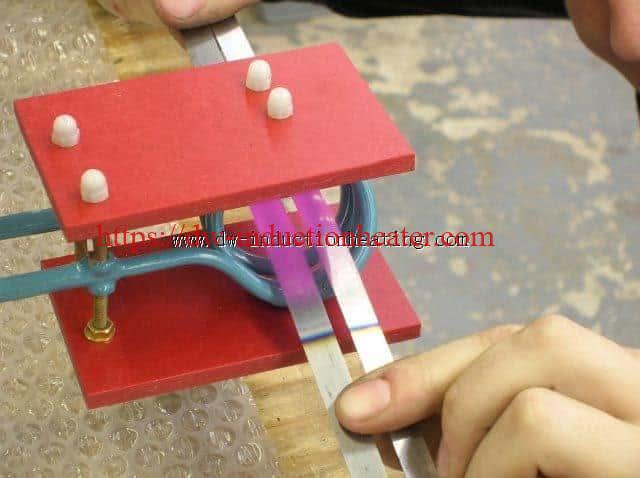 Induction Annealing Saw Blades
Objective: Induction Annealing saw blades used for cutting bread, prior to hole punching.
Material .38" (9.6mm) wide and .51" (12.9mm) wide continuous strips of 400 series stainless steel.
Temperature 600°C (315.6°F) for one second
Frequency 589kHz
Equipment • DW-UHF-6KW induction heating system equipped with a remote workhead containing one 1.00 μF capacitor. • An induction heating coil designed and developed specifically for this application.
Process A three turn helical coil at a 45º angle is used to anneal a 1.2" (30.5mm) strip of saw blade prior to hole punching.
Results/Benefits Induction heating provides: • Improved quality of blades at hole punching location • Decreased scrap product • Easily incorporated into existing production lines
https://dw-inductionheater.com/annealing-saw-blades-with-induction.html?feed_id=253133&_unique_id=668b4adc2c54f
Induction Annealing Saw Blades
Objective: Induction Annealing saw blades used for cutting bread, prior to hole punching.
Material .38" (9.6mm) wide and .51" (12.9mm) wide continuous strips of 400 series stainless steel.
Temperature 600°C (315.6°F) for one second
Frequency 589kHz
Equipment • DW-UHF-6KW induction heating system equipped with a remote workhead containing one 1.00 μF capacitor. • An induction heating coil designed and developed specifically for this application.
Process A three turn helical coil at a 45º angle is used to anneal a 1.2" (30.5mm) strip of saw blade prior to hole punching.
Results/Benefits Induction heating provides: • Improved quality of blades at hole punching location • Decreased scrap product • Easily incorporated into existing production lines
https://dw-inductionheater.com/annealing-saw-blades-with-induction.html?feed_id=253133&_unique_id=668b4adc2c54f
Induction Brazing Steel Pipe
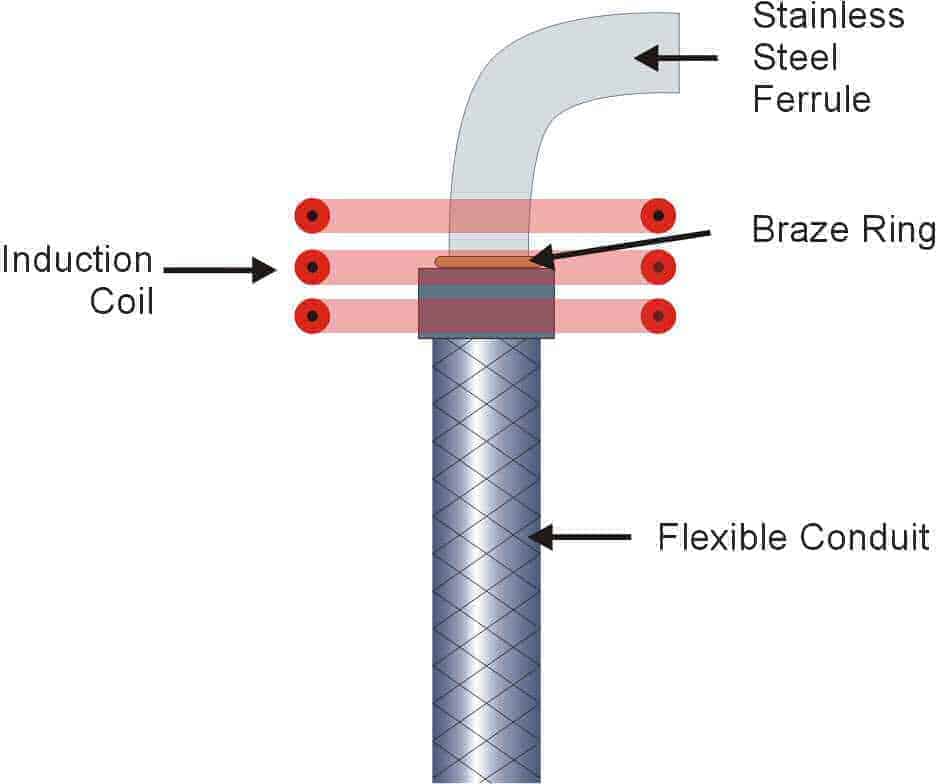 Induction Brazing Steel Pipe
Objective: To heat a stainless steel pipe, ferrule and elbow assembly to 1400°F (760°C) within 20 seconds for brazing.
Material 6"(152.4mm)long x 0.5"(12.7mm) diameter stainless steel conduit, 0.5"(12.7mm) long x 0.5"(12.7mm) diameter ferrule, 2"(50.8mm) elbow with 0.5" (12.7mm) diameter
Temperature 1400°F (760°C)
Frequency 400 kHz
Equipment • DW-UHF-6KW-I induction heating system equipped with a remote workhead • An induction heating coil designed and developed specifically for this application.
Process: A specially designed, three-turn helical coil is used to provide heat to the assembly at the braze joint area. Two small silver solder braze rings are placed at each joint; the joints are coated with black flux to insure that the braze material flows cleanly. The assembly is placed inside the coil and power is applied for 15 seconds to cause the braze to flow.
Results/Benefits: Induction heating provides: • Consistent and repeatable results • No flame process • Faster process time
https://dw-inductionheater.com/induction-brazing-steel-pipe.html?feed_id=253065&_unique_id=668a9431e0f3d
Induction Brazing Steel Pipe
Objective: To heat a stainless steel pipe, ferrule and elbow assembly to 1400°F (760°C) within 20 seconds for brazing.
Material 6"(152.4mm)long x 0.5"(12.7mm) diameter stainless steel conduit, 0.5"(12.7mm) long x 0.5"(12.7mm) diameter ferrule, 2"(50.8mm) elbow with 0.5" (12.7mm) diameter
Temperature 1400°F (760°C)
Frequency 400 kHz
Equipment • DW-UHF-6KW-I induction heating system equipped with a remote workhead • An induction heating coil designed and developed specifically for this application.
Process: A specially designed, three-turn helical coil is used to provide heat to the assembly at the braze joint area. Two small silver solder braze rings are placed at each joint; the joints are coated with black flux to insure that the braze material flows cleanly. The assembly is placed inside the coil and power is applied for 15 seconds to cause the braze to flow.
Results/Benefits: Induction heating provides: • Consistent and repeatable results • No flame process • Faster process time
https://dw-inductionheater.com/induction-brazing-steel-pipe.html?feed_id=253065&_unique_id=668a9431e0f3d
2024年7月6日星期六
Automatic Induction Forging Video
Induction Heating Fluidized Bed Reactors
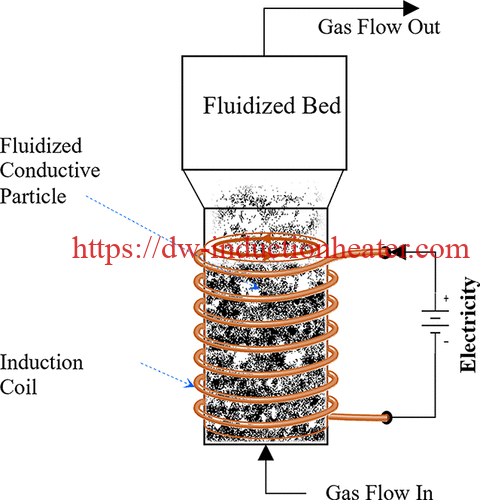
Enhancing Efficiency and Control: Induction Heating Fluidized Bed Reactors
Introduction
Fluidized bed reactors are integral to many industrial processes due to their excellent heat and mass transfer properties. When combined with induction heating technology, these reactors achieve a new level of efficiency, control, and environmental sustainability. This article delves into the principles and advantages of induction heating fluidized bed reactors, their applications across various industries, and the challenges and future directions of this innovative technology.Principles of Fluidized Bed Reactors
Fluidized bed reactors operate by suspending solid particles in an upward flow of gas or liquid, creating a state that mimics fluid behavior. This fluidization enhances mixing and allows for uniform temperature distribution, making these reactors ideal for processes such as combustion, drying, and chemical reactions. Key components and principles include: 1. **Distributor Plate**: Ensures even distribution of the fluidizing medium to achieve consistent fluidization. 2. **Solid Particles**: Act as the medium for reactions, ranging from fine powders to larger granules. 3. **Fluidizing Medium**: Typically air, steam, or other gases, chosen based on process requirements. 4. **Enhanced Transfer Rates**: The fluidized state significantly improves heat and mass transfer rates within the reactor.Applications of Fluidized Beds
1. Chemical Reactions: Fluidized beds are widely used in catalytic cracking, gasification, and other chemical reactions where efficient mixing and temperature control are crucial for optimizing reaction rates and product yields.
2. Combustion: In fluidized bed combustion, fuels such as coal, biomass, or waste materials are burned more efficiently due to the enhanced mixing and heat transfer, resulting in lower emissions and better combustion control.
3. Drying: Fluidized bed dryers are used to remove moisture from solid particles, providing uniform drying conditions and preventing overheating or degradation of the material.
4. Coating and Granulation: Fluidized beds are used in the pharmaceutical and food industries for coating particles with protective or functional layers and for granulating powders into larger, more manageable particles.
5. Heat Treatment: Metal and ceramic particles can be uniformly heated or cooled in fluidized beds, ensuring consistent treatment and improving the quality of the final product.
Principles of Induction Heating
Induction heating generates heat within conductive materials through electromagnetic induction. An alternating current (AC) passes through a coil, creating a varying magnetic field that induces eddy currents in nearby conductive materials.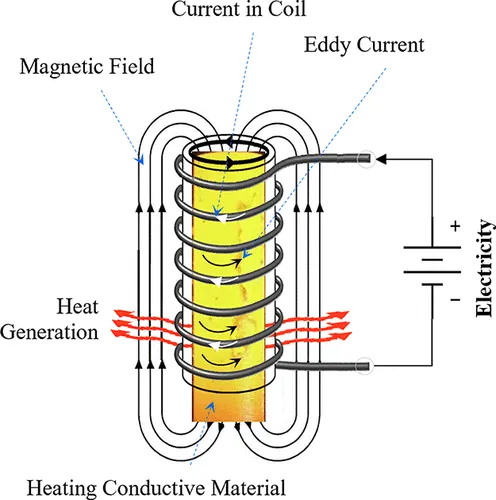
Integration of Induction Heating with Fluidized Bed Reactors
Combining induction heating with fluidized bed reactors leverages the benefits of both technologies, resulting in superior process performance. Here’s how this integration enhances fluidized bed reactors: 1. **Uniform Heating**: Induction heating ensures direct and uniform heating of conductive particles, maintaining consistent temperatures throughout the reactor. 2. **Energy Efficiency**: Induction heating minimizes energy loss, reducing operational costs and improving sustainability. 3. **Environmental Impact**: Non-contact heating eliminates the need for combustion, lowering emissions of pollutants and greenhouse gases. 4. **Enhanced Process Control**: Precise control over heating parameters allows for optimization of reaction conditions, improving product quality and yield.Applications of Induction Heated Fluidized Bed Reactors
The integration of induction heating in fluidized bed reactors has broad applications across various industries: 1. **Chemical Processing**: Ideal for catalytic reactions and other processes requiring precise temperature control, such as methanation and Fischer-Tropsch synthesis. 2. **Material Processing**: Suitable for sintering, melting, and heat treatment of metals and ceramics, ensuring consistent material properties. 3. **Energy Production**: Enhances processes like biomass gasification and pyrolysis, maximizing energy output and efficiency. 4. **Environmental Remediation**: Effective for soil decontamination and waste treatment, offering rapid and uniform heating.Advantages of Induction Heated Fluidized Bed Reactors
1. **Improved Efficiency**: Enhanced heat transfer and mixing lead to higher reaction rates and yields. 2. **Cost Savings**: Reduced energy consumption and lower operational costs due to the efficiency of induction heating.
3. **Environmental Benefits**: Lower emissions and reduced environmental footprint compared to traditional heating methods.
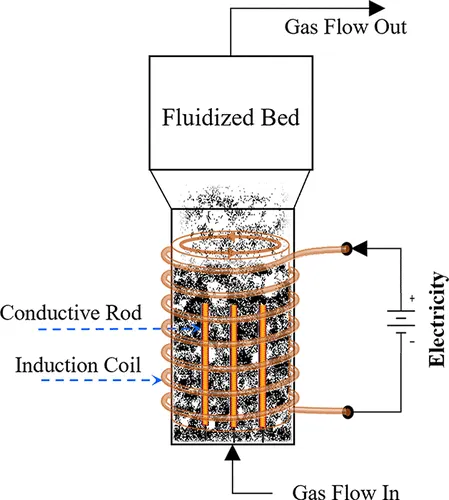 4. **Scalability and Flexibility**: Suitable for a wide range of scales and adaptable to various industrial processes.
Challenges and Future Directions
Despite the numerous advantages, several challenges need to be addressed: 1. **Design Optimization**: Developing efficient induction coil and power supply designs to ensure uniform heating and minimize energy loss. 2. **Material Durability**: Ensuring the durability of reactor materials and particles subjected to continuous motion and heating. 3. **Scalability**: Expanding the technology for large-scale industrial applications while maintaining efficiency and control. Future research should focus on optimizing reactor designs, exploring new conductive materials and coatings, and expanding the range of applications. Collaboration between industry and academia will be crucial in overcoming these challenges and realizing the full potential of induction heated fluidized bed reactors.
Conclusion
Induction heating fluidized bed reactors represent a significant advancement in industrial processing technology. By combining the rapid, precise, and efficient heating capabilities of induction with the superior heat and mass transfer properties of fluidized beds, this integration offers substantial benefits in terms of efficiency, control, and environmental impact. As research and development continue to address existing challenges, the adoption of this innovative technology is likely to grow, contributing to more sustainable, efficient, and effective industrial processes.
订阅:
博文 (Atom)
我的简介

- HLQ induction heating machine
- HLQ induction heating machine manufacturer provides the service of induction brazing,melting,hot forming,hardening surface,annealing,shrink fitting,PWHT,etc.