显示标签为“heattreatment”的博文。显示所有博文

2024年2月18日星期日

Induction Heat Treating Surface Process

What is induction heat treating surface process?

Induction heating is a heat treating process that allows very targeted heating of metals by electromagnetic induction. The process relies on induced electrical currents within the material to produce heat and is the preferred method used to bond, harden or soften metals or other conductive materials. In modern manufacturing processes, this form of heat treatment offers a beneficial combination of speed, consistency and control. Although the basic principles are well known, modern advances in solid state technology have made the process remarkably simple, cost-effective heating method for applications which involve joining, treating, heating and materials testing. Induction heat treating, through the highly controllable use of an electrically heated coil, will allow you to select the best physical characteristics for not only each metal part—but for each section on that metal part. Induction hardening can impart superior durability to bearing journals and shaft sections without sacrificing the ductility necessary to handle shock loads and vibration. You can harden internal bearing surfaces and valve seats in intricate parts without creating distortion problems. This means that you are able to harden or anneal specific areas for durability and ductility in ways that will best serve your needs.

Benefits of Induction Heat Treating Services

  • Focused Heat Treat Surface hardening retains original ductility of core while hardening a high wear area of the part. The hardened area is accurately controlled in respect to case depth, width, location and hardness.
  • Optimized Consistency Eliminate the inconsistencies and quality issues associated with open flame, torch heating and other methods. Once the system is properly calibrated and set up, there is no guess work or variation; the heating pattern is repeatable and consistent. With modern solid state systems, precise temperature control provides uniform results.
  • Maximized Productivity Production rates can be maximized because heat is developed directly and instantly (>2000º F. in < 1 second) inside the part. Startup is virtually instantaneous; no warm up or cool down cycle is required.
  • Improved Product Quality Parts never come into direct contact with a flame or other heating element; the heat is induced within the part itself by alternating electrical current. As a result, product warpage, distortion and reject rates are minimized.
  • Reduced Energy Consumption Tired of increasing utility bills? This uniquely energy-efficient process converts up to 90% of the energy expended energy into useful heat; batch furnaces are generally only 45% energy-efficient. No warm-up or cool-down cycles are required so stand-by heat losses are reduced to a bare minimum.
  • Environmentally Sound The burning of traditional fossil fuels is unnecessary, resulting in a clean, non-polluting process which will help protect the environment.

What is Induction Heating?

Induction Heating is a Contactless Heating Method of bodies, which absorb energy from an Alternating Magnetic Field, generated by Induction Coil (Inductor). There are two mechanisms of energy absorption:
  • generation of close-loop (eddy) currents inside the body which cause heating due to electrical resistance of the body material
  • hysteresis heating (for magnetic materials ONLY!) due to a friction of magnetic micro volumes (domains), which rotate following orientation of external magnetic field

Principle of Induction Heating

Chain of phenomena:
  • Induction heating power supply delivers current (I1) to induction coil
  • Coil currents (ampere-turns) generate magnetic field. Lines of field are always closed (law of nature!) and each line goes around the current source – coil turns and workpiece
  • Alternating magnetic field flowing through the part cross-section (coupled to the part) induces voltage in the part
  • Induced voltage creates eddy currents (I2) in the part flowing in direction opposite to the coil current where possible
  • Eddy currents generate heat in the part

Power Flow in Induction Heating Installations

Alternating current changes direction twice during each frequency cycle. If frequency is 1kHz, current changes direction 2000 times in a second. A product of current and voltage gives the value of instantaneous power (p = i x u), which oscillates between the power supply and the coil. We can say that power is being partially absorbed (Active Power) and partially reflected (Reactive Power) by the coil. Capacitor battery is used to unload the generator from the reactive power. Capacitors receive reactive power from the coil and send it back to the coil supporting oscillations. A circuit “coil-transformer-capacitors” is called Resonant or Tank Circuit. https://dw-inductionheater.com/induction-heat-treating-surface-process.html?feed_id=234310&_unique_id=65d2565f679c5

2024年1月11日星期四

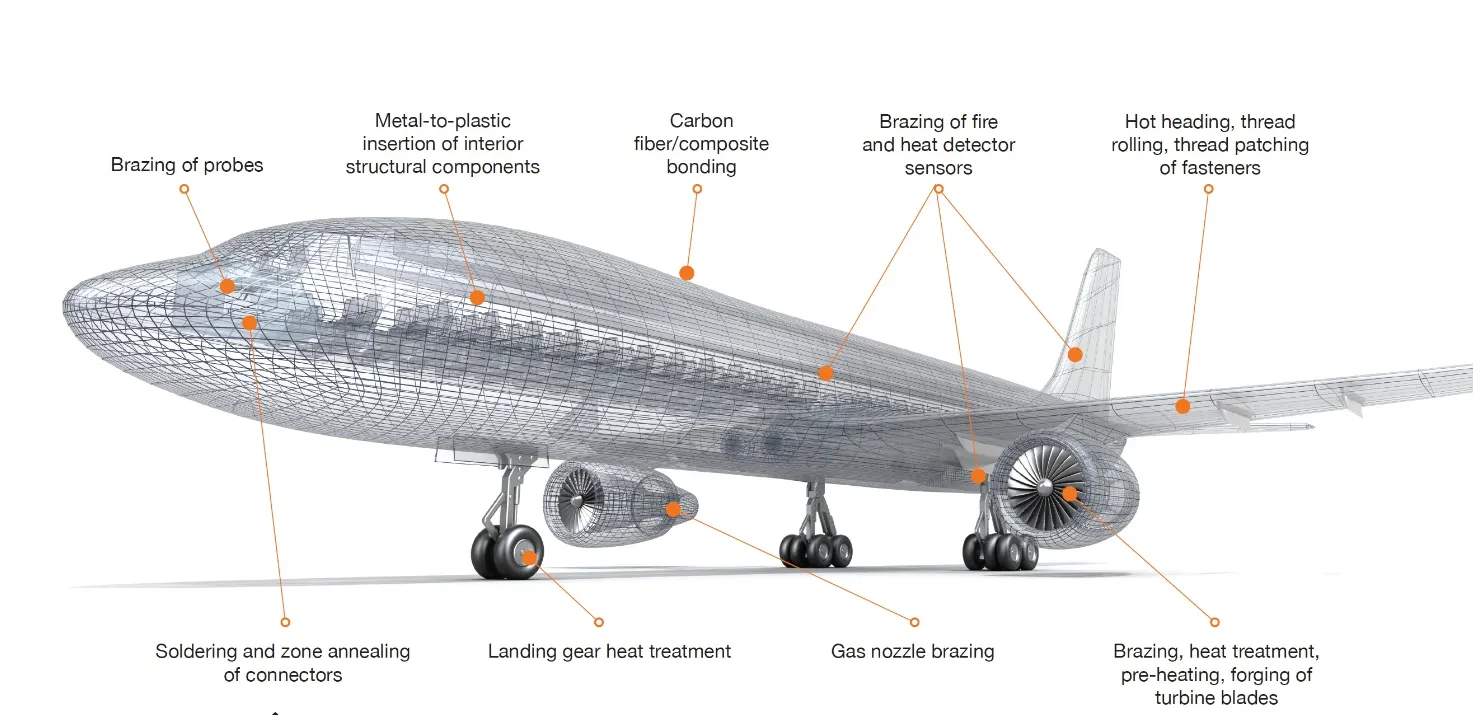
Induction Quenching Applications in the Aerospace Industry

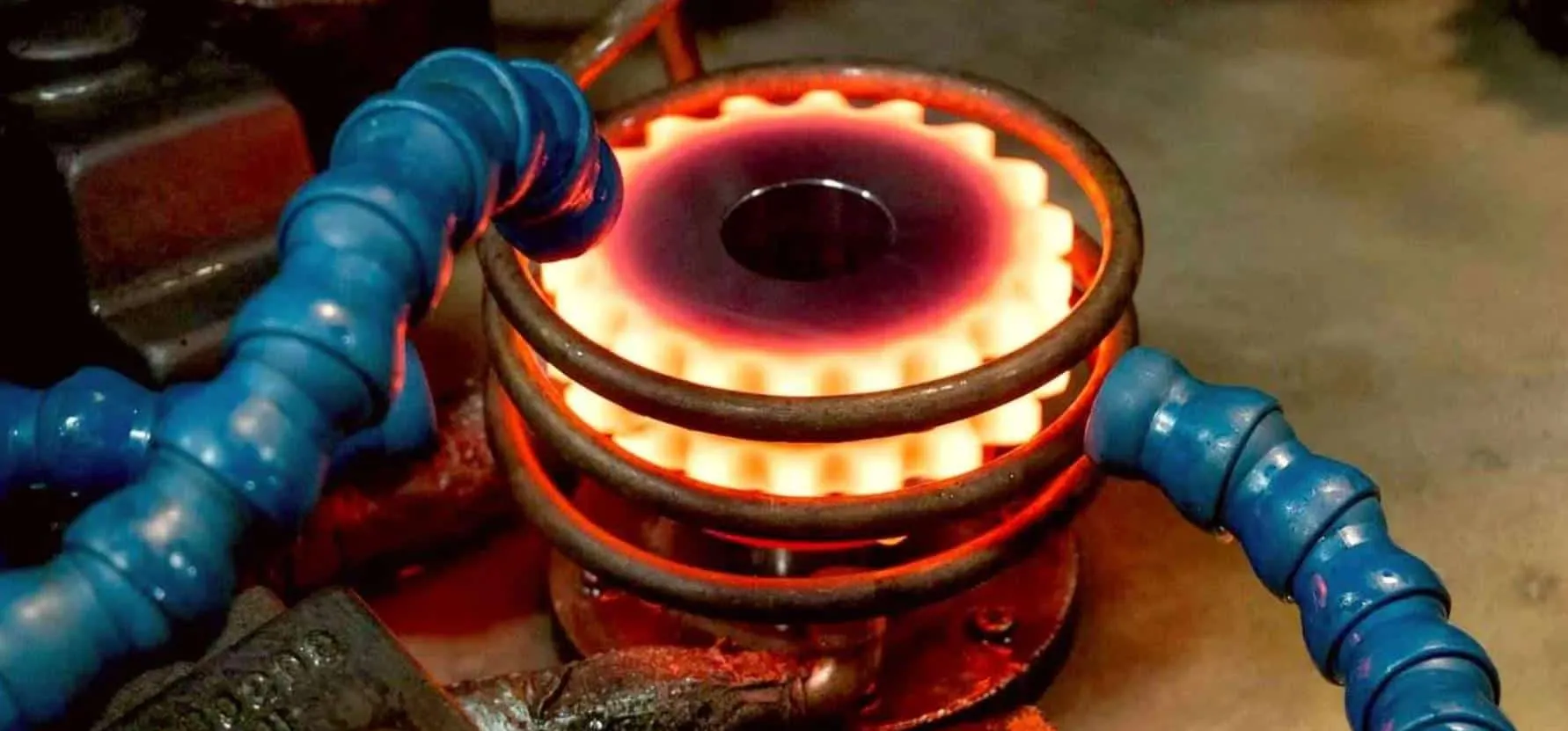
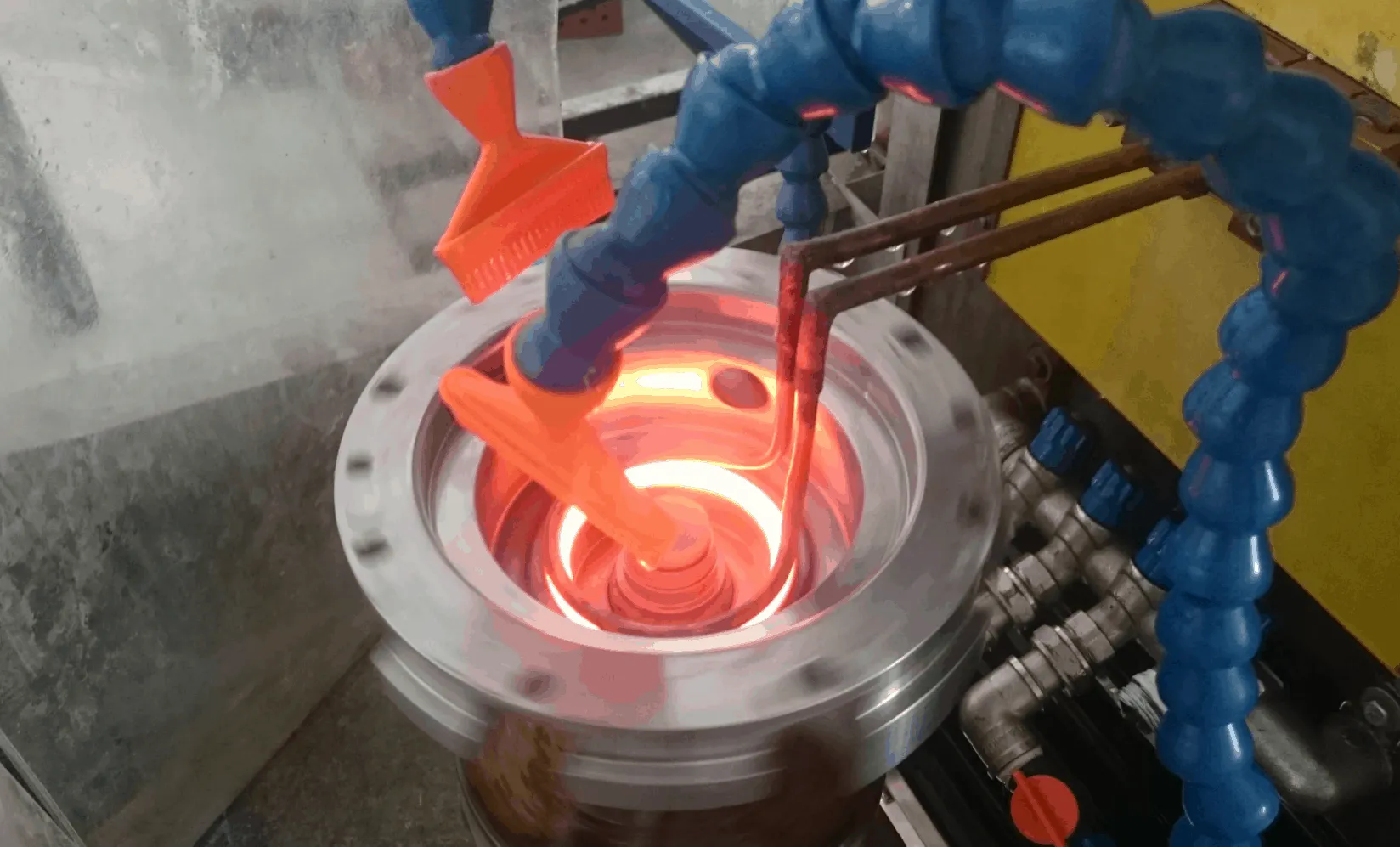
The aerospace industry is known for its stringent requirements in terms of safety, reliability, and performance. To meet these demands, various advanced technologies are employed throughout the manufacturing process. One such technology is induction quenching, which plays a crucial role in enhancing the durability and strength of aerospace components. This article aims to explore the applications of induction quenching in the aerospace industry, highlighting its benefits and significance. 1.1 Definition and Principles Induction quenching is a heat treatment process used to harden the surface of metal components by rapidly heating them using electromagnetic induction and then quenching them in a cooling medium, such as water or oil. The process involves the use of an induction coil that generates a high-frequency alternating current, which creates a magnetic field that induces eddy currents in the workpiece, causing it to heat up. The principles behind induction quenching are based on the concept of selective heating, where only the surface layer of the component is heated while maintaining the core at a lower temperature. This allows for controlled hardening of the surface without affecting the overall properties of the component. 1.2 Process Overview The induction quenching process typically involves several steps: 1) Preheating: The component is preheated to a specific temperature to ensure uniform heating during the quenching process. 2) Heating: The component is placed within an induction coil, and an alternating current is passed through it, generating eddy currents that heat up the surface layer. 3) Quenching: After reaching the desired temperature, the component is rapidly cooled by immersing it in a cooling medium, such as water or oil, to achieve rapid transformation and hardening of the surface layer. 4) Tempering: In some cases, after quenching, the component may undergo tempering to reduce internal stresses and improve toughness. 1.3 Advantages over Conventional Quenching Methods Induction quenching offers several advantages over conventional quenching methods: - Faster heating: Induction heating allows for rapid and localized heating of specific areas, reducing overall processing time compared to conventional methods. - Selective hardening: The ability to control heating patterns enables selective hardening of specific areas while leaving other parts unaffected. - Reduced distortion: Induction quenching minimizes distortion due to localized heating and cooling, resulting in improved dimensional stability. - Improved repeatability: The use of automated systems ensures consistent results from batch to batch. - Energy efficiency: Induction heating consumes less energy compared to other methods due to its localized nature. 2. Importance of Induction Quenching in Aerospace 2.1 Enhancing Component Durability In aerospace applications, where components are subjected to extreme operating conditions such as high temperatures, pressures, and vibrations, durability is crucial for ensuring safe and reliable operation. Induction quenching plays a vital role in enhancing component durability by increasing their resistance to wear, fatigue, and corrosion. By selectively hardening critical areas such as turbine blades or landing gear components using induction quenching techniques, their lifespan can be significantly extended under harsh operating conditions. 2.2 Improving Mechanical Properties Induction quenching also improves mechanical properties such as hardness and strength by transforming the microstructure of metal components through rapid cooling after heating. By carefully controlling the heating parameters during induction quenching processes like tempering or martempering, desired mechanical properties can be achieved for different aerospace applications. 2.3 Ensuring Consistency and Precision Aerospace components require strict adherence to specifications due to their critical nature in ensuring flight safety. Induction quenching provides consistent results with high precision due to its automated nature and ability to control heat distribution accurately. This ensures that each component undergoes uniform heat treatment with minimal variation from batch to batch or part-to-part within a batch. 3. Applications of Induction Quenching in Aerospace 3.1 Engine Components Induction quenching is widely used in the aerospace industry for various engine components due to its ability to provide high strength and wear resistance. 3.1.1 Turbine Blades Turbine blades are subjected to high temperatures and extreme conditions, making them prone to wear and fatigue. Induction quenching can be used to harden the leading edges and airfoil surfaces of turbine blades, improving their resistance to erosion and extending their service life. 3.1.2 Compressor Disks Compressor disks are critical components in jet engines that require high strength and fatigue resistance. Induction quenching can be used to selectively harden the teeth and root areas of compressor disks, ensuring their durability under high rotational speeds and loads. 3.1.3 Shafts and Gears Shafts and gears in aerospace engines also benefit from induction quenching. By selectively hardening the contact surfaces, these components can withstand the high torque, bending, and sliding forces they experience during operation. 3.2 Landing Gear Components Landing gear components are subjected to heavy loads during takeoff, landing, and taxiing operations. Induction quenching is commonly used to enhance the strength and wear resistance of these components. 3.2.1 Axles and Shafts Axles and shafts in landing gear systems can be induction hardened to improve their load-carrying capacity and resistance against fatigue failure. 3.2.2 Wheel Hubs Wheel hubs are critical for supporting the weight of an aircraft during landing operations. Induction quenching can be applied to increase their hardness, reducing wear and extending their lifespan. 3.2.3 Brackets and Mounts Brackets and mounts play a crucial role in securing various landing gear components together. Induction quenching can improve their strength, preventing deformation or failure under heavy loads. 3.3 Structural Components Induction quenching is also utilized for strengthening structural components in aerospace applications. 3.4 Fasteners and Connectors Fasteners such as bolts, screws, rivets, and connectors are essential for joining different parts of an aircraft together securely. Induction quenching can enhance their mechanical properties, ensuring reliable connections under extreme conditions. 4.Techniques Used in Induction Quenching 4 . 1 Single Shot Induction Hardening Single shot induction hardening is a common technique used in aerospace applications where specific areas need to be hardened quickly with minimal distortion or heat affected zone (HAZ). In this technique, a single coil is used to heat the desired area rapidly before it is cooled using a spray or immersion quenching process. 4 . 2 Scanning Induction Hardening Scanning induction hardening involves moving an induction coil over the surface of a component while applying heat locally through electromagnetic induction followed by rapid cooling using a spray or immersion method. This technique allows for precise control over the hardened area while minimizing distortion. 4 . 3 Dual Frequency Induction Hardening Dual frequency induction hardening involves using two different frequencies simultaneously or sequentially during the heating process to achieve desired hardness profiles on complex-shaped components with varying cross-sections or thicknesses. 4 . 4 Surface Hardening Surface hardening techniques involve selectively heating only the surface layer of a component while maintaining its core properties intact through techniques such as flame hardening or laser surface hardening. 5. Advancements in Induction Quenching Technology Induction quenching is a heat treatment process that involves heating a metal component using electromagnetic induction and then rapidly cooling it to increase its hardness and strength. This process has been widely used in various industries, including the aerospace industry, due to its ability to provide precise and controlled heat treatment. In recent years, there have been significant advancements in induction quenching technology that have further improved the efficiency and effectiveness of the process. This section will discuss some of these advancements. 5.1 Simulation Techniques for Process Optimization Simulation techniques have become an essential tool for optimizing induction quenching processes. These techniques involve creating computer models that simulate the heating and cooling behavior of the metal component during the quenching process. By using these simulations, engineers can optimize various parameters such as power density, frequency, and quenching medium to achieve desired hardness profiles and minimize distortion. These simulations also allow for virtual prototyping, which reduces the need for physical prototypes and testing. This not only saves time and cost but also enables engineers to explore different design options before manufacturing. 5.2 Intelligent Control Systems Intelligent control systems have been developed to enhance the precision and repeatability of induction quenching processes. These systems use advanced algorithms and sensors to monitor and control various parameters such as power input, temperature distribution, and cooling rate. By continuously adjusting these parameters in real-time based on feedback from sensors, intelligent control systems can ensure consistent heat treatment results even with variations in material properties or component geometry. This improves process reliability and reduces scrap rates. 5.3 Integration with Robotics The integration of induction quenching technology with robotics has enabled automation of the heat treatment process. Robotic systems can handle complex geometries with high precision, ensuring uniform heating and cooling throughout the component. Robotic integration also allows for increased productivity by reducing cycle times and enabling continuous operation without human intervention. Additionally, it improves worker safety by eliminating manual handling of hot components. 5.4 Non-Destructive Testing Techniques Non-destructive testing (NDT) techniques have been developed to assess the quality of induction-quenched components without causing any damage or alteration to them. These techniques include methods such as ultrasonic testing, eddy current testing, magnetic particle inspection, etc. By using NDT techniques, manufacturers can detect defects such as cracks or voids that may have occurred during the quenching process or due to material properties. This ensures that only components meeting quality standards are used in aerospace applications where reliability is critical. 6.Challenges and Limitations Despite advancements in induction quenching technology, there are still several challenges and limitations that need to be addressed for its widespread adoption in the aerospace industry. 6.1 Material Selection Challenges Different materials require different heat treatment parameters for optimal results. The aerospace industry uses a wide range of materials with varying compositions and properties. Therefore, selecting appropriate heat treatment parameters for each material can be challenging. Engineers need to consider factors such as material composition, microstructure requirements, desired hardness profiles, etc., while designing induction quenching processes for aerospace components. 6.2 Distortion Control Issues Induction quenching processes can induce distortion in metal components due to non-uniform heating or cooling rates. This distortion can result in dimensional inaccuracies, warping, or even cracking of the components. One common cause of distortion in induction quenching is non-uniform heating. Induction heating relies on electromagnetic fields to generate heat in the metal component. However, the distribution of heat within the component may not be uniform, leading to uneven expansion and contraction during the quenching process. This can cause bending or twisting of the component. Another factor that contributes to distortion is non-uniform cooling rates. Quenching involves rapidly cooling the heated metal component to harden it. However, if the cooling rate is not consistent throughout the component, different areas may experience varying levels of contraction, leading to distortion. To mitigate distortion issues, several strategies can be employed. One approach is to optimize the design of the induction coil and its positioning relative to the component. This can help ensure more uniform heating and minimize temperature gradients within the part. Controlling the quenching process is also crucial for reducing distortion. The selection of an appropriate quenchant and its application method can significantly impact cooling rates and minimize distortion. Additionally, using fixtures or jigs during quenching can help constrain movement and prevent warping or bending. Post-quenching processes such as tempering or stress relieving can also be employed to reduce residual stresses that contribute to distortion. These processes involve controlled heating and cooling cycles that help stabilize the metal structure and relieve internal stresses. Induction quenching is a heat treatment process that involves rapidly heating a metal component using electromagnetic induction and then rapidly cooling it to increase its hardness and strength. This process has been widely used in the aerospace industry for many years, and its future prospects look promising due to advancements in material science, integration with additive manufacturing processes, and enhanced process monitoring techniques. 7.Future Prospects of Induction Quenching in Aerospace Industry 7.1 Advancements in Material Science: Material science plays a crucial role in the aerospace industry as it constantly seeks to develop new materials with improved properties. Induction quenching can benefit from these advancements by utilizing new materials that are more resistant to high temperatures and have better mechanical properties. For example, the development of advanced alloys such as nickel-based superalloys or titanium alloys can enhance the performance of components subjected to induction quenching. These materials offer higher strength, better corrosion resistance, and improved fatigue properties, making them ideal for aerospace applications. 7.2 Integration with Additive Manufacturing Processes: Additive manufacturing, also known as 3D printing, has gained significant attention in recent years due to its ability to produce complex geometries with high precision. The integration of induction quenching with additive manufacturing processes opens up new possibilities for the aerospace industry. By selectively heating specific areas of a 3D printed component using induction quenching, it is possible to locally modify the material's microstructure and improve its mechanical properties. This combination allows for the production of lightweight components with tailored properties, reducing weight and increasing fuel efficiency in aircraft. 7.3 Enhanced Process Monitoring Techniques: Process monitoring is essential for ensuring consistent quality and reliability in induction quenching operations. Advancements in sensor technology and data analysis techniques have enabled more accurate monitoring of key parameters during the heat treatment process. Real-time monitoring of temperature gradients, cooling rates, and phase transformations can help optimize the induction quenching process parameters for specific aerospace components. Additionally, advanced non-destructive testing methods such as thermography or acoustic emission can be integrated into the process monitoring system to detect any defects or anomalies that may occur during induction quenching. Conclusion Induction quenching has emerged as a critical technology within the aerospace industry due to its ability to enhance component durability, improve mechanical properties, ensure consistency, and precision during manufacturing processes. As advancements continue to be made in this field, it is expected that induction quenching will play an even more significant role in meeting the evolving demands of the aerospace industry. By leveraging simulation techniques, intelligent control systems, integration with robotics, and non-destructive testing techniques, manufacturers can overcome challenges associated with material selection, distortion control issues, and energy consumption. With future prospects including advancements in material science, integration with additive manufacturing processes, and enhanced process monitoring techniques; induction quenching is poised to revolutionize the aerospace industry by enabling the production of safer, more reliable aircraft components. https://dw-inductionheater.com/induction-quenching-applications-in-the-aerospace-industry.html?feed_id=232051&_unique_id=65a0674fd9b6e
Induction Quenching Applications in the Aerospace Industry

The aerospace industry is known for its stringent requirements in terms of safety, reliability, and performance. To meet these demands, various advanced technologies are employed throughout the manufacturing process. One such technology is induction quenching, which plays a crucial role in enhancing the durability and strength of aerospace components. This article aims to explore the applications of induction quenching in the aerospace industry, highlighting its benefits and significance. 1.1 Definition and Principles Induction quenching is a heat treatment process used to harden the surface of metal components by rapidly heating them using electromagnetic induction and then quenching them in a cooling medium, such as water or oil. The process involves the use of an induction coil that generates a high-frequency alternating current, which creates a magnetic field that induces eddy currents in the workpiece, causing it to heat up. The principles behind induction quenching are based on the concept of selective heating, where only the surface layer of the component is heated while maintaining the core at a lower temperature. This allows for controlled hardening of the surface without affecting the overall properties of the component. 1.2 Process Overview The induction quenching process typically involves several steps: 1) Preheating: The component is preheated to a specific temperature to ensure uniform heating during the quenching process. 2) Heating: The component is placed within an induction coil, and an alternating current is passed through it, generating eddy currents that heat up the surface layer. 3) Quenching: After reaching the desired temperature, the component is rapidly cooled by immersing it in a cooling medium, such as water or oil, to achieve rapid transformation and hardening of the surface layer. 4) Tempering: In some cases, after quenching, the component may undergo tempering to reduce internal stresses and improve toughness. 1.3 Advantages over Conventional Quenching Methods Induction quenching offers several advantages over conventional quenching methods: - Faster heating: Induction heating allows for rapid and localized heating of specific areas, reducing overall processing time compared to conventional methods. - Selective hardening: The ability to control heating patterns enables selective hardening of specific areas while leaving other parts unaffected. - Reduced distortion: Induction quenching minimizes distortion due to localized heating and cooling, resulting in improved dimensional stability. - Improved repeatability: The use of automated systems ensures consistent results from batch to batch. - Energy efficiency: Induction heating consumes less energy compared to other methods due to its localized nature. 2. Importance of Induction Quenching in Aerospace 2.1 Enhancing Component Durability In aerospace applications, where components are subjected to extreme operating conditions such as high temperatures, pressures, and vibrations, durability is crucial for ensuring safe and reliable operation. Induction quenching plays a vital role in enhancing component durability by increasing their resistance to wear, fatigue, and corrosion. By selectively hardening critical areas such as turbine blades or landing gear components using induction quenching techniques, their lifespan can be significantly extended under harsh operating conditions. 2.2 Improving Mechanical Properties Induction quenching also improves mechanical properties such as hardness and strength by transforming the microstructure of metal components through rapid cooling after heating. By carefully controlling the heating parameters during induction quenching processes like tempering or martempering, desired mechanical properties can be achieved for different aerospace applications. 2.3 Ensuring Consistency and Precision Aerospace components require strict adherence to specifications due to their critical nature in ensuring flight safety. Induction quenching provides consistent results with high precision due to its automated nature and ability to control heat distribution accurately. This ensures that each component undergoes uniform heat treatment with minimal variation from batch to batch or part-to-part within a batch. 3. Applications of Induction Quenching in Aerospace 3.1 Engine Components Induction quenching is widely used in the aerospace industry for various engine components due to its ability to provide high strength and wear resistance. 3.1.1 Turbine Blades Turbine blades are subjected to high temperatures and extreme conditions, making them prone to wear and fatigue. Induction quenching can be used to harden the leading edges and airfoil surfaces of turbine blades, improving their resistance to erosion and extending their service life. 3.1.2 Compressor Disks Compressor disks are critical components in jet engines that require high strength and fatigue resistance. Induction quenching can be used to selectively harden the teeth and root areas of compressor disks, ensuring their durability under high rotational speeds and loads. 3.1.3 Shafts and Gears Shafts and gears in aerospace engines also benefit from induction quenching. By selectively hardening the contact surfaces, these components can withstand the high torque, bending, and sliding forces they experience during operation. 3.2 Landing Gear Components Landing gear components are subjected to heavy loads during takeoff, landing, and taxiing operations. Induction quenching is commonly used to enhance the strength and wear resistance of these components. 3.2.1 Axles and Shafts Axles and shafts in landing gear systems can be induction hardened to improve their load-carrying capacity and resistance against fatigue failure. 3.2.2 Wheel Hubs Wheel hubs are critical for supporting the weight of an aircraft during landing operations. Induction quenching can be applied to increase their hardness, reducing wear and extending their lifespan. 3.2.3 Brackets and Mounts Brackets and mounts play a crucial role in securing various landing gear components together. Induction quenching can improve their strength, preventing deformation or failure under heavy loads. 3.3 Structural Components Induction quenching is also utilized for strengthening structural components in aerospace applications. 3.4 Fasteners and Connectors Fasteners such as bolts, screws, rivets, and connectors are essential for joining different parts of an aircraft together securely. Induction quenching can enhance their mechanical properties, ensuring reliable connections under extreme conditions. 4.Techniques Used in Induction Quenching 4 . 1 Single Shot Induction Hardening Single shot induction hardening is a common technique used in aerospace applications where specific areas need to be hardened quickly with minimal distortion or heat affected zone (HAZ). In this technique, a single coil is used to heat the desired area rapidly before it is cooled using a spray or immersion quenching process. 4 . 2 Scanning Induction Hardening Scanning induction hardening involves moving an induction coil over the surface of a component while applying heat locally through electromagnetic induction followed by rapid cooling using a spray or immersion method. This technique allows for precise control over the hardened area while minimizing distortion. 4 . 3 Dual Frequency Induction Hardening Dual frequency induction hardening involves using two different frequencies simultaneously or sequentially during the heating process to achieve desired hardness profiles on complex-shaped components with varying cross-sections or thicknesses. 4 . 4 Surface Hardening Surface hardening techniques involve selectively heating only the surface layer of a component while maintaining its core properties intact through techniques such as flame hardening or laser surface hardening. 5. Advancements in Induction Quenching Technology Induction quenching is a heat treatment process that involves heating a metal component using electromagnetic induction and then rapidly cooling it to increase its hardness and strength. This process has been widely used in various industries, including the aerospace industry, due to its ability to provide precise and controlled heat treatment. In recent years, there have been significant advancements in induction quenching technology that have further improved the efficiency and effectiveness of the process. This section will discuss some of these advancements. 5.1 Simulation Techniques for Process Optimization Simulation techniques have become an essential tool for optimizing induction quenching processes. These techniques involve creating computer models that simulate the heating and cooling behavior of the metal component during the quenching process. By using these simulations, engineers can optimize various parameters such as power density, frequency, and quenching medium to achieve desired hardness profiles and minimize distortion. These simulations also allow for virtual prototyping, which reduces the need for physical prototypes and testing. This not only saves time and cost but also enables engineers to explore different design options before manufacturing. 5.2 Intelligent Control Systems Intelligent control systems have been developed to enhance the precision and repeatability of induction quenching processes. These systems use advanced algorithms and sensors to monitor and control various parameters such as power input, temperature distribution, and cooling rate. By continuously adjusting these parameters in real-time based on feedback from sensors, intelligent control systems can ensure consistent heat treatment results even with variations in material properties or component geometry. This improves process reliability and reduces scrap rates. 5.3 Integration with Robotics The integration of induction quenching technology with robotics has enabled automation of the heat treatment process. Robotic systems can handle complex geometries with high precision, ensuring uniform heating and cooling throughout the component. Robotic integration also allows for increased productivity by reducing cycle times and enabling continuous operation without human intervention. Additionally, it improves worker safety by eliminating manual handling of hot components. 5.4 Non-Destructive Testing Techniques Non-destructive testing (NDT) techniques have been developed to assess the quality of induction-quenched components without causing any damage or alteration to them. These techniques include methods such as ultrasonic testing, eddy current testing, magnetic particle inspection, etc. By using NDT techniques, manufacturers can detect defects such as cracks or voids that may have occurred during the quenching process or due to material properties. This ensures that only components meeting quality standards are used in aerospace applications where reliability is critical. 6.Challenges and Limitations Despite advancements in induction quenching technology, there are still several challenges and limitations that need to be addressed for its widespread adoption in the aerospace industry. 6.1 Material Selection Challenges Different materials require different heat treatment parameters for optimal results. The aerospace industry uses a wide range of materials with varying compositions and properties. Therefore, selecting appropriate heat treatment parameters for each material can be challenging. Engineers need to consider factors such as material composition, microstructure requirements, desired hardness profiles, etc., while designing induction quenching processes for aerospace components. 6.2 Distortion Control Issues Induction quenching processes can induce distortion in metal components due to non-uniform heating or cooling rates. This distortion can result in dimensional inaccuracies, warping, or even cracking of the components. One common cause of distortion in induction quenching is non-uniform heating. Induction heating relies on electromagnetic fields to generate heat in the metal component. However, the distribution of heat within the component may not be uniform, leading to uneven expansion and contraction during the quenching process. This can cause bending or twisting of the component. Another factor that contributes to distortion is non-uniform cooling rates. Quenching involves rapidly cooling the heated metal component to harden it. However, if the cooling rate is not consistent throughout the component, different areas may experience varying levels of contraction, leading to distortion. To mitigate distortion issues, several strategies can be employed. One approach is to optimize the design of the induction coil and its positioning relative to the component. This can help ensure more uniform heating and minimize temperature gradients within the part. Controlling the quenching process is also crucial for reducing distortion. The selection of an appropriate quenchant and its application method can significantly impact cooling rates and minimize distortion. Additionally, using fixtures or jigs during quenching can help constrain movement and prevent warping or bending. Post-quenching processes such as tempering or stress relieving can also be employed to reduce residual stresses that contribute to distortion. These processes involve controlled heating and cooling cycles that help stabilize the metal structure and relieve internal stresses. Induction quenching is a heat treatment process that involves rapidly heating a metal component using electromagnetic induction and then rapidly cooling it to increase its hardness and strength. This process has been widely used in the aerospace industry for many years, and its future prospects look promising due to advancements in material science, integration with additive manufacturing processes, and enhanced process monitoring techniques. 7.Future Prospects of Induction Quenching in Aerospace Industry 7.1 Advancements in Material Science: Material science plays a crucial role in the aerospace industry as it constantly seeks to develop new materials with improved properties. Induction quenching can benefit from these advancements by utilizing new materials that are more resistant to high temperatures and have better mechanical properties. For example, the development of advanced alloys such as nickel-based superalloys or titanium alloys can enhance the performance of components subjected to induction quenching. These materials offer higher strength, better corrosion resistance, and improved fatigue properties, making them ideal for aerospace applications. 7.2 Integration with Additive Manufacturing Processes: Additive manufacturing, also known as 3D printing, has gained significant attention in recent years due to its ability to produce complex geometries with high precision. The integration of induction quenching with additive manufacturing processes opens up new possibilities for the aerospace industry. By selectively heating specific areas of a 3D printed component using induction quenching, it is possible to locally modify the material's microstructure and improve its mechanical properties. This combination allows for the production of lightweight components with tailored properties, reducing weight and increasing fuel efficiency in aircraft. 7.3 Enhanced Process Monitoring Techniques: Process monitoring is essential for ensuring consistent quality and reliability in induction quenching operations. Advancements in sensor technology and data analysis techniques have enabled more accurate monitoring of key parameters during the heat treatment process. Real-time monitoring of temperature gradients, cooling rates, and phase transformations can help optimize the induction quenching process parameters for specific aerospace components. Additionally, advanced non-destructive testing methods such as thermography or acoustic emission can be integrated into the process monitoring system to detect any defects or anomalies that may occur during induction quenching. Conclusion Induction quenching has emerged as a critical technology within the aerospace industry due to its ability to enhance component durability, improve mechanical properties, ensure consistency, and precision during manufacturing processes. As advancements continue to be made in this field, it is expected that induction quenching will play an even more significant role in meeting the evolving demands of the aerospace industry. By leveraging simulation techniques, intelligent control systems, integration with robotics, and non-destructive testing techniques, manufacturers can overcome challenges associated with material selection, distortion control issues, and energy consumption. With future prospects including advancements in material science, integration with additive manufacturing processes, and enhanced process monitoring techniques; induction quenching is poised to revolutionize the aerospace industry by enabling the production of safer, more reliable aircraft components. https://dw-inductionheater.com/induction-quenching-applications-in-the-aerospace-industry.html?feed_id=231987&_unique_id=659fa814e166d

2024年1月1日星期一

Induction Stress Relieving: A Comprehensive Guide

Induction Stress Relieving: A Comprehensive Guide

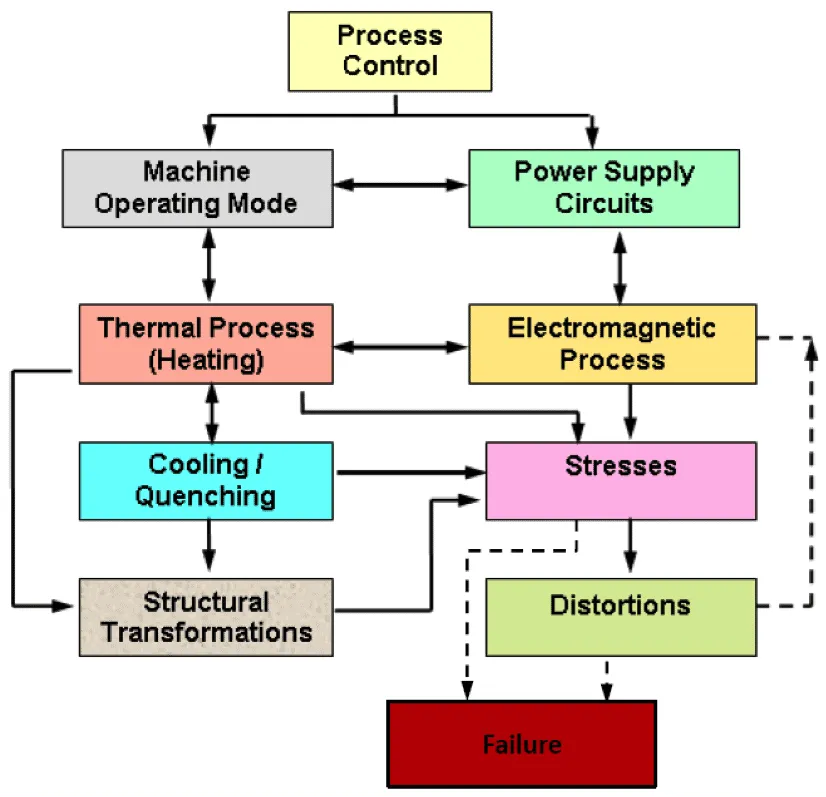
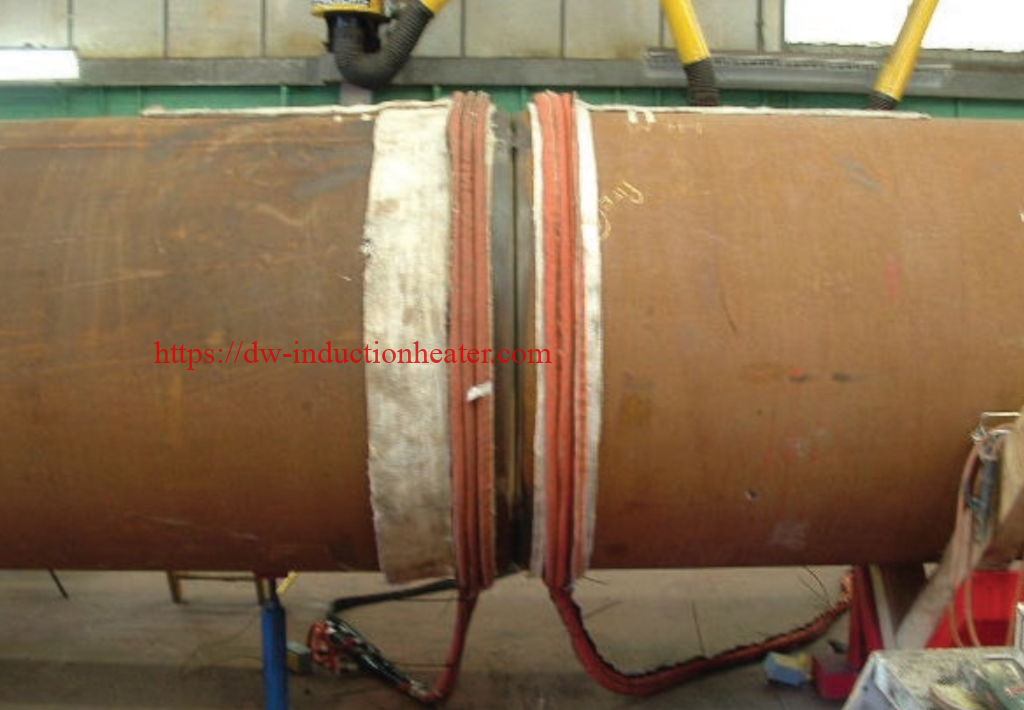
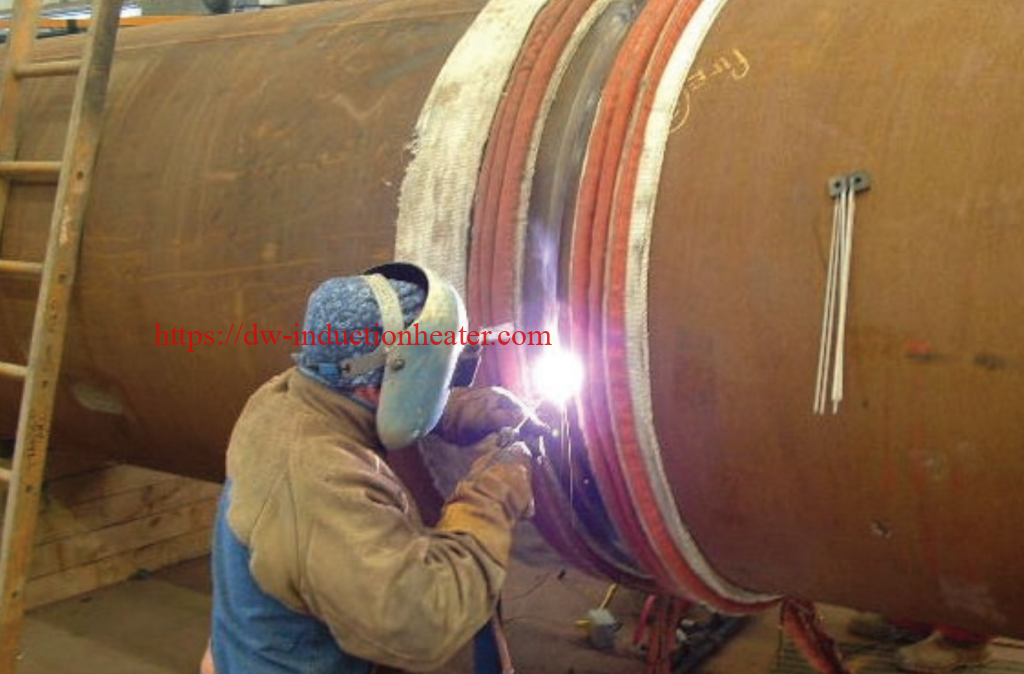
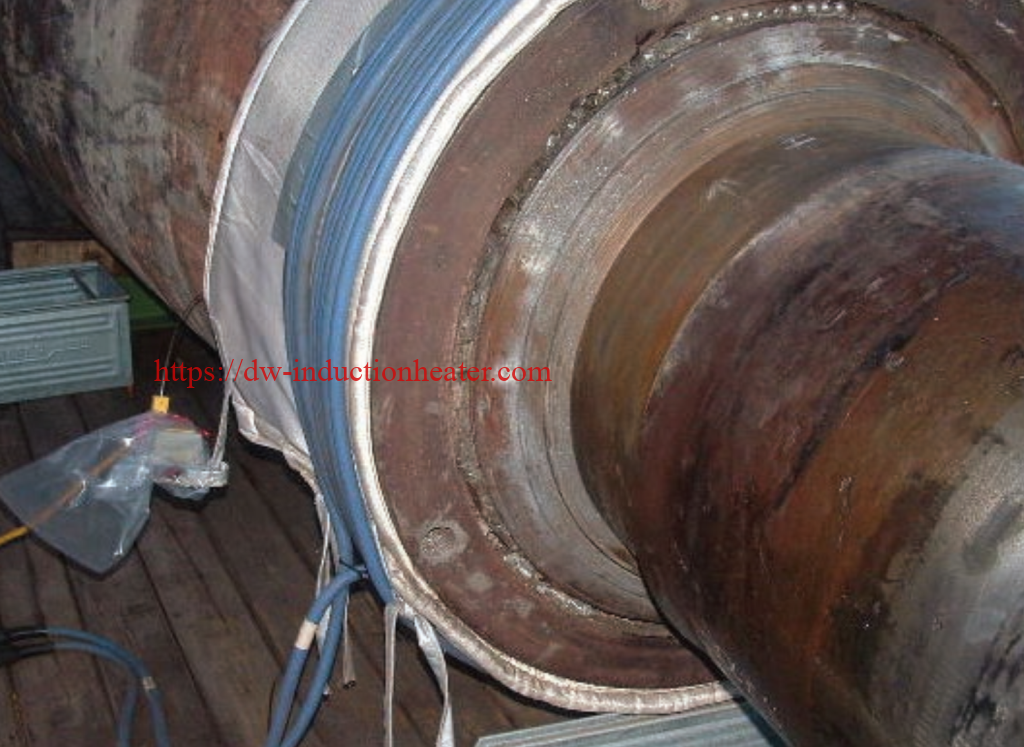
Induction stress relieving is a highly effective method for reducing residual stresses in metal components, resulting in improved durability and performance. This process uses electromagnetic induction to heat the material, allowing for controlled and uniform stress relief without the risk of distortion or damage. With its ability to enhance the mechanical properties of metal parts, induction stress relieving is a crucial step in the manufacturing and maintenance of critical components across various industries.induction stress relieving In today's fast-paced and demanding work environment, stress is a common occurrence for many individuals. Whether it's due to work-related pressures, personal issues, or a combination of both, stress can have a significant impact on an individual's overall well-being and productivity. As a result, finding effective ways to manage and alleviate stress has become increasingly important. One method that has gained popularity in recent years is induction stress relieving. This technique uses electromagnetic induction to heat metal components to a specific temperature and then slowly cool them down, resulting in the reduction of internal stresses within the material. In this comprehensive guide, we will explore the principles behind induction stress relieving, its applications in various industries, and the benefits it offers for individuals and organizations. Principles of Induction Stress Relieving Induction stress relieving is based on the principle of thermal expansion and contraction. When metal components are heated to a specific temperature, their molecules become more mobile, allowing internal stresses to be redistributed and reduced. As the components are slowly cooled down, the molecules return to their original positions in a more relaxed state, resulting in reduced internal stresses. The process of induction stress relieving involves using an induction heating system to generate an alternating magnetic field around the metal components. This magnetic field induces eddy currents within the material, causing it to heat up rapidly. By controlling the frequency and power of the induction heating system, precise temperatures can be achieved to effectively relieve internal stresses within the metal components. Applications of Induction Stress Relieving Induction stress relieving has found widespread applications across various industries due to its effectiveness in reducing internal stresses within metal components. Some common applications include: - Welded assemblies: Welding processes often introduce significant internal stresses within metal components due to rapid heating and cooling cycles. Induction stress relieving can be used to alleviate these stresses and improve the overall integrity of welded assemblies.induction stress relieving process - Machined parts: Metal parts that undergo machining processes such as milling or turning can develop residual stresses that affect their dimensional stability and performance. Induction stress relieving can help mitigate these issues and improve the quality of machined parts. - Castings: Casting processes can result in uneven cooling rates within metal castings, leading to internal stresses that affect their mechanical properties. Induction stress relieving can help homogenize these stresses and improve the overall quality of castings. - Heat-treated components: Heat treatment processes such as quenching or tempering can introduce residual stresses within metal components. Induction stress relieving can be used as a post-treatment step to reduce these residual stresses and improve the overall stability of heat-treated components. Benefits of Induction Stress Relieving The use of induction stress relieving offers several key benefits for individuals and organizations: - Improved mechanical properties: By reducing internal stresses within metal components, induction stress relieving can improve their mechanical properties such as strength, ductility, and fatigue resistance. - Enhanced dimensional stability: Internal stresses within metal components can lead to dimensional instability over time. Induction stress relieving helps mitigate these issues by promoting dimensional stability and reducing distortion. - Increased product reliability: Components that undergo induction stress relieving are less prone to premature failure due to reduced internal stresses, resulting in increased product reliability and longevity. - Improved performance: Induction stress relieving can help improve the performance of components by reducing internal stresses, which can lead to better dimensional stability and overall performance. - Cost savings: By reducing the likelihood of premature failure and the need for frequent repairs or replacements, induction stress relieving can result in cost savings for manufacturers and end users. - Enhanced safety: Components that undergo induction stress relieving are less likely to fail unexpectedly, which can enhance overall safety in various applications. - Better quality control: Induction stress relieving can help manufacturers maintain better quality control by ensuring that components are free from excessive internal stresses that could compromise their performance or reliability. Mastering Induction Stress Relieving for Improved Product Performance Induction stress relieving is a crucial process in the manufacturing industry that can significantly improve the performance of products. By subjecting metal components to controlled heating and cooling cycles, induction stress relieving helps to reduce internal stresses and improve the overall stability and durability of the product. To master induction stress relieving for improved product performance, it is essential to understand the principles behind the process and how it can benefit different types of materials and components. Here are some key steps to consider: 1. Understand the Material Properties: Different materials have unique properties that influence how they respond to stress relieving processes. It's important to have a thorough understanding of the material being used and how it will react to induction heating. 2. Determine Optimal Parameters: The success of induction stress relieving depends on using the right combination of temperature, time, and cooling rates. It's crucial to determine the optimal parameters for each specific application to achieve the desired results. 3. Use Advanced Induction Heating Equipment: Investing in high-quality induction heating equipment is essential for achieving precise control over the stress relieving process. Advanced technology allows for accurate temperature monitoring and uniform heating, resulting in consistent and reliable outcomes. 4. Implement Quality Control Measures: To ensure that induction stress relieving is effectively reducing internal stresses, it's important to implement quality control measures such as non-destructive testing and inspection techniques. 5. Continuously Improve Processes: Mastering induction stress relieving requires a commitment to continuous improvement. By analyzing data, gathering feedback, and making adjustments as needed, manufacturers can refine their processes for optimal results. By mastering induction stress relieving techniques, manufacturers can enhance product performance by reducing distortion, improving dimensional stability, and increasing resistance to fatigue and corrosion. This ultimately leads to higher-quality products with improved reliability and longevity in service. In conclusion, mastering induction stress relieving is essential for achieving improved product performance in manufacturing. By understanding material properties, determining optimal parameters, using advanced equipment, implementing quality control measures, and continuously improving processes, manufacturers can harness the full potential of this critical heat treatment technique. https://dw-inductionheater.com/induction-stress-relieving-a-comprehensive-guide.html?feed_id=231346&_unique_id=65937eedec02d

2023年11月30日星期四

Induction Stress Relieving: A Comprehensive Guide

Induction Stress Relieving: A Comprehensive Guide

Induction stress relieving is a highly effective method for reducing residual stresses in metal components, resulting in improved durability and performance. This process uses electromagnetic induction to heat the material, allowing for controlled and uniform stress relief without the risk of distortion or damage. With its ability to enhance the mechanical properties of metal parts, induction stress relieving is a crucial step in the manufacturing and maintenance of critical components across various industries.induction stress relieving In today's fast-paced and demanding work environment, stress is a common occurrence for many individuals. Whether it's due to work-related pressures, personal issues, or a combination of both, stress can have a significant impact on an individual's overall well-being and productivity. As a result, finding effective ways to manage and alleviate stress has become increasingly important. One method that has gained popularity in recent years is induction stress relieving. This technique uses electromagnetic induction to heat metal components to a specific temperature and then slowly cool them down, resulting in the reduction of internal stresses within the material. In this comprehensive guide, we will explore the principles behind induction stress relieving, its applications in various industries, and the benefits it offers for individuals and organizations. Principles of Induction Stress Relieving Induction stress relieving is based on the principle of thermal expansion and contraction. When metal components are heated to a specific temperature, their molecules become more mobile, allowing internal stresses to be redistributed and reduced. As the components are slowly cooled down, the molecules return to their original positions in a more relaxed state, resulting in reduced internal stresses. The process of induction stress relieving involves using an induction heating system to generate an alternating magnetic field around the metal components. This magnetic field induces eddy currents within the material, causing it to heat up rapidly. By controlling the frequency and power of the induction heating system, precise temperatures can be achieved to effectively relieve internal stresses within the metal components. Applications of Induction Stress Relieving Induction stress relieving has found widespread applications across various industries due to its effectiveness in reducing internal stresses within metal components. Some common applications include: - Welded assemblies: Welding processes often introduce significant internal stresses within metal components due to rapid heating and cooling cycles. Induction stress relieving can be used to alleviate these stresses and improve the overall integrity of welded assemblies.induction stress relieving process - Machined parts: Metal parts that undergo machining processes such as milling or turning can develop residual stresses that affect their dimensional stability and performance. Induction stress relieving can help mitigate these issues and improve the quality of machined parts. - Castings: Casting processes can result in uneven cooling rates within metal castings, leading to internal stresses that affect their mechanical properties. Induction stress relieving can help homogenize these stresses and improve the overall quality of castings. - Heat-treated components: Heat treatment processes such as quenching or tempering can introduce residual stresses within metal components. Induction stress relieving can be used as a post-treatment step to reduce these residual stresses and improve the overall stability of heat-treated components. Benefits of Induction Stress Relieving The use of induction stress relieving offers several key benefits for individuals and organizations: - Improved mechanical properties: By reducing internal stresses within metal components, induction stress relieving can improve their mechanical properties such as strength, ductility, and fatigue resistance. - Enhanced dimensional stability: Internal stresses within metal components can lead to dimensional instability over time. Induction stress relieving helps mitigate these issues by promoting dimensional stability and reducing distortion. - Increased product reliability: Components that undergo induction stress relieving are less prone to premature failure due to reduced internal stresses, resulting in increased product reliability and longevity. - Improved performance: Induction stress relieving can help improve the performance of components by reducing internal stresses, which can lead to better dimensional stability and overall performance. - Cost savings: By reducing the likelihood of premature failure and the need for frequent repairs or replacements, induction stress relieving can result in cost savings for manufacturers and end users. - Enhanced safety: Components that undergo induction stress relieving are less likely to fail unexpectedly, which can enhance overall safety in various applications. - Better quality control: Induction stress relieving can help manufacturers maintain better quality control by ensuring that components are free from excessive internal stresses that could compromise their performance or reliability. Mastering Induction Stress Relieving for Improved Product Performance Induction stress relieving is a crucial process in the manufacturing industry that can significantly improve the performance of products. By subjecting metal components to controlled heating and cooling cycles, induction stress relieving helps to reduce internal stresses and improve the overall stability and durability of the product. To master induction stress relieving for improved product performance, it is essential to understand the principles behind the process and how it can benefit different types of materials and components. Here are some key steps to consider: 1. Understand the Material Properties: Different materials have unique properties that influence how they respond to stress relieving processes. It's important to have a thorough understanding of the material being used and how it will react to induction heating. 2. Determine Optimal Parameters: The success of induction stress relieving depends on using the right combination of temperature, time, and cooling rates. It's crucial to determine the optimal parameters for each specific application to achieve the desired results. 3. Use Advanced Induction Heating Equipment: Investing in high-quality induction heating equipment is essential for achieving precise control over the stress relieving process. Advanced technology allows for accurate temperature monitoring and uniform heating, resulting in consistent and reliable outcomes. 4. Implement Quality Control Measures: To ensure that induction stress relieving is effectively reducing internal stresses, it's important to implement quality control measures such as non-destructive testing and inspection techniques. 5. Continuously Improve Processes: Mastering induction stress relieving requires a commitment to continuous improvement. By analyzing data, gathering feedback, and making adjustments as needed, manufacturers can refine their processes for optimal results. By mastering induction stress relieving techniques, manufacturers can enhance product performance by reducing distortion, improving dimensional stability, and increasing resistance to fatigue and corrosion. This ultimately leads to higher-quality products with improved reliability and longevity in service. In conclusion, mastering induction stress relieving is essential for achieving improved product performance in manufacturing. By understanding material properties, determining optimal parameters, using advanced equipment, implementing quality control measures, and continuously improving processes, manufacturers can harness the full potential of this critical heat treatment technique. https://dw-inductionheater.com/induction-stress-relieving-a-comprehensive-guide.html?feed_id=231149&_unique_id=65693e882da81

Induction Stress Relieving: A Comprehensive Guide

Induction Stress Relieving: A Comprehensive Guide

Induction stress relieving is a highly effective method for reducing residual stresses in metal components, resulting in improved durability and performance. This process uses electromagnetic induction to heat the material, allowing for controlled and uniform stress relief without the risk of distortion or damage. With its ability to enhance the mechanical properties of metal parts, induction stress relieving is a crucial step in the manufacturing and maintenance of critical components across various industries.induction stress relieving In today's fast-paced and demanding work environment, stress is a common occurrence for many individuals. Whether it's due to work-related pressures, personal issues, or a combination of both, stress can have a significant impact on an individual's overall well-being and productivity. As a result, finding effective ways to manage and alleviate stress has become increasingly important. One method that has gained popularity in recent years is induction stress relieving. This technique uses electromagnetic induction to heat metal components to a specific temperature and then slowly cool them down, resulting in the reduction of internal stresses within the material. In this comprehensive guide, we will explore the principles behind induction stress relieving, its applications in various industries, and the benefits it offers for individuals and organizations. Principles of Induction Stress Relieving Induction stress relieving is based on the principle of thermal expansion and contraction. When metal components are heated to a specific temperature, their molecules become more mobile, allowing internal stresses to be redistributed and reduced. As the components are slowly cooled down, the molecules return to their original positions in a more relaxed state, resulting in reduced internal stresses. The process of induction stress relieving involves using an induction heating system to generate an alternating magnetic field around the metal components. This magnetic field induces eddy currents within the material, causing it to heat up rapidly. By controlling the frequency and power of the induction heating system, precise temperatures can be achieved to effectively relieve internal stresses within the metal components. Applications of Induction Stress Relieving Induction stress relieving has found widespread applications across various industries due to its effectiveness in reducing internal stresses within metal components. Some common applications include: - Welded assemblies: Welding processes often introduce significant internal stresses within metal components due to rapid heating and cooling cycles. Induction stress relieving can be used to alleviate these stresses and improve the overall integrity of welded assemblies.induction stress relieving process - Machined parts: Metal parts that undergo machining processes such as milling or turning can develop residual stresses that affect their dimensional stability and performance. Induction stress relieving can help mitigate these issues and improve the quality of machined parts. - Castings: Casting processes can result in uneven cooling rates within metal castings, leading to internal stresses that affect their mechanical properties. Induction stress relieving can help homogenize these stresses and improve the overall quality of castings. - Heat-treated components: Heat treatment processes such as quenching or tempering can introduce residual stresses within metal components. Induction stress relieving can be used as a post-treatment step to reduce these residual stresses and improve the overall stability of heat-treated components. Benefits of Induction Stress Relieving The use of induction stress relieving offers several key benefits for individuals and organizations: - Improved mechanical properties: By reducing internal stresses within metal components, induction stress relieving can improve their mechanical properties such as strength, ductility, and fatigue resistance. - Enhanced dimensional stability: Internal stresses within metal components can lead to dimensional instability over time. Induction stress relieving helps mitigate these issues by promoting dimensional stability and reducing distortion. - Increased product reliability: Components that undergo induction stress relieving are less prone to premature failure due to reduced internal stresses, resulting in increased product reliability and longevity. - Improved performance: Induction stress relieving can help improve the performance of components by reducing internal stresses, which can lead to better dimensional stability and overall performance. - Cost savings: By reducing the likelihood of premature failure and the need for frequent repairs or replacements, induction stress relieving can result in cost savings for manufacturers and end users. - Enhanced safety: Components that undergo induction stress relieving are less likely to fail unexpectedly, which can enhance overall safety in various applications. - Better quality control: Induction stress relieving can help manufacturers maintain better quality control by ensuring that components are free from excessive internal stresses that could compromise their performance or reliability. Mastering Induction Stress Relieving for Improved Product Performance Induction stress relieving is a crucial process in the manufacturing industry that can significantly improve the performance of products. By subjecting metal components to controlled heating and cooling cycles, induction stress relieving helps to reduce internal stresses and improve the overall stability and durability of the product. To master induction stress relieving for improved product performance, it is essential to understand the principles behind the process and how it can benefit different types of materials and components. Here are some key steps to consider: 1. Understand the Material Properties: Different materials have unique properties that influence how they respond to stress relieving processes. It's important to have a thorough understanding of the material being used and how it will react to induction heating. 2. Determine Optimal Parameters: The success of induction stress relieving depends on using the right combination of temperature, time, and cooling rates. It's crucial to determine the optimal parameters for each specific application to achieve the desired results. 3. Use Advanced Induction Heating Equipment: Investing in high-quality induction heating equipment is essential for achieving precise control over the stress relieving process. Advanced technology allows for accurate temperature monitoring and uniform heating, resulting in consistent and reliable outcomes. 4. Implement Quality Control Measures: To ensure that induction stress relieving is effectively reducing internal stresses, it's important to implement quality control measures such as non-destructive testing and inspection techniques. 5. Continuously Improve Processes: Mastering induction stress relieving requires a commitment to continuous improvement. By analyzing data, gathering feedback, and making adjustments as needed, manufacturers can refine their processes for optimal results. By mastering induction stress relieving techniques, manufacturers can enhance product performance by reducing distortion, improving dimensional stability, and increasing resistance to fatigue and corrosion. This ultimately leads to higher-quality products with improved reliability and longevity in service. In conclusion, mastering induction stress relieving is essential for achieving improved product performance in manufacturing. By understanding material properties, determining optimal parameters, using advanced equipment, implementing quality control measures, and continuously improving processes, manufacturers can harness the full potential of this critical heat treatment technique. https://dw-inductionheater.com/induction-stress-relieving-a-comprehensive-guide.html?feed_id=231114&_unique_id=656884774387c

2023年6月27日星期二

Induction Heat Treating Surface Process

What is induction heat treating surface process?

Induction heating is a heat treating process that allows very targeted heating of metals by electromagnetic induction. The process relies on induced electrical currents within the material to produce heat and is the preferred method used to bond, harden or soften metals or other conductive materials. In modern manufacturing processes, this form of heat treatment offers a beneficial combination of speed, consistency and control. Although the basic principles are well known, modern advances in solid state technology have made the process remarkably simple, cost-effective heating method for applications which involve joining, treating, heating and materials testing. Induction heat treating, through the highly controllable use of an electrically heated coil, will allow you to select the best physical characteristics for not only each metal part—but for each section on that metal part. Induction hardening can impart superior durability to bearing journals and shaft sections without sacrificing the ductility necessary to handle shock loads and vibration. You can harden internal bearing surfaces and valve seats in intricate parts without creating distortion problems. This means that you are able to harden or anneal specific areas for durability and ductility in ways that will best serve your needs.

Benefits of Induction Heat Treating Services

  • Focused Heat Treat Surface hardening retains original ductility of core while hardening a high wear area of the part. The hardened area is accurately controlled in respect to case depth, width, location and hardness.
  • Optimized Consistency Eliminate the inconsistencies and quality issues associated with open flame, torch heating and other methods. Once the system is properly calibrated and set up, there is no guess work or variation; the heating pattern is repeatable and consistent. With modern solid state systems, precise temperature control provides uniform results.
  • Maximized Productivity Production rates can be maximized because heat is developed directly and instantly (>2000º F. in < 1 second) inside the part. Startup is virtually instantaneous; no warm up or cool down cycle is required.
  • Improved Product Quality Parts never come into direct contact with a flame or other heating element; the heat is induced within the part itself by alternating electrical current. As a result, product warpage, distortion and reject rates are minimized.
  • Reduced Energy Consumption Tired of increasing utility bills? This uniquely energy-efficient process converts up to 90% of the energy expended energy into useful heat; batch furnaces are generally only 45% energy-efficient. No warm-up or cool-down cycles are required so stand-by heat losses are reduced to a bare minimum.
  • Environmentally Sound The burning of traditional fossil fuels is unnecessary, resulting in a clean, non-polluting process which will help protect the environment.

What is Induction Heating?

Induction Heating is a Contactless Heating Method of bodies, which absorb energy from an Alternating Magnetic Field, generated by Induction Coil (Inductor). There are two mechanisms of energy absorption:
  • generation of close-loop (eddy) currents inside the body which cause heating due to electrical resistance of the body material
  • hysteresis heating (for magnetic materials ONLY!) due to a friction of magnetic micro volumes (domains), which rotate following orientation of external magnetic field

Principle of Induction Heating

Chain of phenomena:
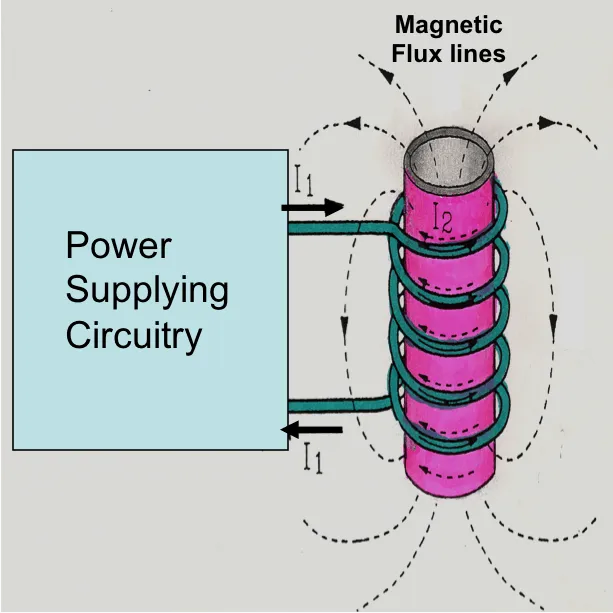
  • Induction heating power supply delivers current (I1) to induction coil
  • Coil currents (ampere-turns) generate magnetic field. Lines of field are always closed (law of nature!) and each line goes around the current source – coil turns and workpiece
  • Alternating magnetic field flowing through the part cross-section (coupled to the part) induces voltage in the part
  • Induced voltage creates eddy currents (I2) in the part flowing in direction opposite to the coil current where possible
  • Eddy currents generate heat in the part

Power Flow in Induction Heating Installations

Alternating current changes direction twice during each frequency cycle. If frequency is 1kHz, current changes direction 2000 times in a second. A product of current and voltage gives the value of instantaneous power (p = i x u), which oscillates between the power supply and the coil. We can say that power is being partially absorbed (Active Power) and partially reflected (Reactive Power) by the coil. Capacitor battery is used to unload the generator from the reactive power. Capacitors receive reactive power from the coil and send it back to the coil supporting oscillations. A circuit “coil-transformer-capacitors” is called Resonant or Tank Circuit. https://dw-inductionheater.com/induction-heat-treating-surface-process.html?feed_id=216361&_unique_id=649ade1c4a5f8

2023年4月2日星期日

Induction Heat Treating Surface Process

What is induction heat treating surface process?

Induction heating is a heat treating process that allows very targeted heating of metals by electromagnetic induction. The process relies on induced electrical currents within the material to produce heat and is the preferred method used to bond, harden or soften metals or other conductive materials. In modern manufacturing processes, this form of heat treatment offers a beneficial combination of speed, consistency and control. Although the basic principles are well known, modern advances in solid state technology have made the process remarkably simple, cost-effective heating method for applications which involve joining, treating, heating and materials testing. Induction heat treating, through the highly controllable use of an electrically heated coil, will allow you to select the best physical characteristics for not only each metal part—but for each section on that metal part. Induction hardening can impart superior durability to bearing journals and shaft sections without sacrificing the ductility necessary to handle shock loads and vibration. You can harden internal bearing surfaces and valve seats in intricate parts without creating distortion problems. This means that you are able to harden or anneal specific areas for durability and ductility in ways that will best serve your needs.

Benefits of Induction Heat Treating Services

  • Focused Heat Treat Surface hardening retains original ductility of core while hardening a high wear area of the part. The hardened area is accurately controlled in respect to case depth, width, location and hardness.
  • Optimized Consistency Eliminate the inconsistencies and quality issues associated with open flame, torch heating and other methods. Once the system is properly calibrated and set up, there is no guess work or variation; the heating pattern is repeatable and consistent. With modern solid state systems, precise temperature control provides uniform results.
  • Maximized Productivity Production rates can be maximized because heat is developed directly and instantly (>2000º F. in < 1 second) inside the part. Startup is virtually instantaneous; no warm up or cool down cycle is required.
  • Improved Product Quality Parts never come into direct contact with a flame or other heating element; the heat is induced within the part itself by alternating electrical current. As a result, product warpage, distortion and reject rates are minimized.
  • Reduced Energy Consumption Tired of increasing utility bills? This uniquely energy-efficient process converts up to 90% of the energy expended energy into useful heat; batch furnaces are generally only 45% energy-efficient. No warm-up or cool-down cycles are required so stand-by heat losses are reduced to a bare minimum.
  • Environmentally Sound The burning of traditional fossil fuels is unnecessary, resulting in a clean, non-polluting process which will help protect the environment.

What is Induction Heating?

Induction Heating is a Contactless Heating Method of bodies, which absorb energy from an Alternating Magnetic Field, generated by Induction Coil (Inductor). There are two mechanisms of energy absorption:
  • generation of close-loop (eddy) currents inside the body which cause heating due to electrical resistance of the body material
  • hysteresis heating (for magnetic materials ONLY!) due to a friction of magnetic micro volumes (domains), which rotate following orientation of external magnetic field

Principle of Induction Heating

Chain of phenomena:
  • Induction heating power supply delivers current (I1) to induction coil
  • Coil currents (ampere-turns) generate magnetic field. Lines of field are always closed (law of nature!) and each line goes around the current source – coil turns and workpiece
  • Alternating magnetic field flowing through the part cross-section (coupled to the part) induces voltage in the part
  • Induced voltage creates eddy currents (I2) in the part flowing in direction opposite to the coil current where possible
  • Eddy currents generate heat in the part

Power Flow in Induction Heating Installations

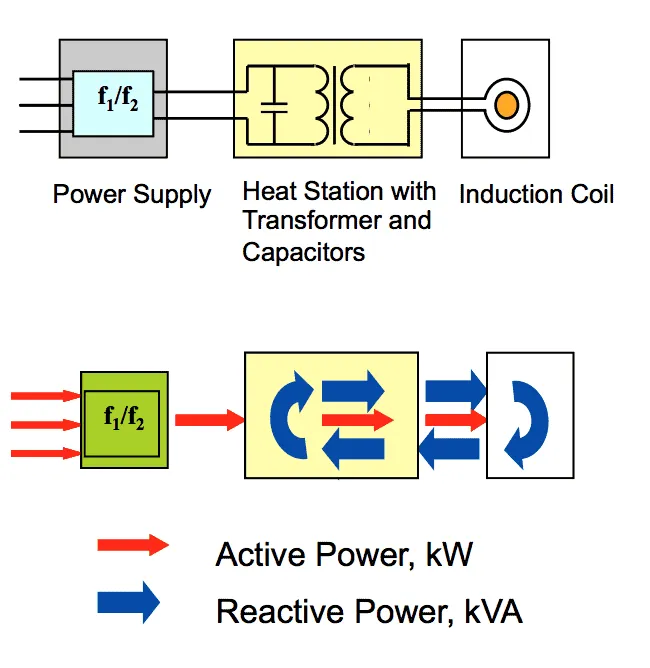
Alternating current changes direction twice during each frequency cycle. If frequency is 1kHz, current changes direction 2000 times in a second. A product of current and voltage gives the value of instantaneous power (p = i x u), which oscillates between the power supply and the coil. We can say that power is being partially absorbed (Active Power) and partially reflected (Reactive Power) by the coil. Capacitor battery is used to unload the generator from the reactive power. Capacitors receive reactive power from the coil and send it back to the coil supporting oscillations. A circuit “coil-transformer-capacitors” is called Resonant or Tank Circuit.

2023年2月14日星期二

Induction Heat Treating Surface Process

What is induction heat treating surface process?


Induction heating is a heat treating process that allows very targeted heating of metals by electromagnetic induction. The process relies on induced electrical currents within the material to produce heat and is the preferred method used to bond, harden or soften metals or other conductive materials. In modern manufacturing processes, this form of heat treatment offers a beneficial combination of speed, consistency and control. Although the basic principles are well known, modern advances in solid state technology have made the process remarkably simple, cost-effective heating method for applications which involve joining, treating, heating and materials testing.

Induction heat treating, through the highly controllable use of an electrically heated coil, will allow you to select the best physical characteristics for not only each metal part—but for each section on that metal part. Induction hardening can impart superior durability to bearing journals and shaft sections without sacrificing the ductility necessary to handle shock loads and vibration. You can harden internal bearing surfaces and valve seats in intricate parts without creating distortion problems. This means that you are able to harden or anneal specific areas for durability and ductility in ways that will best serve your needs.

Benefits of Induction Heat Treating Services


  • Focused Heat Treat Surface hardening retains original ductility of core while hardening a high wear area of the part. The hardened area is accurately controlled in respect to case depth, width, location and hardness.

  • Optimized Consistency Eliminate the inconsistencies and quality issues associated with open flame, torch heating and other methods. Once the system is properly calibrated and set up, there is no guess work or variation; the heating pattern is repeatable and consistent. With modern solid state systems, precise temperature control provides uniform results.


  • Maximized Productivity Production rates can be maximized because heat is developed directly and instantly (>2000º F. in < 1 second) inside the part. Startup is virtually instantaneous; no warm up or cool down cycle is required.

  • Improved Product Quality Parts never come into direct contact with a flame or other heating element; the heat is induced within the part itself by alternating electrical current. As a result, product warpage, distortion and reject rates are minimized.

  • Reduced Energy Consumption Tired of increasing utility bills? This uniquely energy-efficient process converts up to 90% of the energy expended energy into useful heat; batch furnaces are generally only 45% energy-efficient. No warm-up or cool-down cycles are required so stand-by heat losses are reduced to a bare minimum.

  • Environmentally Sound The burning of traditional fossil fuels is unnecessary, resulting in a clean, non-polluting process which will help protect the environment.


What is Induction Heating?


Induction Heating is a Contactless Heating Method of bodies, which absorb energy from an Alternating Magnetic Field, generated by Induction Coil (Inductor).


There are two mechanisms of energy absorption:

  • generation of close-loop (eddy) currents inside the body which cause heating due to electrical resistance of the body material

  • hysteresis heating (for magnetic materials ONLY!) due to a friction of magnetic micro volumes (domains), which rotate following orientation of external magnetic field


Principle of Induction Heating


Chain of phenomena:

  • Induction heating power supply delivers current (I1) to induction coil

  • Coil currents (ampere-turns) generate magnetic field. Lines of field are always closed (law of nature!) and each line goes around the current source – coil turns and workpiece

  • Alternating magnetic field flowing through the part cross-section (coupled to the part) induces voltage in the part


  • Induced voltage creates eddy currents (I2) in the part flowing in direction opposite to the coil current where possible

  • Eddy currents generate heat in the part


Power Flow in Induction Heating Installations


Alternating current changes direction twice during each frequency cycle. If frequency is 1kHz, current changes direction 2000 times in a second.

A product of current and voltage gives the value of instantaneous power (p = i x u), which oscillates between the power supply and the coil. We can say that power is being partially absorbed (Active Power) and partially reflected (Reactive Power) by the coil. Capacitor battery is used to unload the generator from the reactive power. Capacitors receive reactive power from the coil and send it back to the coil supporting oscillations.

A circuit “coil-transformer-capacitors” is called Resonant or Tank Circuit.

2023年2月10日星期五

Induction Heat Treating Surface Process

What is induction heat treating surface process?

Induction heating is a heat treating process that allows very targeted heating of metals by electromagnetic induction. The process relies on induced electrical currents within the material to produce heat and is the preferred method used to bond, harden or soften metals or other conductive materials. In modern manufacturing processes, this form of heat treatment offers a beneficial combination of speed, consistency and control. Although the basic principles are well known, modern advances in solid state technology have made the process remarkably simple, cost-effective heating method for applications which involve joining, treating, heating and materials testing. Induction heat treating, through the highly controllable use of an electrically heated coil, will allow you to select the best physical characteristics for not only each metal part—but for each section on that metal part. Induction hardening can impart superior durability to bearing journals and shaft sections without sacrificing the ductility necessary to handle shock loads and vibration. You can harden internal bearing surfaces and valve seats in intricate parts without creating distortion problems. This means that you are able to harden or anneal specific areas for durability and ductility in ways that will best serve your needs.

Benefits of Induction Heat Treating Services

  • Focused Heat Treat Surface hardening retains original ductility of core while hardening a high wear area of the part. The hardened area is accurately controlled in respect to case depth, width, location and hardness.
  • Optimized Consistency Eliminate the inconsistencies and quality issues associated with open flame, torch heating and other methods. Once the system is properly calibrated and set up, there is no guess work or variation; the heating pattern is repeatable and consistent. With modern solid state systems, precise temperature control provides uniform results.
  • Maximized Productivity Production rates can be maximized because heat is developed directly and instantly (>2000º F. in < 1 second) inside the part. Startup is virtually instantaneous; no warm up or cool down cycle is required.
  • Improved Product Quality Parts never come into direct contact with a flame or other heating element; the heat is induced within the part itself by alternating electrical current. As a result, product warpage, distortion and reject rates are minimized.
  • Reduced Energy Consumption Tired of increasing utility bills? This uniquely energy-efficient process converts up to 90% of the energy expended energy into useful heat; batch furnaces are generally only 45% energy-efficient. No warm-up or cool-down cycles are required so stand-by heat losses are reduced to a bare minimum.
  • Environmentally Sound The burning of traditional fossil fuels is unnecessary, resulting in a clean, non-polluting process which will help protect the environment.

What is Induction Heating?

Induction Heating is a Contactless Heating Method of bodies, which absorb energy from an Alternating Magnetic Field, generated by Induction Coil (Inductor). There are two mechanisms of energy absorption:
  • generation of close-loop (eddy) currents inside the body which cause heating due to electrical resistance of the body material
  • hysteresis heating (for magnetic materials ONLY!) due to a friction of magnetic micro volumes (domains), which rotate following orientation of external magnetic field

Principle of Induction Heating

Chain of phenomena:
  • Induction heating power supply delivers current (I1) to induction coil
  • Coil currents (ampere-turns) generate magnetic field. Lines of field are always closed (law of nature!) and each line goes around the current source – coil turns and workpiece
  • Alternating magnetic field flowing through the part cross-section (coupled to the part) induces voltage in the part
  • Induced voltage creates eddy currents (I2) in the part flowing in direction opposite to the coil current where possible
  • Eddy currents generate heat in the part

Power Flow in Induction Heating Installations

Alternating current changes direction twice during each frequency cycle. If frequency is 1kHz, current changes direction 2000 times in a second. A product of current and voltage gives the value of instantaneous power (p = i x u), which oscillates between the power supply and the coil. We can say that power is being partially absorbed (Active Power) and partially reflected (Reactive Power) by the coil. Capacitor battery is used to unload the generator from the reactive power. Capacitors receive reactive power from the coil and send it back to the coil supporting oscillations. A circuit “coil-transformer-capacitors” is called Resonant or Tank Circuit.

关注者

我的简介

我的照片
HLQ induction heating machine manufacturer provides the service of induction brazing,melting,hot forming,hardening surface,annealing,shrink fitting,PWHT,etc.