 Induction Brazing Steel Tube
Objective: To heat an oil suction assembly (steel tubing and filter cap) to 1,850°F (1010°C) within 15 seconds for a brazing application.
Material 0.125" (3.2mm) diameter steel tube and filter cap assembly, high temperature brazing flux, copper ring.
Temperature 1850°F(1010°C)
Frequency 500 kHz
Equipment • DW-UHF-6KW-I induction heating system equipped with a remote workhead containing 0.66 μF capacitors • An induction heating coil designed and developed specifically for this application.
Process A two-turn, specially-contoured helical induction coil is used to heat the tube assembly near the joint area. A copper ring and high temperature flux are then applied to the joint area. Power is applied for 15 seconds until the braze flows.
Results/Benefits Induction heating provides:
• Easy loading and unloading of parts
• Heat very precise areas within production tolerances
• Hands free heating that involves minimal operator skill for manufacturing
https://dw-inductionheater.com/induction-brazing-steel-tube.html?feed_id=252863&_unique_id=6689268bd1eeb
Induction Brazing Steel Tube
Objective: To heat an oil suction assembly (steel tubing and filter cap) to 1,850°F (1010°C) within 15 seconds for a brazing application.
Material 0.125" (3.2mm) diameter steel tube and filter cap assembly, high temperature brazing flux, copper ring.
Temperature 1850°F(1010°C)
Frequency 500 kHz
Equipment • DW-UHF-6KW-I induction heating system equipped with a remote workhead containing 0.66 μF capacitors • An induction heating coil designed and developed specifically for this application.
Process A two-turn, specially-contoured helical induction coil is used to heat the tube assembly near the joint area. A copper ring and high temperature flux are then applied to the joint area. Power is applied for 15 seconds until the braze flows.
Results/Benefits Induction heating provides:
• Easy loading and unloading of parts
• Heat very precise areas within production tolerances
• Hands free heating that involves minimal operator skill for manufacturing
https://dw-inductionheater.com/induction-brazing-steel-tube.html?feed_id=252863&_unique_id=6689268bd1eeb
2024年7月6日星期六
Induction Brazing Steel Tube
Induction Brazing Steel Tube
Objective: To heat an oil suction assembly (steel tubing and filter cap) to 1,850°F (1010°C) within 15 seconds for a brazing application.
Material 0.125" (3.2mm) diameter steel tube and filter cap assembly, high temperature brazing flux, copper ring.
Temperature 1850°F(1010°C)
Frequency 500 kHz
Equipment • DW-UHF-6KW-I induction heating system equipped with a remote workhead containing 0.66 μF capacitors • An induction heating coil designed and developed specifically for this application.
Process A two-turn, specially-contoured helical induction coil is used to heat the tube assembly near the joint area. A copper ring and high temperature flux are then applied to the joint area. Power is applied for 15 seconds until the braze flows.
Results/Benefits Induction heating provides:
• Easy loading and unloading of parts
• Heat very precise areas within production tolerances
• Hands free heating that involves minimal operator skill for manufacturing
https://dw-inductionheater.com/induction-brazing-steel-tube.html?feed_id=252863&_unique_id=6689268bd1eeb

Induction Heating Fluidized Bed Reactors
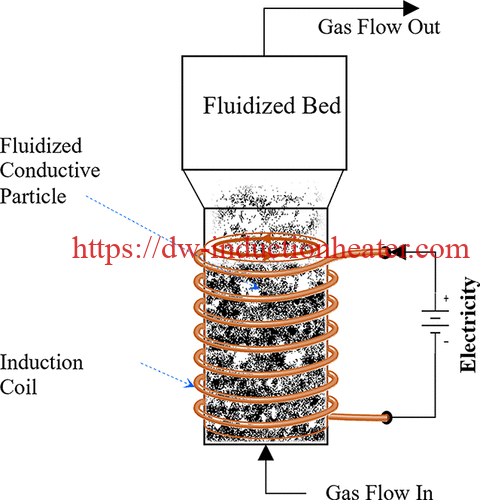
Enhancing Efficiency and Control: Induction Heating Fluidized Bed Reactors
Introduction
Fluidized bed reactors are integral to many industrial processes due to their excellent heat and mass transfer properties. When combined with induction heating technology, these reactors achieve a new level of efficiency, control, and environmental sustainability. This article delves into the principles and advantages of induction heating fluidized bed reactors, their applications across various industries, and the challenges and future directions of this innovative technology.Principles of Fluidized Bed Reactors
Fluidized bed reactors operate by suspending solid particles in an upward flow of gas or liquid, creating a state that mimics fluid behavior. This fluidization enhances mixing and allows for uniform temperature distribution, making these reactors ideal for processes such as combustion, drying, and chemical reactions. Key components and principles include: 1. **Distributor Plate**: Ensures even distribution of the fluidizing medium to achieve consistent fluidization. 2. **Solid Particles**: Act as the medium for reactions, ranging from fine powders to larger granules. 3. **Fluidizing Medium**: Typically air, steam, or other gases, chosen based on process requirements. 4. **Enhanced Transfer Rates**: The fluidized state significantly improves heat and mass transfer rates within the reactor.Applications of Fluidized Beds
1. Chemical Reactions: Fluidized beds are widely used in catalytic cracking, gasification, and other chemical reactions where efficient mixing and temperature control are crucial for optimizing reaction rates and product yields.
2. Combustion: In fluidized bed combustion, fuels such as coal, biomass, or waste materials are burned more efficiently due to the enhanced mixing and heat transfer, resulting in lower emissions and better combustion control.
3. Drying: Fluidized bed dryers are used to remove moisture from solid particles, providing uniform drying conditions and preventing overheating or degradation of the material.
4. Coating and Granulation: Fluidized beds are used in the pharmaceutical and food industries for coating particles with protective or functional layers and for granulating powders into larger, more manageable particles.
5. Heat Treatment: Metal and ceramic particles can be uniformly heated or cooled in fluidized beds, ensuring consistent treatment and improving the quality of the final product.
Principles of Induction Heating
Induction heating generates heat within conductive materials through electromagnetic induction. An alternating current (AC) passes through a coil, creating a varying magnetic field that induces eddy currents in nearby conductive materials.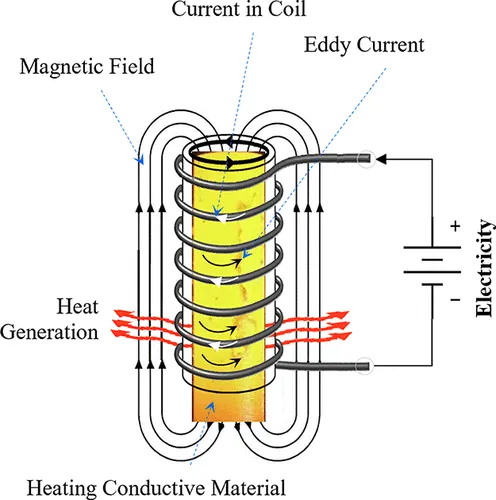
Integration of Induction Heating with Fluidized Bed Reactors
Combining induction heating with fluidized bed reactors leverages the benefits of both technologies, resulting in superior process performance. Here’s how this integration enhances fluidized bed reactors: 1. **Uniform Heating**: Induction heating ensures direct and uniform heating of conductive particles, maintaining consistent temperatures throughout the reactor. 2. **Energy Efficiency**: Induction heating minimizes energy loss, reducing operational costs and improving sustainability. 3. **Environmental Impact**: Non-contact heating eliminates the need for combustion, lowering emissions of pollutants and greenhouse gases. 4. **Enhanced Process Control**: Precise control over heating parameters allows for optimization of reaction conditions, improving product quality and yield.Applications of Induction Heated Fluidized Bed Reactors
The integration of induction heating in fluidized bed reactors has broad applications across various industries: 1. **Chemical Processing**: Ideal for catalytic reactions and other processes requiring precise temperature control, such as methanation and Fischer-Tropsch synthesis. 2. **Material Processing**: Suitable for sintering, melting, and heat treatment of metals and ceramics, ensuring consistent material properties. 3. **Energy Production**: Enhances processes like biomass gasification and pyrolysis, maximizing energy output and efficiency. 4. **Environmental Remediation**: Effective for soil decontamination and waste treatment, offering rapid and uniform heating.Advantages of Induction Heated Fluidized Bed Reactors
1. **Improved Efficiency**: Enhanced heat transfer and mixing lead to higher reaction rates and yields. 2. **Cost Savings**: Reduced energy consumption and lower operational costs due to the efficiency of induction heating.
3. **Environmental Benefits**: Lower emissions and reduced environmental footprint compared to traditional heating methods.
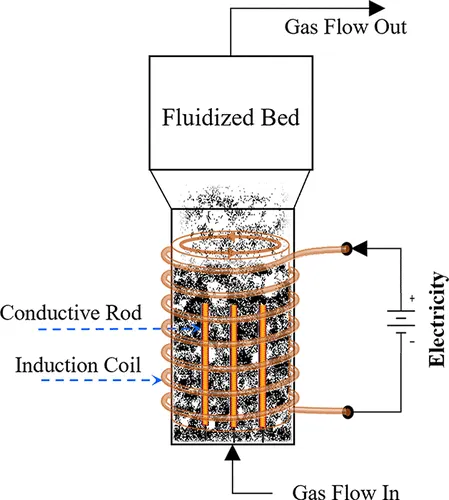 4. **Scalability and Flexibility**: Suitable for a wide range of scales and adaptable to various industrial processes.
Challenges and Future Directions
Despite the numerous advantages, several challenges need to be addressed: 1. **Design Optimization**: Developing efficient induction coil and power supply designs to ensure uniform heating and minimize energy loss. 2. **Material Durability**: Ensuring the durability of reactor materials and particles subjected to continuous motion and heating. 3. **Scalability**: Expanding the technology for large-scale industrial applications while maintaining efficiency and control. Future research should focus on optimizing reactor designs, exploring new conductive materials and coatings, and expanding the range of applications. Collaboration between industry and academia will be crucial in overcoming these challenges and realizing the full potential of induction heated fluidized bed reactors.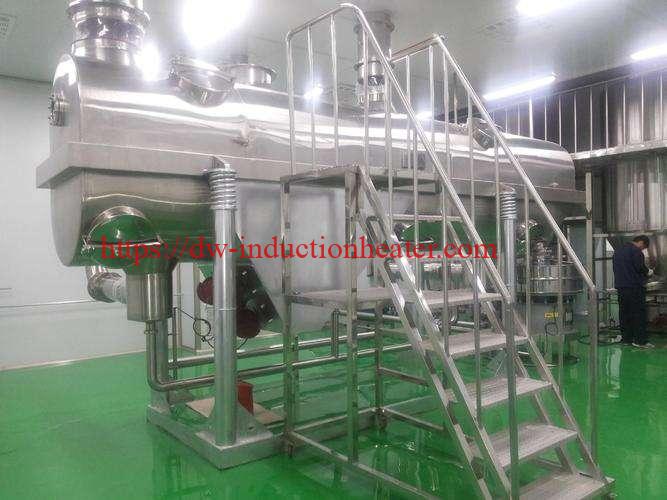
Conclusion
Induction heating fluidized bed reactors represent a significant advancement in industrial processing technology. By combining the rapid, precise, and efficient heating capabilities of induction with the superior heat and mass transfer properties of fluidized beds, this integration offers substantial benefits in terms of efficiency, control, and environmental impact. As research and development continue to address existing challenges, the adoption of this innovative technology is likely to grow, contributing to more sustainable, efficient, and effective industrial processes.
2024年7月5日星期五
Brazing Copper Tube with Induction
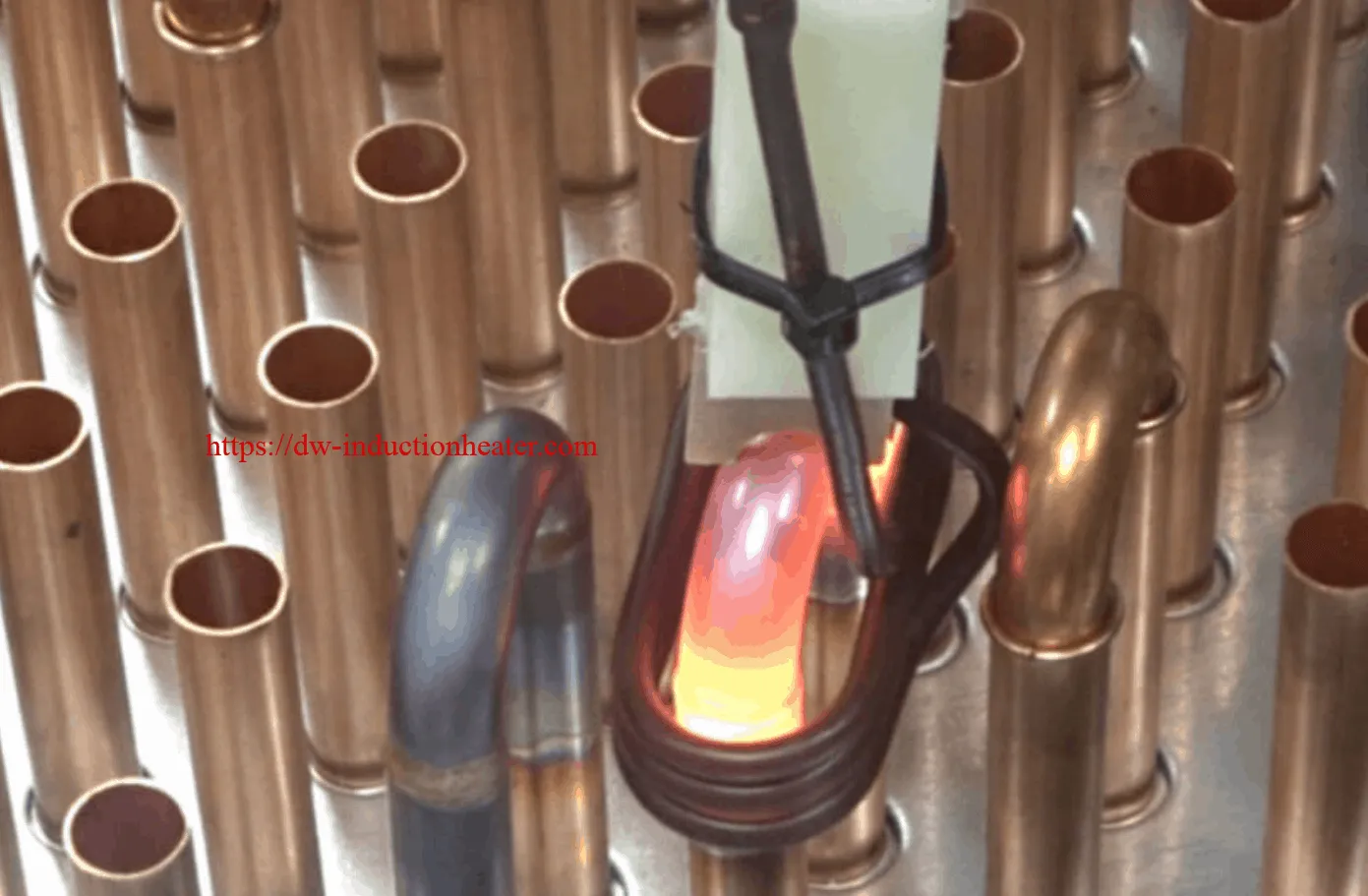 Brazing Copper Tube with Induction
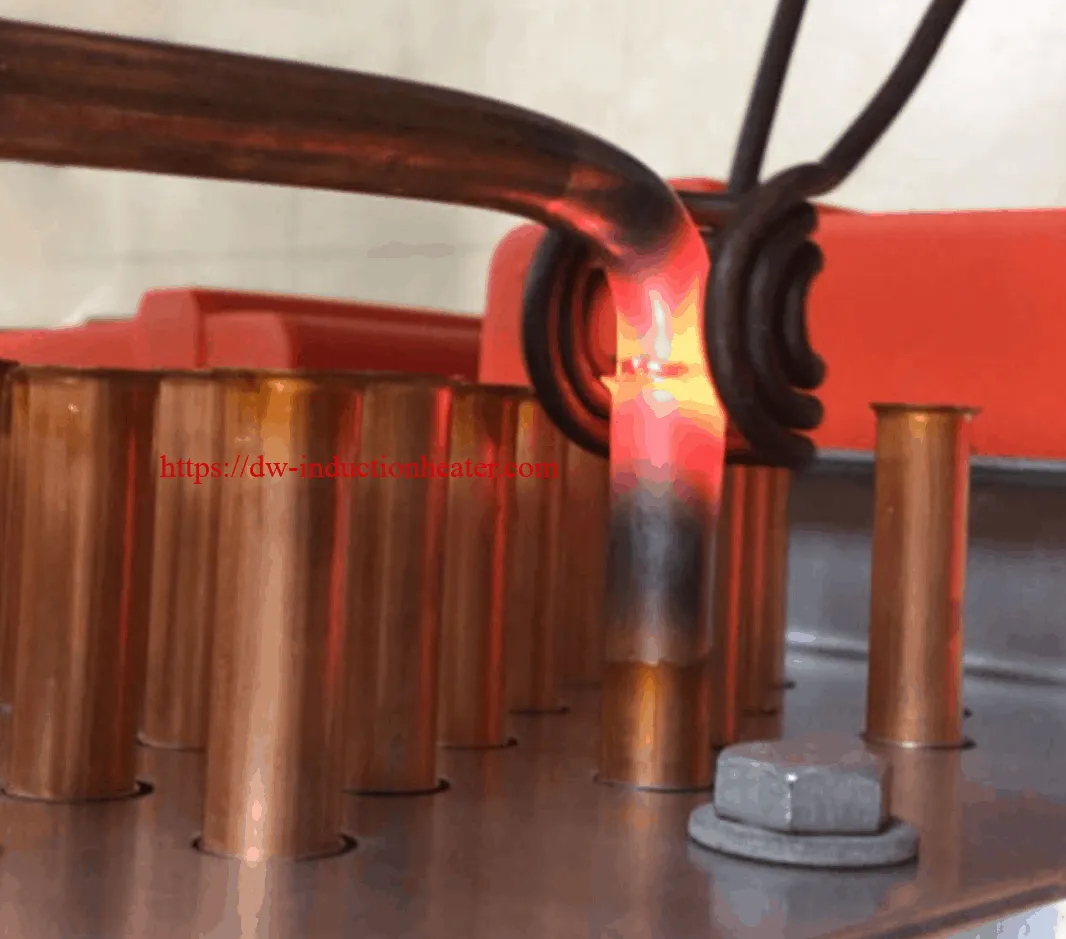
Objective: To braze a copper tube ( 3/8" OD by 2-4" long) into a 3/8" fitting in less than 10 seconds. Heating must take place in a channel type coil to allow for easy loading of parts.
Material Copper Tubing and Fitting with Braze and Stay Silv White Flux
Temperature 1300°F
Frequency 215 kHz
Equipment DW-UHF-10kw output solid state induction power supply equipped with a standard heat station containing eight 0.33 μF capacitors for a total of 0.66μF, a step down transformer, and a specifically designed induction heating coil.
Process DW-UHF-10kw solid state induction power supply was setup to achieve the following results: · 2.0 kW of power was directly loaded into the copper tube resulting in a heating time of 7.2 seconds to reach the necessary 13000F for brazing.
Results& Processing ease was achieved through the design of a unique channel type coil comprised of three turns of 1/8" copper.
Brazing Copper Tube with Induction
Objective: To braze a copper tube ( 3/8" OD by 2-4" long) into a 3/8" fitting in less than 10 seconds. Heating must take place in a channel type coil to allow for easy loading of parts.
Material Copper Tubing and Fitting with Braze and Stay Silv White Flux
Temperature 1300°F
Frequency 215 kHz
Equipment DW-UHF-10kw output solid state induction power supply equipped with a standard heat station containing eight 0.33 μF capacitors for a total of 0.66μF, a step down transformer, and a specifically designed induction heating coil.
Process DW-UHF-10kw solid state induction power supply was setup to achieve the following results: · 2.0 kW of power was directly loaded into the copper tube resulting in a heating time of 7.2 seconds to reach the necessary 13000F for brazing.
Results& Processing ease was achieved through the design of a unique channel type coil comprised of three turns of 1/8" copper.
 https://dw-inductionheater.com/brazing-copper-tube-with-induction.html?feed_id=252766&_unique_id=66886faf6bfe7
Brazing Eyeglass Frames With Induction
 Brazing Eyeglass Frames With Induction
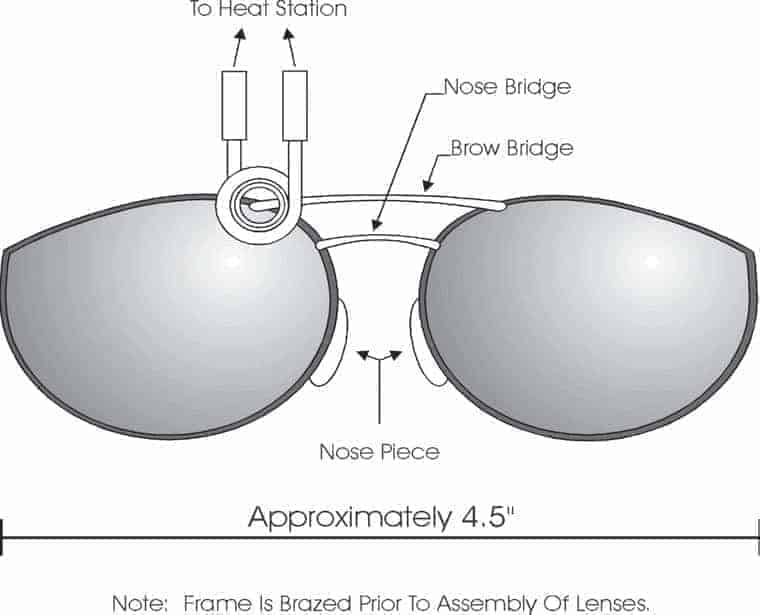
Objective: Produce repeatable braze joints for the assembly of eyeglass frames. Induction heating is to be used to achieve quality braze joints on the nose bridge, brow bridge and nose piece. Brazing is to be done at 1300°F with approximately 3-5 seconds allowed for heating. Surface quality is of utmost importance since limited post-brazing cleanup is preferred.
Material: Monel Bridge With 18% Silver Braze
Temperature: 1300°F
Frequency: 600 kHz
Equipment:DW-UHF-4.5KW output solid state induction power supply.
Process The DW-UHF-4.5KW output solid state induction power supply was utilized to achieve the following results: • A temperature of 13000F was reached in 3 seconds through the use of a three turn, 0.2" ID, transverse helical coil. This coil design allows for the pinpoint application of heat to a specific area. • Surface flaws were kept to a minimum due to the use of a gas flood which was comprised of Hydrogen and an inert agent. The Hydrogen acts as a "fluxing" agent which eliminates the need for flux. The inert gas eliminates oxidation of the metal components when at brazing temperature. These two features produce a finished product without the need for post-brazing cleanup. • Present fixturing can be kept due to the use of transverse heating which allows for easy removal of the finished product. Results Overall, induction heating fulfilled all of the objectives established by the customer to produce quality braze joints for the manufacture of eyeglass frames.
https://dw-inductionheater.com/brazing-eyeglass-frames-with-induction.html?feed_id=252698&_unique_id=6687b8dc97137
Brazing Eyeglass Frames With Induction
Objective: Produce repeatable braze joints for the assembly of eyeglass frames. Induction heating is to be used to achieve quality braze joints on the nose bridge, brow bridge and nose piece. Brazing is to be done at 1300°F with approximately 3-5 seconds allowed for heating. Surface quality is of utmost importance since limited post-brazing cleanup is preferred.
Material: Monel Bridge With 18% Silver Braze
Temperature: 1300°F
Frequency: 600 kHz
Equipment:DW-UHF-4.5KW output solid state induction power supply.
Process The DW-UHF-4.5KW output solid state induction power supply was utilized to achieve the following results: • A temperature of 13000F was reached in 3 seconds through the use of a three turn, 0.2" ID, transverse helical coil. This coil design allows for the pinpoint application of heat to a specific area. • Surface flaws were kept to a minimum due to the use of a gas flood which was comprised of Hydrogen and an inert agent. The Hydrogen acts as a "fluxing" agent which eliminates the need for flux. The inert gas eliminates oxidation of the metal components when at brazing temperature. These two features produce a finished product without the need for post-brazing cleanup. • Present fixturing can be kept due to the use of transverse heating which allows for easy removal of the finished product. Results Overall, induction heating fulfilled all of the objectives established by the customer to produce quality braze joints for the manufacture of eyeglass frames.
https://dw-inductionheater.com/brazing-eyeglass-frames-with-induction.html?feed_id=252698&_unique_id=6687b8dc97137
2024年7月4日星期四
Brazing Copper Tube to Brass Fitting With Induction
 Brazing Copper Tube to Brass Fitting With Induction
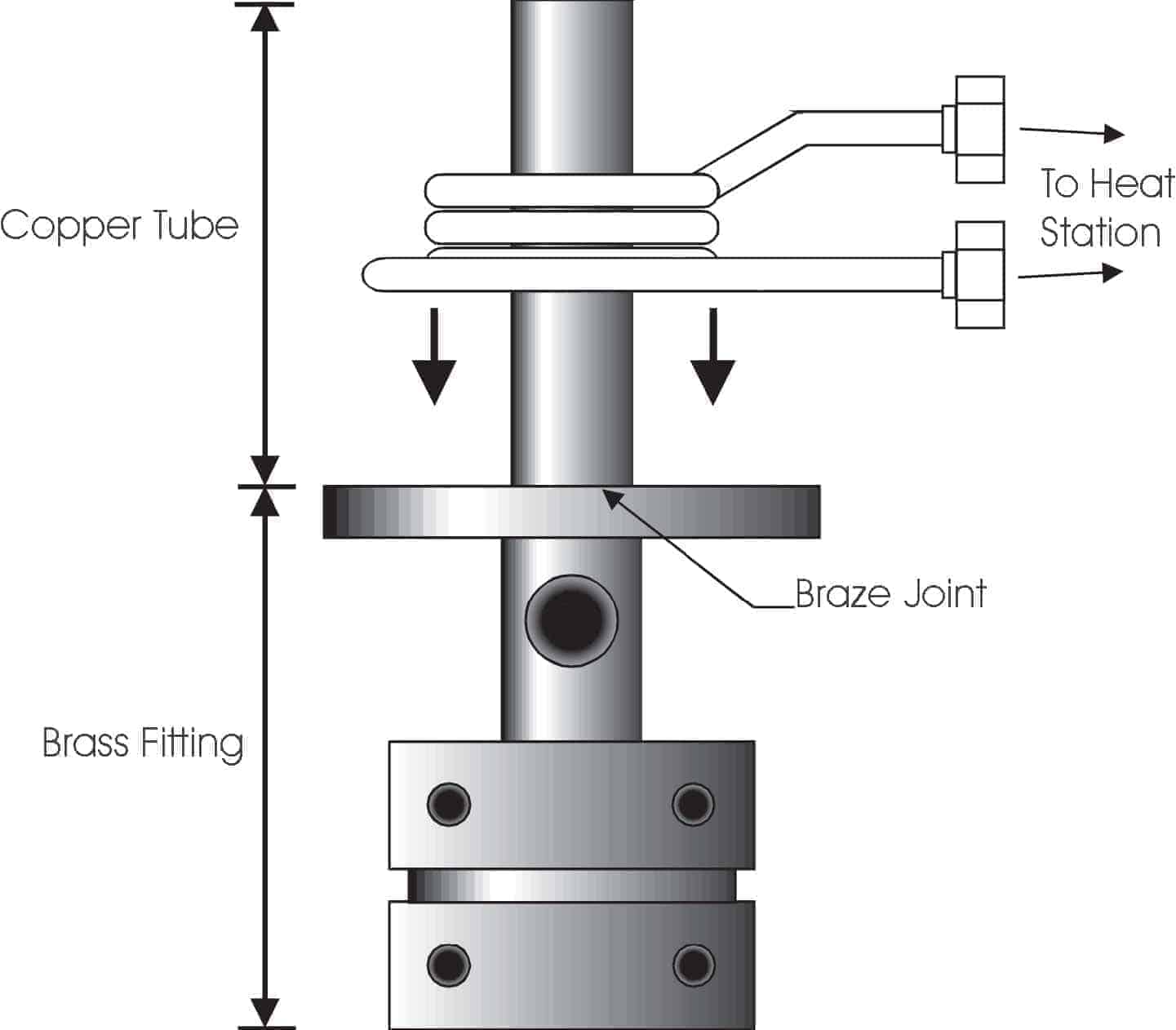
Objective: To use induction heating to braze a copper tube to a brass fitting using a preform braze wire. Processing is to occur under an atmosphere of Nitrogen and 4% Hydrogen gas. The braze preforms melt at 1190°F, but the parts need to be kept below 1300°F. The parts need to be processed at a rate of 175 to 200 per hour which translates into 18 seconds of heating time per part.
Material Copper Tubing Measuring 0.5" OD and 2" Long, Brass fitting, Braze Preform, No Flux.
Temperature Above 1190°F but not to exceed 1300°F
Frequency :300 kHz
Equipment: DW-UHF-10KW output solid state induction heating power supply with three (3) busses, eight (8) capacitors totaling 0.66 μF, and a unique four turn helical coil. Process The DW-UHF-10KW output solid state power supply along with a unique four turn helical coil were used to achieve the following results.
Results • The requested atmosphere was provided under a bell jar by supplying 95% Nitrogen/5%Hydrogen at a rate of 25-30 cfh. • A heating cycle of only 10 seconds was necessary to attain sufficient braze flow which surpasses the required limit of 18 seconds.
https://dw-inductionheater.com/brazing-copper-tube-to-brass-fitting-with-induction.html?feed_id=252630&_unique_id=668702447dc78
Brazing Copper Tube to Brass Fitting With Induction
Objective: To use induction heating to braze a copper tube to a brass fitting using a preform braze wire. Processing is to occur under an atmosphere of Nitrogen and 4% Hydrogen gas. The braze preforms melt at 1190°F, but the parts need to be kept below 1300°F. The parts need to be processed at a rate of 175 to 200 per hour which translates into 18 seconds of heating time per part.
Material Copper Tubing Measuring 0.5" OD and 2" Long, Brass fitting, Braze Preform, No Flux.
Temperature Above 1190°F but not to exceed 1300°F
Frequency :300 kHz
Equipment: DW-UHF-10KW output solid state induction heating power supply with three (3) busses, eight (8) capacitors totaling 0.66 μF, and a unique four turn helical coil. Process The DW-UHF-10KW output solid state power supply along with a unique four turn helical coil were used to achieve the following results.
Results • The requested atmosphere was provided under a bell jar by supplying 95% Nitrogen/5%Hydrogen at a rate of 25-30 cfh. • A heating cycle of only 10 seconds was necessary to attain sufficient braze flow which surpasses the required limit of 18 seconds.
https://dw-inductionheater.com/brazing-copper-tube-to-brass-fitting-with-induction.html?feed_id=252630&_unique_id=668702447dc78
Brazing Copper Assemblies With Induction
 Brazing Copper Assemblies With Induction
Objective:To heat copper ‘T’ assemblies to 1400(760) ºF(ºC) for brazing
Material: Copper ‘T’ assemblies,Silver-copper eutectic braze,White flux
Temperature: 1400(760) ºF(ºC) Frequency: 250 kHz
Equipment: DW-UHF-20KW, 450 kHz solid state induction power supply with a remote heat station containing two 1.32 mF capacitors (total capacitance 0.66 mF). A custom-designed induction heating coil.
Process A custom double-wound pancake-helical coil combination is used to efficiently transfer RF Induction Heating power. Tests were conducted using temperature indicating paint to establish heating profiles and time-to-temperature. After the optimum time-totemperature of 3-5 minutes is established, a braze ring is placed at the joint and white flux applied to the joint area. The first joint on each piece takes 5 minutes with subsequent joints on the same copper piece taking much less time (~3 minutes).
Results/Benefits · Semi-automatic process reduces amount of operator laborinvolved· Easy and effective completion of braze joints
https://dw-inductionheater.com/brazing-copper-assemblies-with-induction.html?feed_id=252562&_unique_id=66864b35df3a6
Brazing Copper Assemblies With Induction
Objective:To heat copper ‘T’ assemblies to 1400(760) ºF(ºC) for brazing
Material: Copper ‘T’ assemblies,Silver-copper eutectic braze,White flux
Temperature: 1400(760) ºF(ºC) Frequency: 250 kHz
Equipment: DW-UHF-20KW, 450 kHz solid state induction power supply with a remote heat station containing two 1.32 mF capacitors (total capacitance 0.66 mF). A custom-designed induction heating coil.
Process A custom double-wound pancake-helical coil combination is used to efficiently transfer RF Induction Heating power. Tests were conducted using temperature indicating paint to establish heating profiles and time-to-temperature. After the optimum time-totemperature of 3-5 minutes is established, a braze ring is placed at the joint and white flux applied to the joint area. The first joint on each piece takes 5 minutes with subsequent joints on the same copper piece taking much less time (~3 minutes).
Results/Benefits · Semi-automatic process reduces amount of operator laborinvolved· Easy and effective completion of braze joints
https://dw-inductionheater.com/brazing-copper-assemblies-with-induction.html?feed_id=252562&_unique_id=66864b35df3a6
2024年7月3日星期三
Brazing Thin Copper Tube With Induction
 Brazing Thin Copper Tube With Induction
Objective: To braze a thin copper oval tube to a brass fitting at 1400 º F and to cap the other end of the copper tube with a brass plate.
Material: Brass fitting - 0.875 in2 and 2.5 in long (22mm2 x 64mm) Copper tube 0.01 in (0.254mm) wall Brass plate 0.10 in (2.54mm) thick and 0.5 in X 0.25 inch Braze alloy shim and white flux
Temperature: 1400 ºF (760 °C)
Frequency: 300 kHz
Equipment: DW-UHF-10KW induction power supply equipped with a remote heat station using two 1.32μF capacitors (total 0.66 μF) Two custom-designed induction heating coils. Process A split, f our-turn induction coil is used to deliver the heat energy into the brass fitting (Fig. 1). To prevent over heating of the edges of the brass fitting and the thin copper tube, a smaller coil diameter (Fig. 2) was added to deliver heat into the brass fitting. A braze shim preform is placed at the joint area, and is then covered with white flux. The height of the coil is adjusted to deliver proportional heat to the assembly. This setting raises the temperature of the thicker brass piece and the thin copper tube at the same rate enabling a uniform flow of the braze shim preform. The other end of the copper tube is brazed successfully using a 2-turn helical coil (Fig.3.)
Results/Benefits • Preservation of the copper's mechanical properties • Minimized heat migration along both ends of the tube • Reduced heat-up time (under 60 sec.)
https://dw-inductionheater.com/brazing-thin-copper-tube-with-induction.html?feed_id=252494&_unique_id=6685947e7ce60
Brazing Thin Copper Tube With Induction
Objective: To braze a thin copper oval tube to a brass fitting at 1400 º F and to cap the other end of the copper tube with a brass plate.
Material: Brass fitting - 0.875 in2 and 2.5 in long (22mm2 x 64mm) Copper tube 0.01 in (0.254mm) wall Brass plate 0.10 in (2.54mm) thick and 0.5 in X 0.25 inch Braze alloy shim and white flux
Temperature: 1400 ºF (760 °C)
Frequency: 300 kHz
Equipment: DW-UHF-10KW induction power supply equipped with a remote heat station using two 1.32μF capacitors (total 0.66 μF) Two custom-designed induction heating coils. Process A split, f our-turn induction coil is used to deliver the heat energy into the brass fitting (Fig. 1). To prevent over heating of the edges of the brass fitting and the thin copper tube, a smaller coil diameter (Fig. 2) was added to deliver heat into the brass fitting. A braze shim preform is placed at the joint area, and is then covered with white flux. The height of the coil is adjusted to deliver proportional heat to the assembly. This setting raises the temperature of the thicker brass piece and the thin copper tube at the same rate enabling a uniform flow of the braze shim preform. The other end of the copper tube is brazed successfully using a 2-turn helical coil (Fig.3.)
Results/Benefits • Preservation of the copper's mechanical properties • Minimized heat migration along both ends of the tube • Reduced heat-up time (under 60 sec.)
https://dw-inductionheater.com/brazing-thin-copper-tube-with-induction.html?feed_id=252494&_unique_id=6685947e7ce60
订阅:
博文 (Atom)
我的简介

- HLQ induction heating machine
- HLQ induction heating machine manufacturer provides the service of induction brazing,melting,hot forming,hardening surface,annealing,shrink fitting,PWHT,etc.