Induction straightening deck and bulkhead heating solutions
Induction straightening deck and bulkhead heating solutions times by as much as 80 per cent compared to alternative methods. Induction straightening is better at preserving metallurgical properties. It’s also the safest, healthiest, most environmentally friendly straightening method available.
The traditional method used for this application is flame straightening. For this, a skilled operator is dedicated to provide heat in specific areas, following a heating pattern, which determines the reduction of distortion in the metal structure.
Currently this straightening process has high costs because it requires a large amount of skilled labour, high workplace hazards, contamination of work area and high energy consumption.
During the welding of plates to fixed structures, buckling stress is produced. In order to eliminate this distortion, different traditional deck and bulkhead straightening techniques are employed: welding of beads in non-visible areas, cutting and re-welding of plates, and stress relieving using flame heating. These techniques are big time consumers, costly and do not provide any added value. Improving the efficiency of this process is paramount.
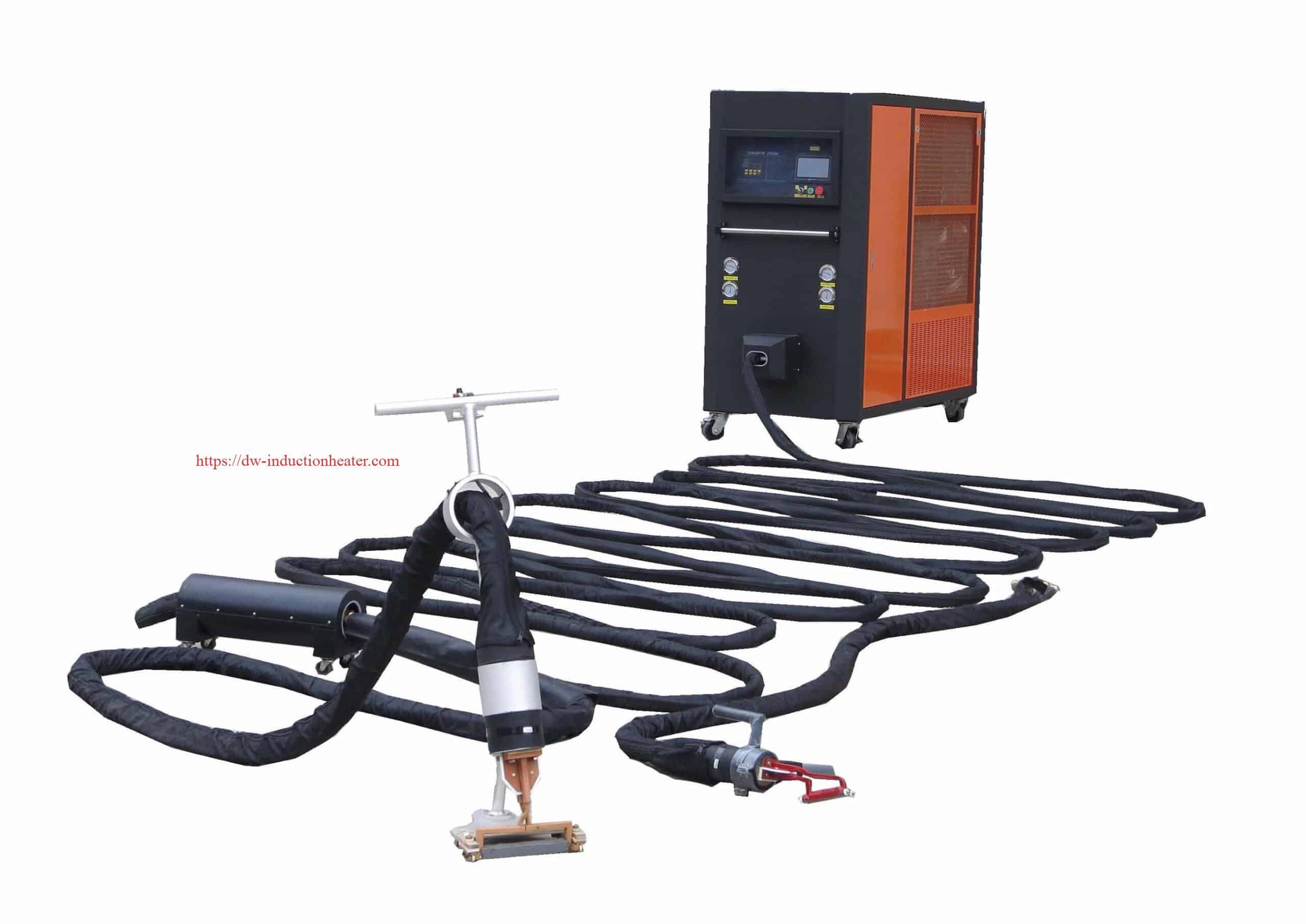
The HLQ Induction Straightening Solution provides a simple, flexible, low-maintenance alternative to traditional deck and bulkhead straightening techniques. The quick, clean induction heating system rapidly generates heat with precision to relief the stress and straighten the plate.
Induction Portable Heating Design
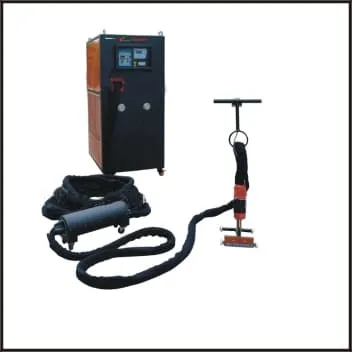
The HLQ induction straightening heating System is housed in an all-in-one, portable container. The container is placed at a suppport beam; eyebolts are provided for easy movement.
Horizontal or Vertical Orientation
With just a tool change, the equipment can be used in either horizontal or vertical position. The system can be placed on both flat and tilted surfaces.
Low Maintenance
The HLQ induction straightening heating System is designed for marine environments and meets both IP55 and AISI1316 requirements. The cabinet is made of stainless steel and the induction process requires no expendable materials.
Easy to Operate
System operators can master the three basic steps with just a few hours of training.
Program selection based on plate thickness. The system handles steel plates with thickness of 4 to 20mm, and aluminum plates with thickness of 3 to 6 mm.
Position the inductor on the heating tool, in horizontal or vertical orientation, at the desired location
Press the start buttom to begin the program. The advanced induction technology generates the required amount of heat rapidly, without exceeding the Curie temperature.
What is induction straightening?
Induction straightening uses a coil to generate localized heat in pre-defined heating zones. As these zones cool, they contract, "pulling" the metal into a flatter condition.
Where is it used?
Induction heating is widely used to straighten ship decks and bulkheads. In the construction industry it straightens beams. Induction straightening is increas-ingly used in the manufacture and repair of locomotives, rolling stock and heavy goods vehicles.
What are the benefits?
Induction straightening is extremely fast. When straightening ship decks and bulkheads, our customers often report minimum 50% time savings compared to traditional methods. Without induction, straightening on a large vessel can easily consume tens of thousands of man-hours. The precision of induction also boosts productivity. For example, when straightening truck chassis, there is no need to remove heat-sensitive components. Induction is so precise it leaves adjacent materials unaffected.
Induction straightening heating advantages
The replacement of flame straightening by the method of induction has the following advantages:
Significant time reduction in the straightening operation
Repeatability and heating quality
Improved quality of working environment (no hazardous fumes)
Improved safety for workers
Energy and labor cost savings
Related industries are shipbuilding, railway and steel structures in construction among others.
Enhancing Automotive Efficiency: The Role of Induction Heating in Shrink Fitting Aluminum Motor Housings
The automotive industry is constantly seeking methods to improve the performance, efficiency, and sustainability of its products. Shrink fitting using induction heating has emerged as a pivotal technology in the assembly of aluminum motor housings. This article delves into the principles of shrink fitting and induction heating, highlighting their significance in automotive manufacturing. It explores the benefits of using aluminum in motor housings, the process of induction heating for shrink fitting applications, the advantages over traditional methods, and the impact on the automotive industry's future.
Introduction:
In the quest for superior automotive performance and efficiency, the integration of lightweight materials such as aluminum in motor housings has become increasingly prevalent. The assembly of these components often involves the process of shrink fitting, which requires precise thermal expansion to create a tight, secure fit between parts. Induction heating has revolutionized this process, offering a fast, controllable, and energy-efficient method to achieve the desired interference fit. This article examines the application of induction heating in the shrink fitting of automotive aluminum motor housings and its implications for the industry.
The Advantages of Aluminum Motor Housings:
Aluminum, known for its lightweight, high strength-to-weight ratio, and excellent thermal conductivity, makes it an ideal choice for motor housings. These properties lead to reduced vehicle weight, improved fuel efficiency, and better heat dissipation, all critical factors in the performance and longevity of automotive engines.
Principles of Shrink Fitting:
Shrink fitting is a mechanical method used to join two components with a high degree of precision. It involves heating the outer component (in this case, the aluminum motor housing) to expand it, allowing the insertion of the inner part (such as a steel shaft). Upon cooling, the outer component contracts to form a tight, seamless joint that can withstand significant mechanical loads without the need for adhesives or mechanical fasteners.
Induction Heating in Shrink Fitting:
Induction heating is a non-contact process that uses electromagnetic fields to heat conductive materials rapidly and selectively. In the context of shrink fitting, induction heating provides several benefits, including:
Speed: Induction heating can rapidly bring the aluminum housing to the required temperature, reducing process times and increasing throughput.
Control: The process offers precise temperature control, ensuring uniform expansion and preventing damage to the components.
Energy Efficiency: Induction heating is highly energy-efficient, converting most of the energy into heat within the workpiece, minimizing waste.
Localized Heating: The ability to localize the heat to specific areas of the housing allows for targeted expansion and protects surrounding materials and components.
Cleanliness and Safety: Since induction heating does not rely on flame or contact heating, it is a cleaner and safer alternative that fits well within modern manufacturing environments.
The Process of Shrink Fitting with Induction Heating:
The shrink fitting process using induction heating involves several steps:
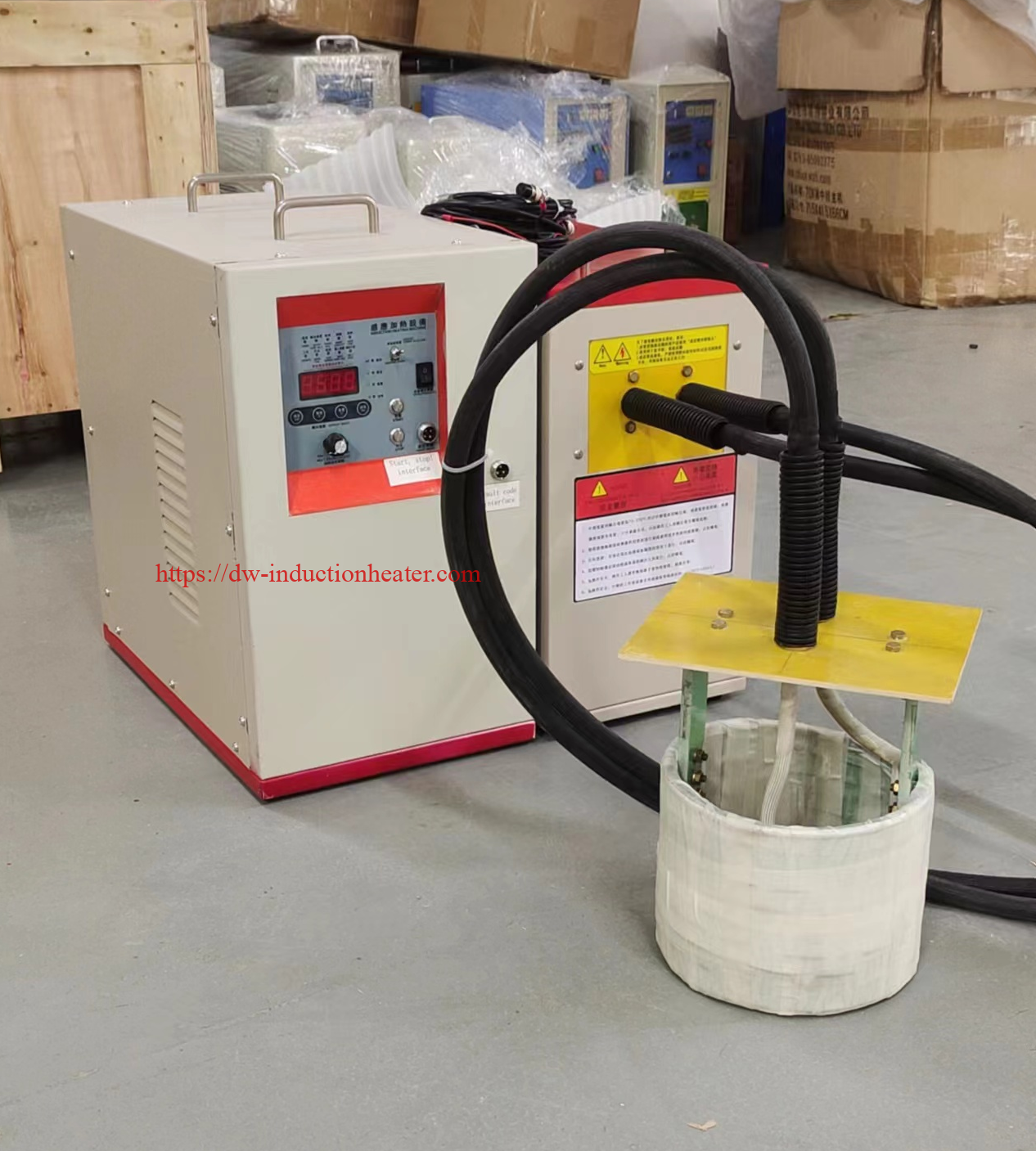
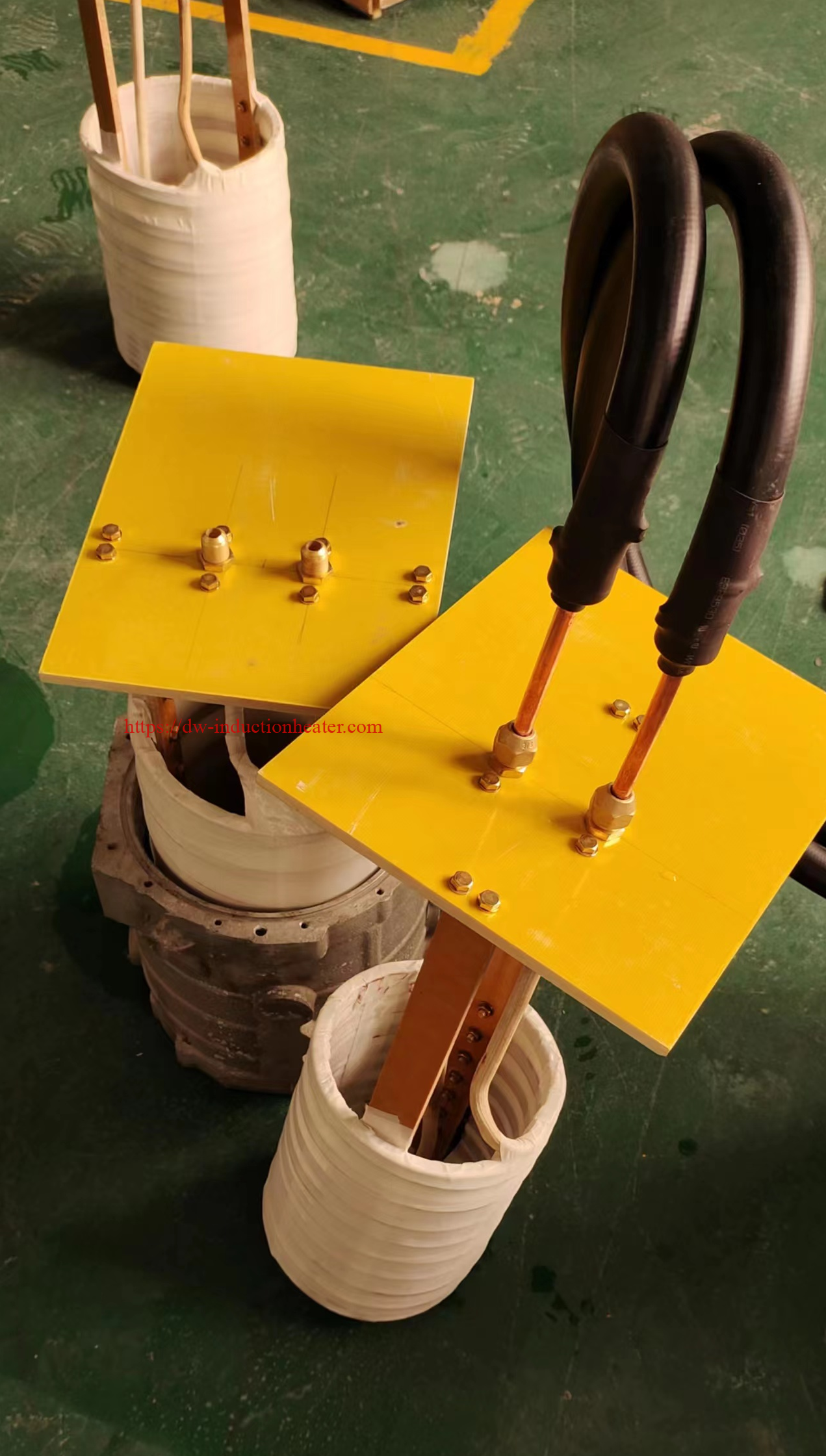
Designing an induction coil that conforms to the geometry of the motor housing.
Setting up the induction heating equipment with the correct power and frequency to achieve the necessary temperature.
Heating the aluminum motor housing uniformly to the desired temperature to allow for expansion.
Quickly inserting the inner component before the housing cools and contracts.
Monitoring the cooling process to ensure a secure fit and prevent thermal stresses.
Advantages Over Traditional Methods:
Compared to conventional heating methods like ovens or torches, induction heating offers superior consistency, repeatability, and efficiency. It reduces the risk of component distortion and eliminates the need for long cool-down periods associated with oven heating.
Impact on the Automotive Industry:
The adoption of induction heating for shrink fitting in the automotive sector has a transformative impact. It enables manufacturers to meet the increasing demand for lightweight, high-performance vehicles while maintaining high production rates and stringent quality standards. This technology supports the industry's shift towards more sustainable manufacturing practices and contributes to the development of electric and hybrid vehicles that require lightweight, high-efficiency components.
Application in the Production of Automotive Aluminum Motor Housings
In the production of automotive aluminum motor housings, induction shrink fitting has proven to be a game-changer. The process begins with the induction heating of the aluminum housing. Once the housing has expanded, the motor is inserted. As the housing cools and contracts, it forms a tight seal around the motor, ensuring a secure fit.
This method not only accelerates the production process but also results in a superior product. The precision of induction shrink fitting ensures that the motor is securely housed, enhancing the overall performance and lifespan of the vehicle.
Conclusion:
The induction shrink fitting of automotive aluminum motor housings is a significant advancement in automotive manufacturing. By offering a combination of speed, precision, safety, and quality, this innovative process is set to become a standard in the industry, propelling the production of high-performance vehicles into the future. As technology continues to evolve, it’s exciting to imagine what other advancements lie ahead in the realm of automotive manufacturing.
Induction Brazing Aluminum Tubes with High Frequency Induction Heating
The novel applications areas of induction heating require analyzing the temperature distribution inside the heated components taking into account the corresponding structures and the material properties. The finite element method (FEM) provides a powerful tool to perform such analyses and optimization of induction heating processes through coupled electromagnetic and thermal numerical analyses and simulations.
The main aim of this contribution is to indicate the possibility of application of the proper, sophisticated and efficient induction brazing technology for the manufacturing of solar collectors based on numerical simulation and performed experiments.
Problem description
This work deals with the design of components for solar collectors suitable for brazing process, namely the parts of collecting tubing (Fig. 1a). Tubes are made from the Al alloy of the AW 3000 type with the chemical composition given in the Table 1. For brazing, the alloy of Al 104 type is used (Table 2) together with the flux Braze Tec 32/80 which residues are non-corrosive. The temperature interval between solidus and liquidus temperatures for the Al 104 brazing alloy ranges from 575 °C to 585 °C. The solidus temperature of the tube material is 650 °C.
Table 1 Chemical composition of AW 3000 alloy [wt. %]
Si
Fe
Cu
Mn
Mg
Zn
Cr
Al
0.05-0.15
0.06-0.35
max. 0.1
0.3-0.6
0.02-0.20
0.05-0.3
max. 0.25
balance
Table 2 Chemical composition of the brazing alloy of the Al 104 type [wt. %]
Si
Fe
Cu
Mn
Mg
Zn
Ti
Al
11-13
0.6
max. 0.3
0.15
0.1
0.2
max. 0.15
balance
The brazing process supposes the application of induction heating. It is necessary to design the system of induction heating in such a manner that brazing temperatures should be achieved in the joint zone (brazed metals – brazing alloy) in the same time. From this viewpoint, a proper selection of induction coil, its geometry and operation parameters (mainly the frequency and the source current) is very important. The shape and dimensions of the designed copper water-cooled induction coil are shown in Fig. 1b
The effect of relevant parameters of induction heating on the temperature distribution in the brazed parts was assessed using the numerical simulation of induction heating applying the program code ANSYS 10.0.
Simulation model
In accordance with the methodology of solution of coupled electromagnetic and thermal problems by FEM using the ANSYS 10.0 software [3-5], the simulation model of induction heating process for brazing was developed including geometrical, physical, and initial and boundary conditions. The main aim of numerical simulation was to define the optimum parameters of induction heating (the frequency and the source current) to achieve the required temperature distribution in the zone of joint formation.
Suggested 3D-model (Fig. 2) for electromagnetic analysis consists of the model of tubes, brazing alloy, water-cooled induction coil and surrounding air (not shown in Fig. 2). In the thermal analysis, only the tubes and brazing alloy were considered. A detail of the mesh generated from the linear, 8-node elements in the zone of joint formation is illustrated in Fig. 2b.
Fig. 2 a) Geometrical model for electromagnetic analysis without surrounding air and b) detail of the 3D mesh generated in the zone of joint formation.The temperature dependences of electric and thermal properties of AW 3000 alloy and Al 104 brazing alloy were obtained using JMatPro software [6]. Following from the fact that the applied materials are non-magnetic, their relative permeability µr = 1.
The initial temperature of brazed materials was 20 °C. Perfect electric and thermal contacts on the boundary surfaces of materials were supposed. The frequency of the source current in the induction coil was supposed to be 350 kHz. The value of the source current was defined from the interval from 600 A to 700 A. Cooling of the brazed tubes by free convection and radiation to the air with the temperature of 20 °C was taken into account. Combined heat transfer coefficient dependent on the surface temperature of brazed parts was defined. In Fig. 3, the temperature distribution in brazed components after the achievement of required temperatures in the joint zone are shown for chosen values of applied source currents in induction heating coil. The time of 36 seconds using the source current of 600 A seems to be quite long. The fast heating applying the source current of 700 A cannot be sufficient for the melting of the Al 104 brazing alloy. In this reason the source current approximately of the level of 620 A to 640 A is recommended leading to the brazing times from 25 to 27.5 seconds......
Brazing Aluminum Tubes with Induction Heatinghttps://dw-inductionheater.com/brazing-aluminum-tubes-with-induction-heating.html?feed_id=235016&_unique_id=65dd0cab5cb7e
Induction Annealing Brass Bullet Shells Heating Treatment UHF Series With Induction Heating System
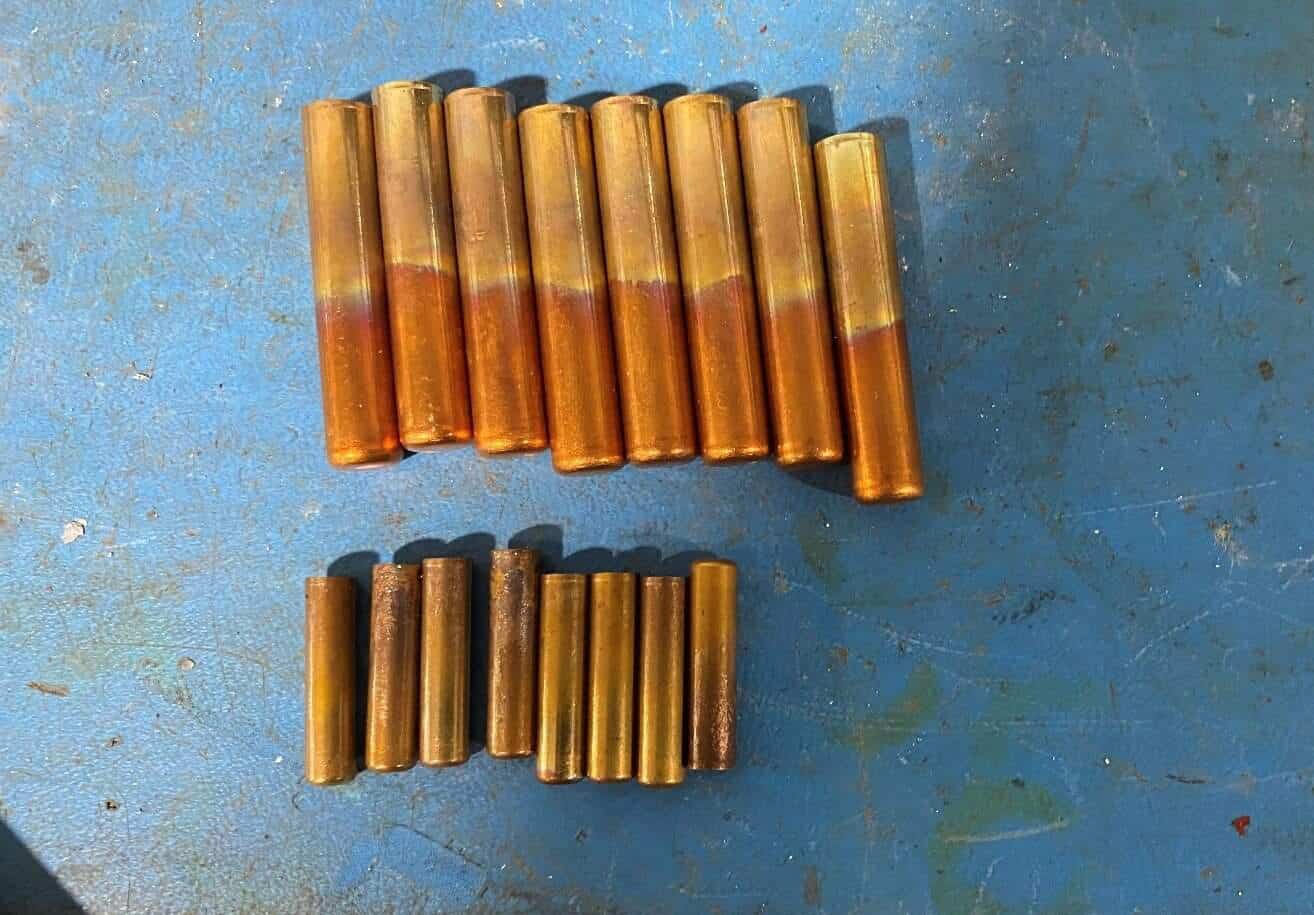
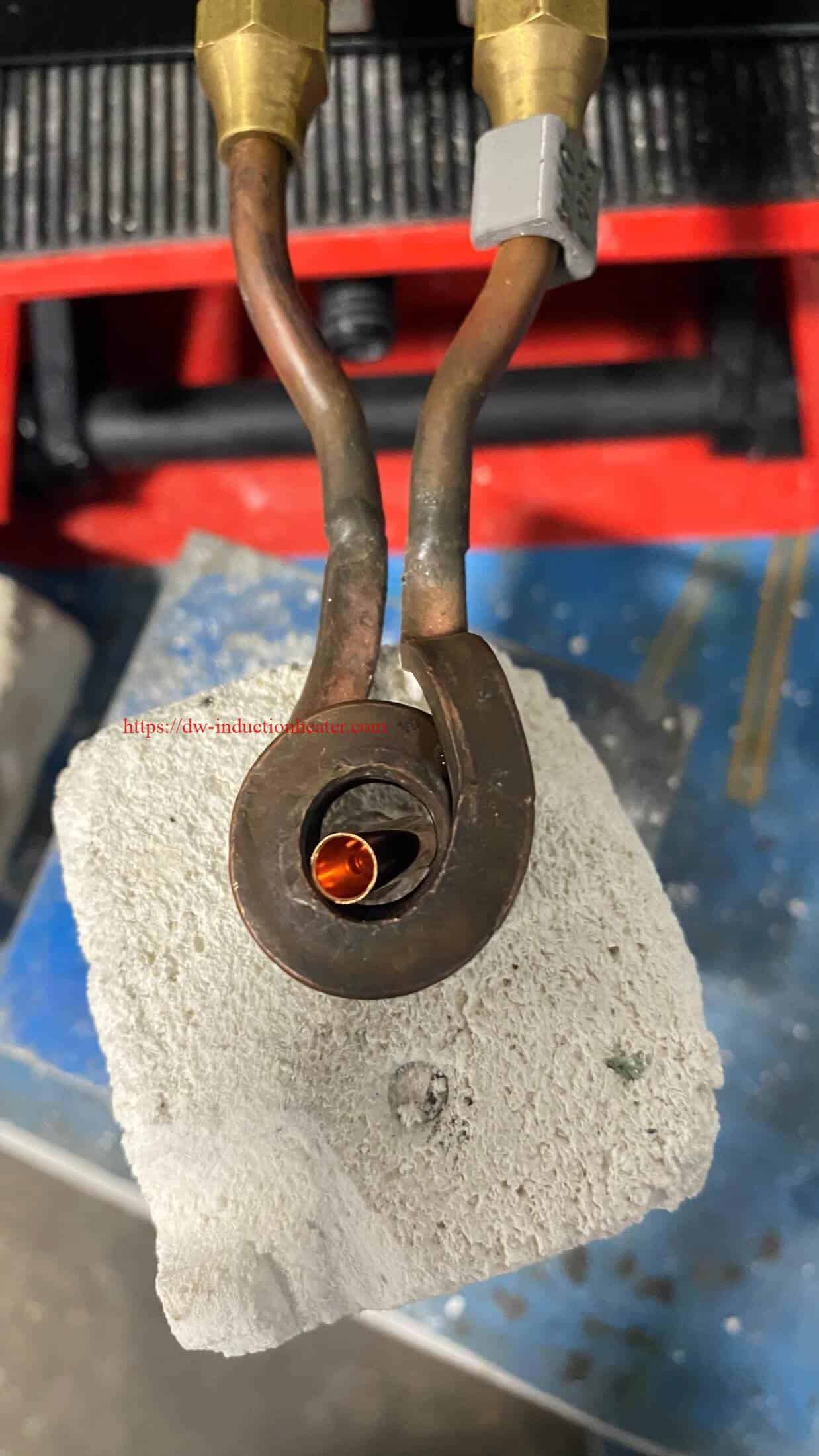
Application Note Objective:A manufacturer of brass bullet shells wants to upgrade their existing induction heating equipment and is looking for improved efficiency.The goal of this application test is to demonstrate that the DW-UHF-6KW-III induction system will meet and exceed its requirements for achieving improved heating times and maintaining heat uniformity within the targeted area. Two sizes of brass ammunition shells were used for the test– bullet casings with 1.682” (42.7 mm) length and 0.929” (23.5 mm) length. The targeted annealing timeis 0.6seconds for both parts usinga single induction heating coil.Equipment: HLQ DW-UHF-6kW-III air-cooled induction heating systemwasutilized in the annealing process. Tempilaqpaint was used to determineif the desired temperature in the annealed area is reached.
Process: The brass bullet shells were positioned in the induction heating coil.The area to be annealed took about 60% of the part’s length counting from the open end. The heated area was painted with Tempilaqwhich helped us evaluate the temperature distribution.Both parts successfully reached the target temperature of 750°F (398°C) in 0.6sec. For the smaller part, the power supply power was reduced to 45% to prevent the part’s overheating.
In general, the main purpose of induction annealing heat treatment is to soften the steel, regenerate overheated steel structures or just remove internal tensions.
It basically consists of heating to austenitizing temperature (800ºC and 950ºC depending on the type of steel), followed by slow cooling.
Induction Annealing is a heat treatment process which involves heating of material above its recrystallization temperature. The aim is to reach and maintain a suitable temperature for enough time followed by proper cooling. It is often used in metallurgy and material science to make the treated sample more workable by reducing its hardness and increasing its ductility (ability to undergo a change of form without breaking).
Annealing alters the physical and sometimes the chemical properties of the material as recrystallization is obtained during the process of cooling. Therefore, the outcoming structures of many alloys, including carbon steel, are both dependent on the heating and on the cooling rate. Ferrous metals, such as steel, require slow cooling to anneal. Other materials (e.g. copper, silver) can be either cooled slowly in air or quickly quenched in water.
Induction heating provides improved control of the annealing process. Repeatable heating profiles can easily be obtained by precise regulation of the heating power. Since the workpiece is directly heated by the magnetic field, a faster response can be achieved. Moreover, the high overall efficiency of the induction heating process is crucial for such lengthy treatment.
Compared to most of the standard methods, induction annealing is a clean and easy to automate, contactless approach providing a high quality of the treated workpieces.
Induction annealing heating advantages:
Processed in line with control of parameters in real time
Metallurgical results similar to those obtained in conventional ovens
Less environmental pollution
Increase energy efficiency
Reduced processing time
Ability to control the heat, temperature accuracy
Ability to heat small areas without changing the characteristics of the rest of the part
Cycle accurate and repetitive heat
Reduction of surface oxidation
Improved job environment
Some related industries are tube and pipe, medicine, oil and gas and automotive.
Plastic Injection Molding with Induction Heating Machine
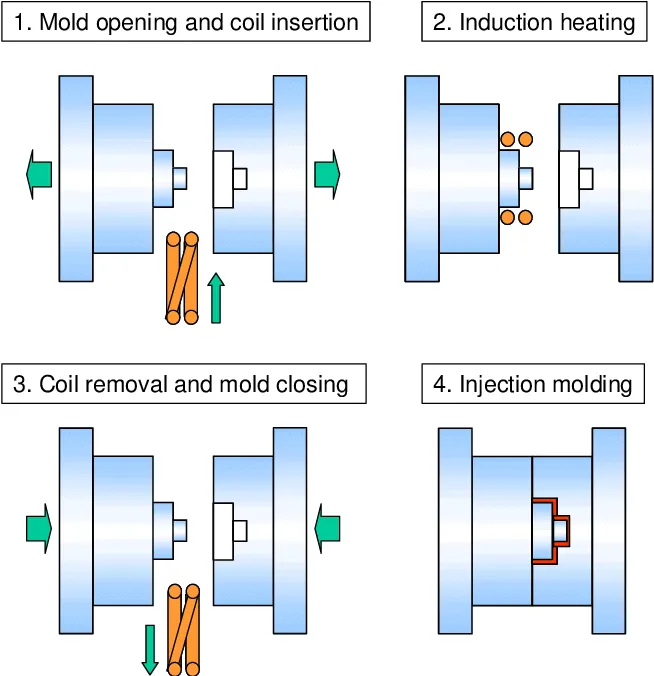
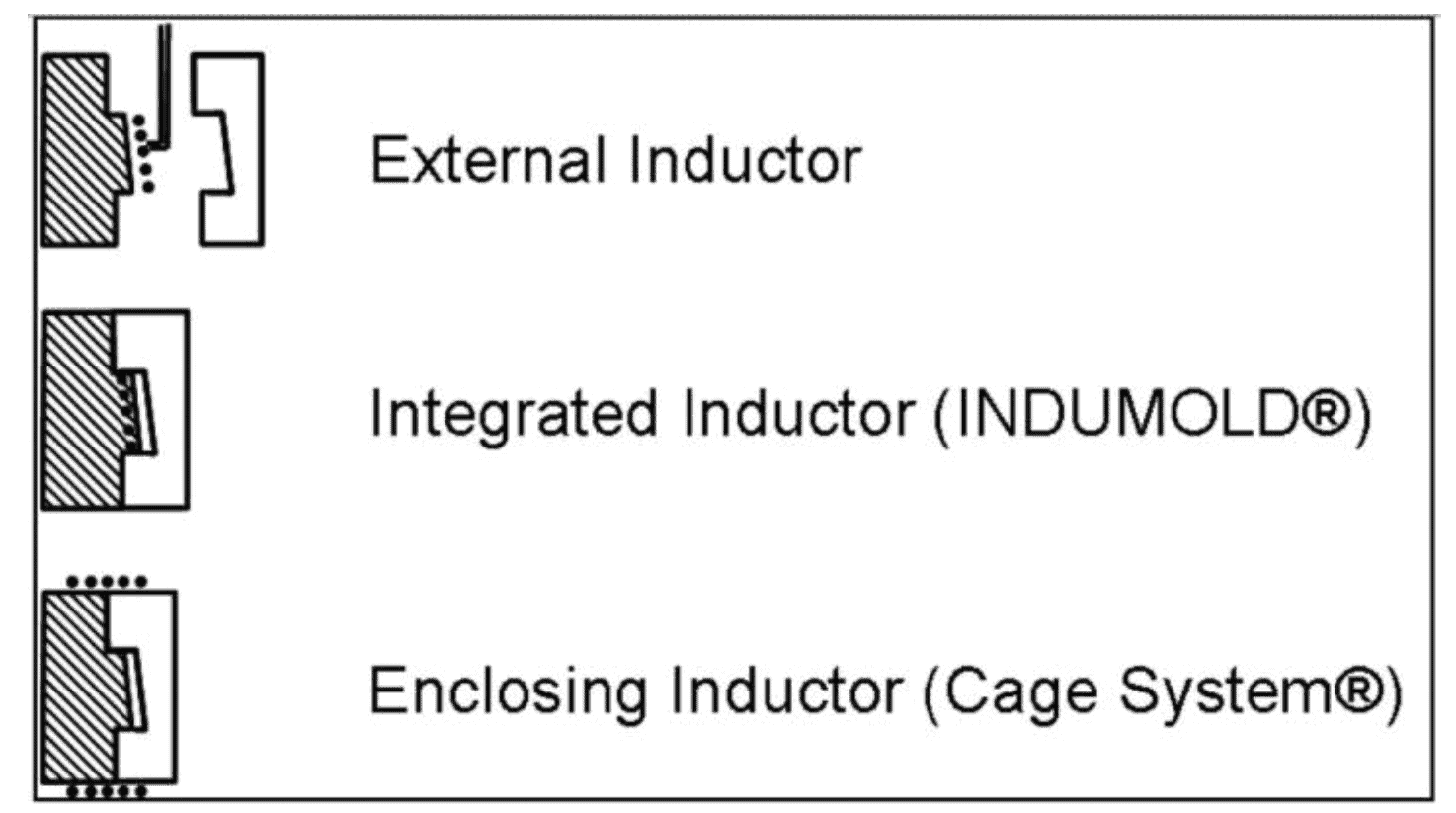
Plastic Injection molding with induction heating requires pre-heating of the molds to a higher temperature, to ensure the proper flow or curing of the injection-molded material. Typical heating methods used in the industry are steam or resistive heating, but they are messy, inefficient, and unreliable. Induction heating is a clean, fast and energy-efficient alternative which has been widely used in recent years to replace steam, gas or resistive heating of molds and dies.
What is Injection Moulding?
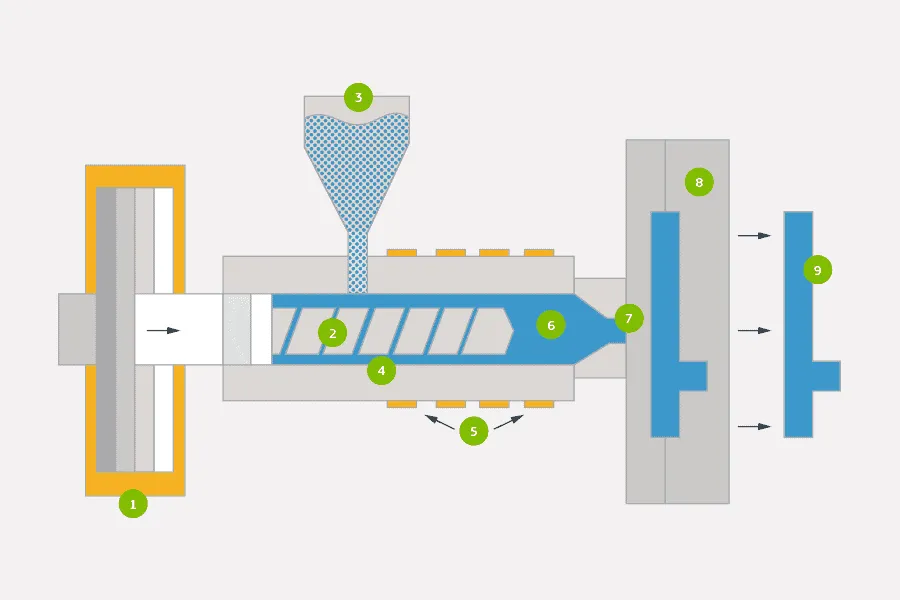
Plastic injection moulding with induction heating is the process of melting plastic pellets (thermosetting/ thermoplastic polymers) that once malleable enough, are injected at pressure into a mould cavity, which fills and solidifies to produce the final product.
How Does Plastic Injection Moulding Work?
The plastic injection moulding process at Protolabs is a standard process involving an aluminium mould. Aluminium transfers heat much more efficiently than steel, so does not require cooling channels - which means the time we save on cooling can be applied to monitoring fill pressure, cosmetic concerns and producing a quality part.
Resin pellets are loaded into a barrel where they will eventually be melted, compressed, and injected into the mould’s runner system. Hot resin is shot into the mould cavity through the gates and the part is moulded. Ejector pins facilitate removal of the part from the mould where it falls into a loading bin. When the run is complete, parts (or the initial sample run) are boxed and shipped shortly thereafter.
How Induction Heating is used in Dies & Molds Industry?
Induction Preheating of tools and molds for plastic injection molding
Heating of molding tools for curing of rubber product and automobile tires
Die induction heating for catheter tipping and medical products manufacturing
Die and platen heating for metal stamping and forming
Induction Preheating of casting molds in the metal casting industry
Induction Heat treating and hardening of stamping and punching tools and dies
Curing coating of pipeline using induction heating involves a process where heat is generated directly in the pipe wall or the coating material by an electromagnetic field. This method is used to cure epoxy, powder coatings, or other types of coatings that require heat to set and harden properly.
Here’s an overview of how the process generally works:
Preparation: The pipeline surface is prepared for coating. This may involve cleaning and potentially applying a primer or undercoat depending on the coating system’s requirements.
Coating Application: The coating is applied to the pipeline. This might be done by spraying, brushing, or another method suitable for the coating material and the pipe.
Induction Coil Setup: After the coating application, induction coils are placed around the pipeline. These coils are part of an induction heating system that includes a power source and control unit.
Heating Process: The induction heating system is activated. An alternating current passes through the induction coil, creating a varying magnetic field that induces eddy currents in the conductive pipe material.
Curing: The eddy currents generate heat due to the electrical resistance of the pipe material. This heat is transferred to the coating, bringing it up to the required temperature for curing. The temperature and duration of heating depend on the type of coating used and the manufacturer’s specifications.
Monitoring and Control: The temperature of the pipe and coating is carefully monitored, often with temperature sensors or infrared cameras, to ensure even heating and to prevent overheating, which could damage the coating or the pipe. The induction heating system is regulated to maintain the necessary curing temperature for the specified time.
Cooling: After the curing time has elapsed, the induction heating is turned off, and the pipeline is allowed to cool down. This may be a controlled process to avoid thermal shock or any adverse effects on the coating integrity.
Inspection: Once the pipeline has cooled, the coating is inspected to ensure it has cured properly. Inspection methods may include visual checks, dry film thickness measurements, adhesion testing, and holiday detection to ensure there are no defects or discontinuities in the coating.
Induction heating for curing coatings on pipelines offers several advantages:
Speed: Induction heating can cure coatings much faster than traditional methods like oven curing or air drying.
Control: The process provides precise control over the heating temperature and rate, leading to a uniform cure of the coating.
Energy Efficiency: Induction heating is often more energy-efficient than other heating methods because the heat is generated directly in the material.
Safety: This method minimizes the risk of fire and explosion since there are no open flames or hot surfaces.
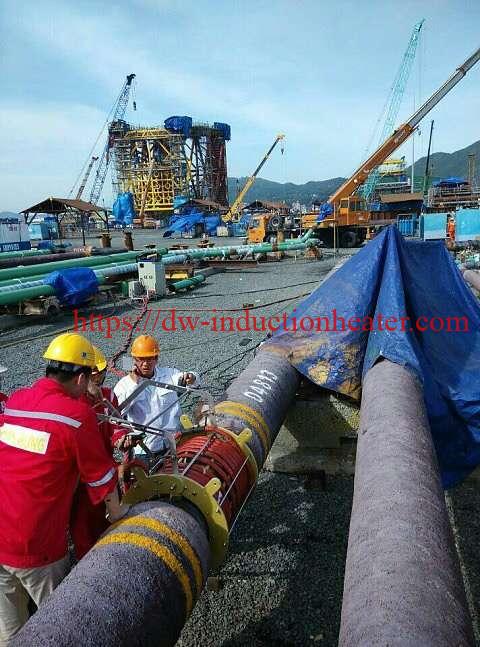
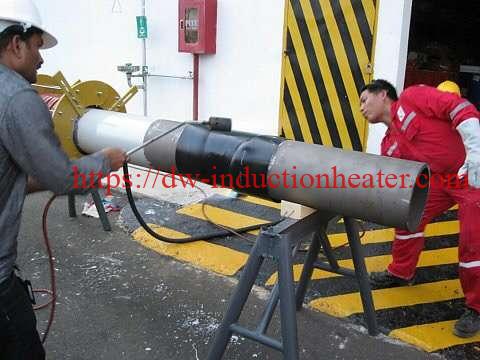
Induction heating is particularly useful in field joint coating applications where the pipeline sections are welded together in the field and the coating at the joint needs to be cured quickly to maintain the integrity of the pipeline’s protective system.
Curing coating of pipeline using induction heating involves a process where heat is generated directly in the pipe wall or the coating material by an electromagnetic field. This method is used to cure epoxy, powder coatings, or other types of coatings that require heat to set and harden properly.
Here’s an overview of how the process generally works:
Preparation: The pipeline surface is prepared for coating. This may involve cleaning and potentially applying a primer or undercoat depending on the coating system’s requirements.
Coating Application: The coating is applied to the pipeline. This might be done by spraying, brushing, or another method suitable for the coating material and the pipe.
Induction Coil Setup: After the coating application, induction coils are placed around the pipeline. These coils are part of an induction heating system that includes a power source and control unit.
Heating Process: The induction heating system is activated. An alternating current passes through the induction coil, creating a varying magnetic field that induces eddy currents in the conductive pipe material.
Curing: The eddy currents generate heat due to the electrical resistance of the pipe material. This heat is transferred to the coating, bringing it up to the required temperature for curing. The temperature and duration of heating depend on the type of coating used and the manufacturer’s specifications.
Monitoring and Control: The temperature of the pipe and coating is carefully monitored, often with temperature sensors or infrared cameras, to ensure even heating and to prevent overheating, which could damage the coating or the pipe. The induction heating system is regulated to maintain the necessary curing temperature for the specified time.
Cooling: After the curing time has elapsed, the induction heating is turned off, and the pipeline is allowed to cool down. This may be a controlled process to avoid thermal shock or any adverse effects on the coating integrity.
Inspection: Once the pipeline has cooled, the coating is inspected to ensure it has cured properly. Inspection methods may include visual checks, dry film thickness measurements, adhesion testing, and holiday detection to ensure there are no defects or discontinuities in the coating.
Induction heating for curing coatings on pipelines offers several advantages:
Speed: Induction heating can cure coatings much faster than traditional methods like oven curing or air drying.
Control: The process provides precise control over the heating temperature and rate, leading to a uniform cure of the coating.
Energy Efficiency: Induction heating is often more energy-efficient than other heating methods because the heat is generated directly in the material.
Safety: This method minimizes the risk of fire and explosion since there are no open flames or hot surfaces.
Induction heating is particularly useful in field joint coating applications where the pipeline sections are welded together in the field and the coating at the joint needs to be cured quickly to maintain the integrity of the pipeline’s protective system.
HLQ induction heating machine manufacturer provides the service of induction brazing,melting,hot forming,hardening surface,annealing,shrink fitting,PWHT,etc.
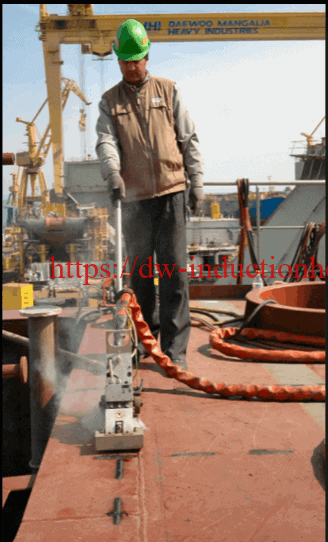
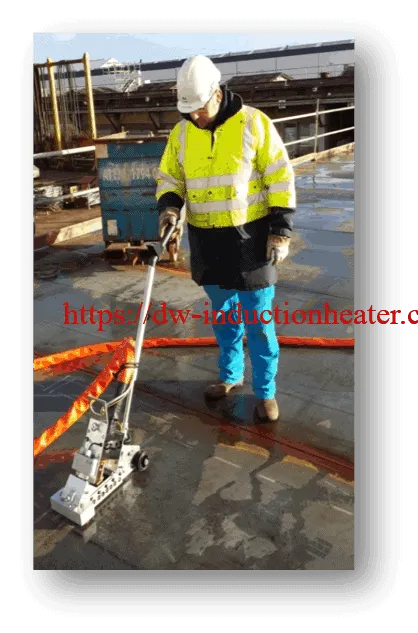 The traditional method used for this application is flame straightening. For this, a skilled operator is dedicated to provide heat in specific areas, following a heating pattern, which determines the reduction of distortion in the metal structure.
Currently this straightening process has high costs because it requires a large amount of skilled labour, high workplace hazards, contamination of work area and high energy consumption.
During the welding of plates to fixed structures, buckling stress is produced. In order to eliminate this distortion, different traditional deck and bulkhead straightening techniques are employed: welding of beads in non-visible areas, cutting and re-welding of plates, and stress relieving using flame heating. These techniques are big time consumers, costly and do not provide any added value. Improving the efficiency of this process is paramount.
The HLQ Induction Straightening Solution provides a simple, flexible, low-maintenance alternative to traditional deck and bulkhead straightening techniques. The quick, clean induction heating system rapidly generates heat with precision to relief the stress and straighten the plate.
The traditional method used for this application is flame straightening. For this, a skilled operator is dedicated to provide heat in specific areas, following a heating pattern, which determines the reduction of distortion in the metal structure.
Currently this straightening process has high costs because it requires a large amount of skilled labour, high workplace hazards, contamination of work area and high energy consumption.
During the welding of plates to fixed structures, buckling stress is produced. In order to eliminate this distortion, different traditional deck and bulkhead straightening techniques are employed: welding of beads in non-visible areas, cutting and re-welding of plates, and stress relieving using flame heating. These techniques are big time consumers, costly and do not provide any added value. Improving the efficiency of this process is paramount.
The HLQ Induction Straightening Solution provides a simple, flexible, low-maintenance alternative to traditional deck and bulkhead straightening techniques. The quick, clean induction heating system rapidly generates heat with precision to relief the stress and straighten the plate.
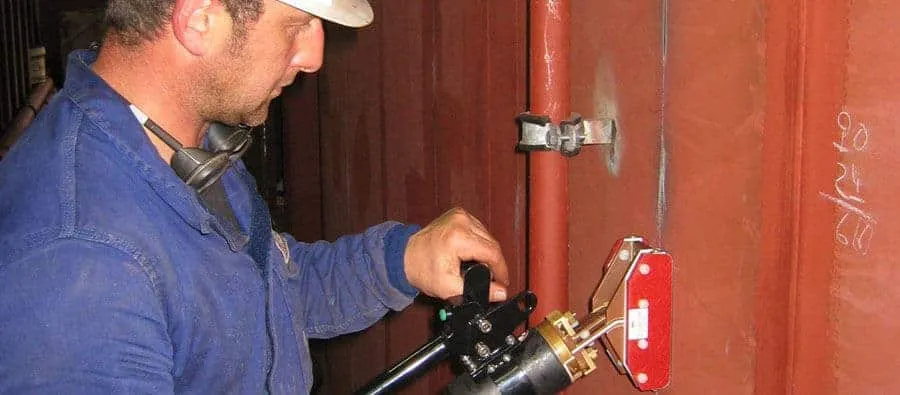 Easy to Operate
System operators can master the three basic steps with just a few hours of training.
Easy to Operate
System operators can master the three basic steps with just a few hours of training.
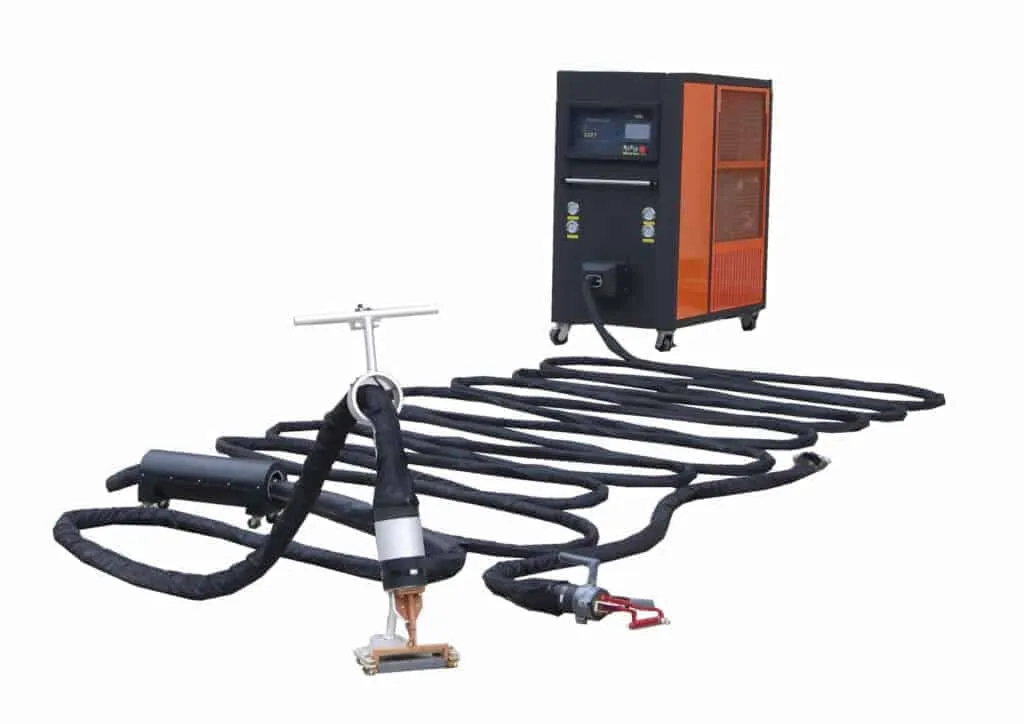 What is induction straightening?