 Induction Heating Molding Catheter Tip With IGBT High Frequency Heating Units
Objective Heat a water-cooled steel mandrel to 700°F (371ºC) to form a high quality Teflon catheter tip.
Material Teflon catheter tubing, mandrel assembly
Temperature 600-700°F (315-371ºC)
Frequency 376 kHz
Equipment • DW-UHF-6 kW induction heating system, equipped with a remote workhead containing one 0.66μF capacitor.
• An induction heating coil designed and developed specifically for this application.
Process A two turn coil is used to heat the steel mandrel to 660ºF (371ºC) in 2.7 seconds. To form the catheter tip, RF power is applied while the catheter is held over the mandrel. The tubing is then pushed on to the mandrel to form a consistent, even tip.
Results/Benefits Induction heating provides:
• Precise, repeatable application of heat
• Non-contact heating
• Faster cycle times
https://dw-inductionheater.com/induction-heating-molding-catheter-tip.html?feed_id=245188&_unique_id=663f98a7d2a68
Induction Heating Molding Catheter Tip With IGBT High Frequency Heating Units
Objective Heat a water-cooled steel mandrel to 700°F (371ºC) to form a high quality Teflon catheter tip.
Material Teflon catheter tubing, mandrel assembly
Temperature 600-700°F (315-371ºC)
Frequency 376 kHz
Equipment • DW-UHF-6 kW induction heating system, equipped with a remote workhead containing one 0.66μF capacitor.
• An induction heating coil designed and developed specifically for this application.
Process A two turn coil is used to heat the steel mandrel to 660ºF (371ºC) in 2.7 seconds. To form the catheter tip, RF power is applied while the catheter is held over the mandrel. The tubing is then pushed on to the mandrel to form a consistent, even tip.
Results/Benefits Induction heating provides:
• Precise, repeatable application of heat
• Non-contact heating
• Faster cycle times
https://dw-inductionheater.com/induction-heating-molding-catheter-tip.html?feed_id=245188&_unique_id=663f98a7d2a68

 Induction Heating Plastic Catheter Tube With IGBT High Frequency Heating Units
Objective Heat a metal braid in a plastic catheter tube to 250°F (121.1ºC) so that another catheter tube can be bonded to it.
Material 0.05” (1.27mm)diameter catheter tubes, some with a metal braid, ceramic rod
Temperature 250°F(121.1ºC)
Frequency 306kHz
Equipment • DW-UHF-4.5kW induction heating system equipped with a remote workhead with one 1.2 μF capacitor
• An induction heating coil designed and developed specifically for this application.
Process A single turn helical coil is used to heat the metal braid for plastic reflow. To maintain the correct inside diameter of the tubing. A ceramic rod is inserted through the tubing. Heat is applied for 3.5 seconds to reach 250°F (121.1ºC). The metal braid melts the plastic and creates a bond.
Results/Benefits Induction heating provides:
• Controlled rapid application of heat
• Consistent, repeatable results
• Energy efficient
Induction Heating Plastic Catheter Tube With IGBT High Frequency Heating Units
Objective Heat a metal braid in a plastic catheter tube to 250°F (121.1ºC) so that another catheter tube can be bonded to it.
Material 0.05” (1.27mm)diameter catheter tubes, some with a metal braid, ceramic rod
Temperature 250°F(121.1ºC)
Frequency 306kHz
Equipment • DW-UHF-4.5kW induction heating system equipped with a remote workhead with one 1.2 μF capacitor
• An induction heating coil designed and developed specifically for this application.
Process A single turn helical coil is used to heat the metal braid for plastic reflow. To maintain the correct inside diameter of the tubing. A ceramic rod is inserted through the tubing. Heat is applied for 3.5 seconds to reach 250°F (121.1ºC). The metal braid melts the plastic and creates a bond.
Results/Benefits Induction heating provides:
• Controlled rapid application of heat
• Consistent, repeatable results
• Energy efficient
 Induction Shrink Fitting Steel Tube With IGBT Heating Units
Objective Heating a steel tube to 500-1000°F for a shrink-fitting application. Determine expansion (growth) of ID at varying temperatures.
Material Steel tubes 7” OD x 4.75” ID x 5” heat zone
Type ‘K’ thermocouple to measure temperature
Thermal blanket
Temperature 500, 800, 1000 °F (260, 427, 538° C)
Frequency 66 kHz
Equipment DW-HF-7.5, 7.5 kW, 150-400 kHz induction power supply, equipped with a remote heat station containing two 1.5 μF capacitors (for a total of 0.75 μF)
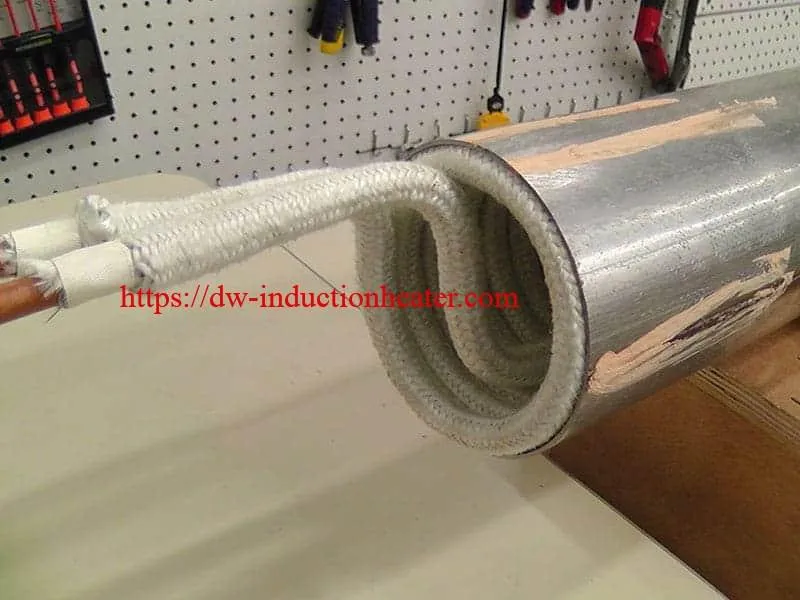
A multi-turn, special series-parallel induction heating coil designed and developed specifically for this application.
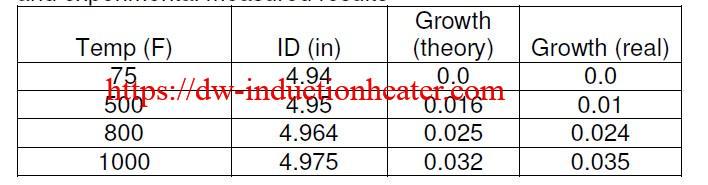
Process Initial tests were completed on a sample without a thermal blanket. A thermocouple is slipped between the copper ring and the steel tube to measure temperature. The part measured
4.940” (at room temperature with an ID gauge.) The part reaches 1000°F (538°C) in about 10 minutes.
The chart below shows the comparison between theoretical and experimental measured results
Induction Shrink Fitting Steel Tube With IGBT Heating Units
Objective Heating a steel tube to 500-1000°F for a shrink-fitting application. Determine expansion (growth) of ID at varying temperatures.
Material Steel tubes 7” OD x 4.75” ID x 5” heat zone
Type ‘K’ thermocouple to measure temperature
Thermal blanket
Temperature 500, 800, 1000 °F (260, 427, 538° C)
Frequency 66 kHz
Equipment DW-HF-7.5, 7.5 kW, 150-400 kHz induction power supply, equipped with a remote heat station containing two 1.5 μF capacitors (for a total of 0.75 μF)
A multi-turn, special series-parallel induction heating coil designed and developed specifically for this application.
Process Initial tests were completed on a sample without a thermal blanket. A thermocouple is slipped between the copper ring and the steel tube to measure temperature. The part measured
4.940” (at room temperature with an ID gauge.) The part reaches 1000°F (538°C) in about 10 minutes.
The chart below shows the comparison between theoretical and experimental measured results

 Induction Shrink Fitting For Inserts with IGBT Shrink fitting Heater
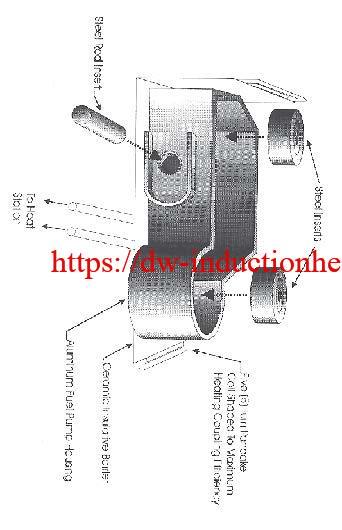
Objective: To heat an aluminum fuel pump housing measuring 8" x 4 1/2" x 3 1/2" to 3750F, allowing steel parts to be inserted. Presently the housings are heated for over one hour in a convection oven. The areas that are to have steel parts inserted measure 1.5" and 0.6875" in diameter. In addition, the insertion process lasts for a little over one minute, so 3750F should be maintained for a
period of time to complete the process.
Material: Aluminum Pump Housing measuring 8" x 4 1/2" x 3 1/2"
Steel insertion parts.
Temperature: 3750F
Application: By using the DW-HF- 25, 25 kW output solid state induction power supply the following results were achieved.
- 3750F was reached in one (1) minute to allow for insertion.
- 20 housings were successfully heated using a five (5) turn right angle pancake coil.
Equipment: Ameritherm SP 25, 25 kW output solid state induction power supply including one (1) remote heat station containing four (4) capacitors totalling 1.0 μF, and a five (5) turn right angle pancake coil made from 3/16" copper tube.
Frequency: 80 kHz
Induction Shrink Fitting For Inserts with IGBT Shrink fitting Heater
Objective: To heat an aluminum fuel pump housing measuring 8" x 4 1/2" x 3 1/2" to 3750F, allowing steel parts to be inserted. Presently the housings are heated for over one hour in a convection oven. The areas that are to have steel parts inserted measure 1.5" and 0.6875" in diameter. In addition, the insertion process lasts for a little over one minute, so 3750F should be maintained for a
period of time to complete the process.
Material: Aluminum Pump Housing measuring 8" x 4 1/2" x 3 1/2"
Steel insertion parts.
Temperature: 3750F
Application: By using the DW-HF- 25, 25 kW output solid state induction power supply the following results were achieved.
- 3750F was reached in one (1) minute to allow for insertion.
- 20 housings were successfully heated using a five (5) turn right angle pancake coil.
Equipment: Ameritherm SP 25, 25 kW output solid state induction power supply including one (1) remote heat station containing four (4) capacitors totalling 1.0 μF, and a five (5) turn right angle pancake coil made from 3/16" copper tube.
Frequency: 80 kHz
 Induction Heating Shrink Fitting Camshaft Gear with IGBT Induction Heater
Objective: Heating a camshaft gear with a bore size of 1.630" to shrink fit over a steel shaft that has a diameter of 1.632". A temperature of 5000F is required for the gear to expand 0.002" in order to slip over the shaft. Production is presently done at a rate of 15-20 gears per 24 hour shift by heating the gear
on a hot plate. The hot plate heating cycle lasts for approximately 45 minutes.
The customer would like to explore the options available in terms of heating times and machine size.
Material: Steel Camshaft Gear measuring 7" in diameter, 1" thick, with a bore size of 1.630".
Temperature: 5000F
Application: A unique three (3) turn helical coil along with the various DAWEI solid state induction power supplies were used to achieve the following results:
- 5000F was reached in three (3) minutes while using the DW-HF 5, 5 kW output solid state induction power supply.
- 5000F was reached in five (5), eight (8), and ten (10) minutes using the DW-HF-3, 5 kW output solid state induction power supply.
- Even heating was observed as a result of the unique three (3) turn helical induction coil.
Equipment: DW-HF-35 and DW-HF-55 kW output solid state induction power supplies respectively, including remote heat stations and a unique three turn helical coil made from 3/16" copper tubing and having a 4.4" inside diameter.
Frequency: 62 kHz
Induction Heating Shrink Fitting Camshaft Gear with IGBT Induction Heater
Objective: Heating a camshaft gear with a bore size of 1.630" to shrink fit over a steel shaft that has a diameter of 1.632". A temperature of 5000F is required for the gear to expand 0.002" in order to slip over the shaft. Production is presently done at a rate of 15-20 gears per 24 hour shift by heating the gear
on a hot plate. The hot plate heating cycle lasts for approximately 45 minutes.
The customer would like to explore the options available in terms of heating times and machine size.
Material: Steel Camshaft Gear measuring 7" in diameter, 1" thick, with a bore size of 1.630".
Temperature: 5000F
Application: A unique three (3) turn helical coil along with the various DAWEI solid state induction power supplies were used to achieve the following results:
- 5000F was reached in three (3) minutes while using the DW-HF 5, 5 kW output solid state induction power supply.
- 5000F was reached in five (5), eight (8), and ten (10) minutes using the DW-HF-3, 5 kW output solid state induction power supply.
- Even heating was observed as a result of the unique three (3) turn helical induction coil.
Equipment: DW-HF-35 and DW-HF-55 kW output solid state induction power supplies respectively, including remote heat stations and a unique three turn helical coil made from 3/16" copper tubing and having a 4.4" inside diameter.
Frequency: 62 kHz
 Induction Shrink Fitting Assemblies
Objective To use induction to prepare cast iron assemblies for shrink fit assembly
Material Customer supplied cast iron rocker arms of varying sizes
Temperature 450 ºF (232 °C)
Process Time 20 seconds
Frequency 148 kHz
Equipment DW-UHF-5.0 kW, 150-400 kHz solid state induction heating system, equipped with a remote heat station containing one 1.0μF capacitor
An induction heating coil designed and developed specifically for this application.
Process A four-turn helical coil heats the ring at one end of the assembly. The coil is designed to concentrate the field towards the center of the assembly where the thermal mass is greatest.
Across the heated ring, the coil presents a lighter field. After heating, a pin is place within the ring and the assembly is water quenched.
The heat time varies from part to part but is less than 20 seconds.
Results/Benefits Induction heating satisfies the needs of this process for:
• rapid part heating
• flexibility for parts of differing geometries
• individual, series part heating, suitable for automation
• a clean source of heat
• even heat distribution
Induction Shrink Fitting Assemblies
Objective To use induction to prepare cast iron assemblies for shrink fit assembly
Material Customer supplied cast iron rocker arms of varying sizes
Temperature 450 ºF (232 °C)
Process Time 20 seconds
Frequency 148 kHz
Equipment DW-UHF-5.0 kW, 150-400 kHz solid state induction heating system, equipped with a remote heat station containing one 1.0μF capacitor
An induction heating coil designed and developed specifically for this application.
Process A four-turn helical coil heats the ring at one end of the assembly. The coil is designed to concentrate the field towards the center of the assembly where the thermal mass is greatest.
Across the heated ring, the coil presents a lighter field. After heating, a pin is place within the ring and the assembly is water quenched.
The heat time varies from part to part but is less than 20 seconds.
Results/Benefits Induction heating satisfies the needs of this process for:
• rapid part heating
• flexibility for parts of differing geometries
• individual, series part heating, suitable for automation
• a clean source of heat
• even heat distribution
