 A source of high frequency electricity is used to drive a large alternating current through a induction coil. This induction heating coil is known as the work coil. See the picture opposite.
The passage of current through this induction heating coil generates a very intense and rapidly changing magnetic field in the space within the work coil. The workpiece to be heated is placed within this intense alternating magnetic field.
Depending on the nature of the workpiece material, a number of things happen...
The alternating magnetic field induces a current flow in the conductive workpiece. The arrangement of the work coil and the workpiece can be thought of as an electrical transformer. The work coil is like the primary where electrical energy is fed in, and the workpiece is like a single turn secondary that is short-circuited. This causes tremendous currents to flow through the workpiece. These are known as eddy currents.
In addition to this, the high frequency used in Induction Heating applications gives rise to a phenomenon called skin effect. This skin effect forces the alternating current to flow in a thin layer towards the surface of the workpiece. The skin effect increases the effective resistance of the metal to the passage of the large current. Therefore it greatly increases the induction heating effect of the induction heater caused by the current induced in the workpiece.
[pdf-embedder url="https://dw-inductionheater.com/wp-content/uploads/2018/08/induction_heating_principle-1.pdf" title="induction_heating_principle"]
https://dw-inductionheater.com/how-does-induction-heating-work.html?feed_id=243490&_unique_id=662e7512c0d85
A source of high frequency electricity is used to drive a large alternating current through a induction coil. This induction heating coil is known as the work coil. See the picture opposite.
The passage of current through this induction heating coil generates a very intense and rapidly changing magnetic field in the space within the work coil. The workpiece to be heated is placed within this intense alternating magnetic field.
Depending on the nature of the workpiece material, a number of things happen...
The alternating magnetic field induces a current flow in the conductive workpiece. The arrangement of the work coil and the workpiece can be thought of as an electrical transformer. The work coil is like the primary where electrical energy is fed in, and the workpiece is like a single turn secondary that is short-circuited. This causes tremendous currents to flow through the workpiece. These are known as eddy currents.
In addition to this, the high frequency used in Induction Heating applications gives rise to a phenomenon called skin effect. This skin effect forces the alternating current to flow in a thin layer towards the surface of the workpiece. The skin effect increases the effective resistance of the metal to the passage of the large current. Therefore it greatly increases the induction heating effect of the induction heater caused by the current induced in the workpiece.
[pdf-embedder url="https://dw-inductionheater.com/wp-content/uploads/2018/08/induction_heating_principle-1.pdf" title="induction_heating_principle"]
https://dw-inductionheater.com/how-does-induction-heating-work.html?feed_id=243490&_unique_id=662e7512c0d85
2024年4月28日星期日
how does induction heating work?
A source of high frequency electricity is used to drive a large alternating current through a induction coil. This induction heating coil is known as the work coil. See the picture opposite.
The passage of current through this induction heating coil generates a very intense and rapidly changing magnetic field in the space within the work coil. The workpiece to be heated is placed within this intense alternating magnetic field.
Depending on the nature of the workpiece material, a number of things happen...
The alternating magnetic field induces a current flow in the conductive workpiece. The arrangement of the work coil and the workpiece can be thought of as an electrical transformer. The work coil is like the primary where electrical energy is fed in, and the workpiece is like a single turn secondary that is short-circuited. This causes tremendous currents to flow through the workpiece. These are known as eddy currents.
In addition to this, the high frequency used in Induction Heating applications gives rise to a phenomenon called skin effect. This skin effect forces the alternating current to flow in a thin layer towards the surface of the workpiece. The skin effect increases the effective resistance of the metal to the passage of the large current. Therefore it greatly increases the induction heating effect of the induction heater caused by the current induced in the workpiece.
[pdf-embedder url="https://dw-inductionheater.com/wp-content/uploads/2018/08/induction_heating_principle-1.pdf" title="induction_heating_principle"]
https://dw-inductionheater.com/how-does-induction-heating-work.html?feed_id=243490&_unique_id=662e7512c0d85

2024年4月15日星期一
Induction Heating Basic
Induction Heating Basics
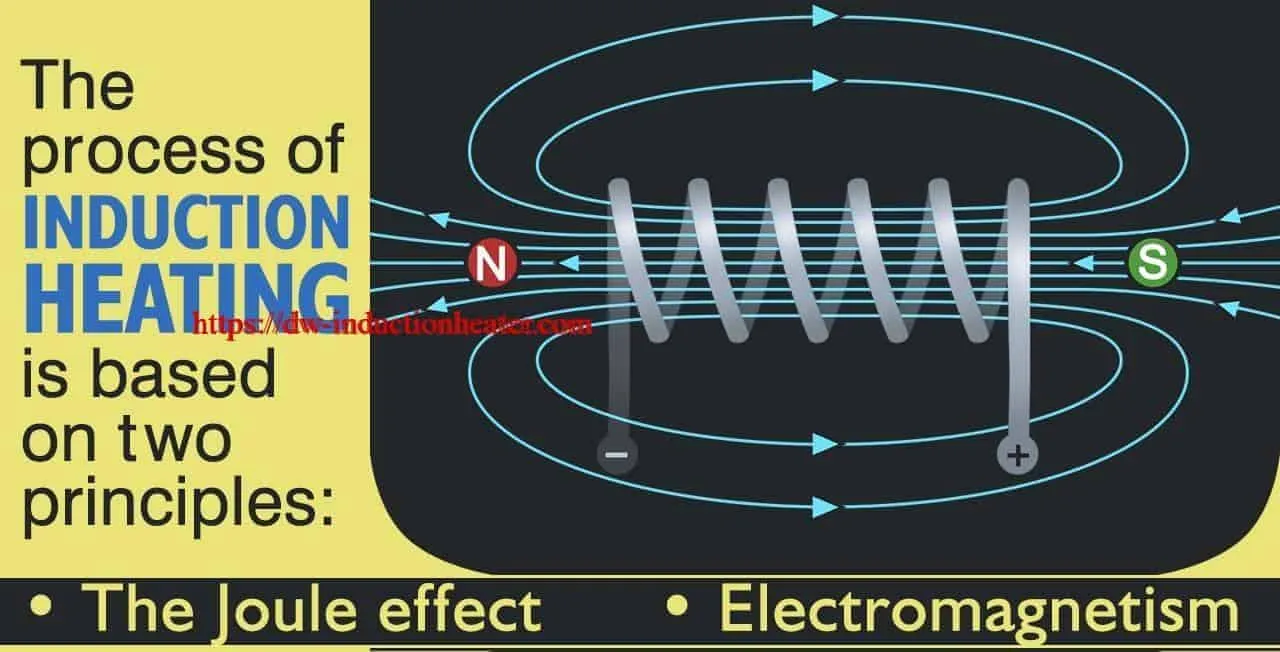
Induction heating takes place in an electrically conducting object (not necessarily magnetic steel) when the object is placed in a varying magnetic field. Induction heating is due to the hysteresis and eddy-current losses.Induction heating is the process of heating an electrically conducting object (usually a metal) by electromagnetic induction, through heat generated in the object by eddy currents. An induction heater consists of an electromagnet and an electronic oscillator that passes a high-frequency alternating current (AC) through the electromagnet. The rapidly alternating magnetic field penetrates the object, generating electric currents inside the conductor, called eddy currents. The eddy currents flowing through the resistance of the material heat it by Joule heating. In ferromagnetic (and ferrimagnetic) materials like iron, heat may also be generated by magnetic hysteresis losses. The frequency of current used depends on the object size, material type, coupling (between the work coil and the object to be heated) and the penetration depth.
Hysteresis losses only occur in magnetic materials such as steel, nickel, and very few others. Hysteresis loss states that this is caused by friction between molecules when the material is magnetized first in one direction, and then in the other. The molecules may be regarded as small magnets which turn around with each reversal of direction of the magnetic field. Work (energy) is required to turn them around. The energy converts into heat. The rate of expenditure of energy (power) increases with an increased rate of reversal (frequency).
Eddy-current losses occur in any conducting material in a varying magnetic field. This causes heading, even if the materials do not have any of the magnetic properties usually associated with iron and steel. Examples are copper, brass, aluminum, zirconium, nonmagnetic stainless steel, and uranium. Eddy currents are electric currents inducted by transformer action in the material. As their name implies, they appear to flow around in swirls on eddies within a solid mass of material. Eddy-current losses are much more important than hysteresis losses in induction heating. Note that induction heating is applied to nonmagnetic materials, where no hysteresis losses occur.
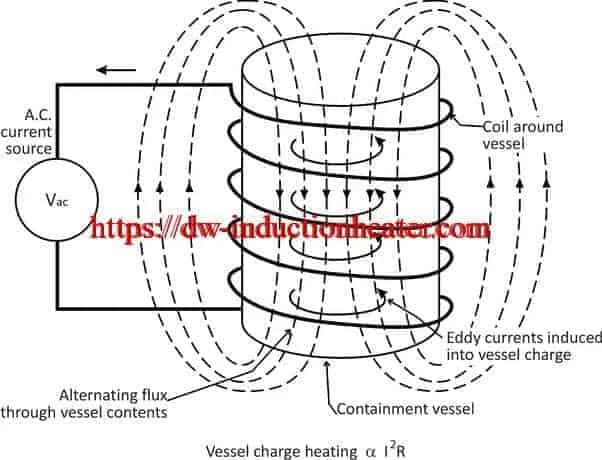 For the heating of steel for hardening, forging, melting, or any other purposes which require a temperature above Curie temperature, we cannot depend upon hysteresis. Steel loses its magnetic properties above this temperature. When steel is heated below the Curie point, the contribution of hysteresis is usually so small that it can be ignored. For all practical purposes, the I2R of the eddy currents is the only way in which electrical energy can be turned into heat for induction heating purposes.
Two basic things for induction heating to occur:
For the heating of steel for hardening, forging, melting, or any other purposes which require a temperature above Curie temperature, we cannot depend upon hysteresis. Steel loses its magnetic properties above this temperature. When steel is heated below the Curie point, the contribution of hysteresis is usually so small that it can be ignored. For all practical purposes, the I2R of the eddy currents is the only way in which electrical energy can be turned into heat for induction heating purposes.
Two basic things for induction heating to occur:
- A changing magnetic field
- An electrically conductive material placed into the magnetic field
2024年3月14日星期四
Induction Heating Theory PDF
 INDUCTION HEATING was first noted when it was found that heat was produced in transformer and motor windings, as mentioned in the Chapter “Heat Treating of Metal” in this book. Accordingly, the theory of induction heating was studied so that motors and transformers could be built for maximum efficiency by minimizing heating losses. The development of high-frequency induction power supplies provided a means of using induction heating for surface hardening. The early use of induction involved trial and error with built-up personal knowledge of specific
applications, but a lack of understanding of the induction heating principles. Throughout the years the understanding of the basic principles has been expanded, extending currently into computer modeling of heating applications and processes. Knowledge of these basic theories of induction heating helps to understand the application of induction heating as applied to induction heat treating. Induction heating occurs due to electromagnetic force fields producing an electrical current in a part. The parts heat due to the resistance to the flow of this electric current.....
[pdf-embedder url="https://dw-inductionheater.com/wp-content/uploads/2020/05/induction_heating_theory.pdf"]
induction_heating_theory
https://dw-inductionheater.com/induction-heating-theory-pdf.html?feed_id=236590&_unique_id=65f3300213ac8
INDUCTION HEATING was first noted when it was found that heat was produced in transformer and motor windings, as mentioned in the Chapter “Heat Treating of Metal” in this book. Accordingly, the theory of induction heating was studied so that motors and transformers could be built for maximum efficiency by minimizing heating losses. The development of high-frequency induction power supplies provided a means of using induction heating for surface hardening. The early use of induction involved trial and error with built-up personal knowledge of specific
applications, but a lack of understanding of the induction heating principles. Throughout the years the understanding of the basic principles has been expanded, extending currently into computer modeling of heating applications and processes. Knowledge of these basic theories of induction heating helps to understand the application of induction heating as applied to induction heat treating. Induction heating occurs due to electromagnetic force fields producing an electrical current in a part. The parts heat due to the resistance to the flow of this electric current.....
[pdf-embedder url="https://dw-inductionheater.com/wp-content/uploads/2020/05/induction_heating_theory.pdf"]
induction_heating_theory
https://dw-inductionheater.com/induction-heating-theory-pdf.html?feed_id=236590&_unique_id=65f3300213ac8
2023年11月5日星期日
Induction Heating Basic
Induction Heating Basics
Induction heating takes place in an electrically conducting object (not necessarily magnetic steel) when the object is placed in a varying magnetic field. Induction heating is due to the hysteresis and eddy-current losses.Induction heating is the process of heating an electrically conducting object (usually a metal) by electromagnetic induction, through heat generated in the object by eddy currents. An induction heater consists of an electromagnet and an electronic oscillator that passes a high-frequency alternating current (AC) through the electromagnet. The rapidly alternating magnetic field penetrates the object, generating electric currents inside the conductor, called eddy currents. The eddy currents flowing through the resistance of the material heat it by Joule heating. In ferromagnetic (and ferrimagnetic) materials like iron, heat may also be generated by magnetic hysteresis losses. The frequency of current used depends on the object size, material type, coupling (between the work coil and the object to be heated) and the penetration depth.
Hysteresis losses only occur in magnetic materials such as steel, nickel, and very few others. Hysteresis loss states that this is caused by friction between molecules when the material is magnetized first in one direction, and then in the other. The molecules may be regarded as small magnets which turn around with each reversal of direction of the magnetic field. Work (energy) is required to turn them around. The energy converts into heat. The rate of expenditure of energy (power) increases with an increased rate of reversal (frequency).
Eddy-current losses occur in any conducting material in a varying magnetic field. This causes heading, even if the materials do not have any of the magnetic properties usually associated with iron and steel. Examples are copper, brass, aluminum, zirconium, nonmagnetic stainless steel, and uranium. Eddy currents are electric currents inducted by transformer action in the material. As their name implies, they appear to flow around in swirls on eddies within a solid mass of material. Eddy-current losses are much more important than hysteresis losses in induction heating. Note that induction heating is applied to nonmagnetic materials, where no hysteresis losses occur.
For the heating of steel for hardening, forging, melting, or any other purposes which require a temperature above Curie temperature, we cannot depend upon hysteresis. Steel loses its magnetic properties above this temperature. When steel is heated below the Curie point, the contribution of hysteresis is usually so small that it can be ignored. For all practical purposes, the I2R of the eddy currents is the only way in which electrical energy can be turned into heat for induction heating purposes.
Two basic things for induction heating to occur:
- A changing magnetic field
- An electrically conductive material placed into the magnetic field
2023年10月13日星期五
Induction Heating Theory PDF
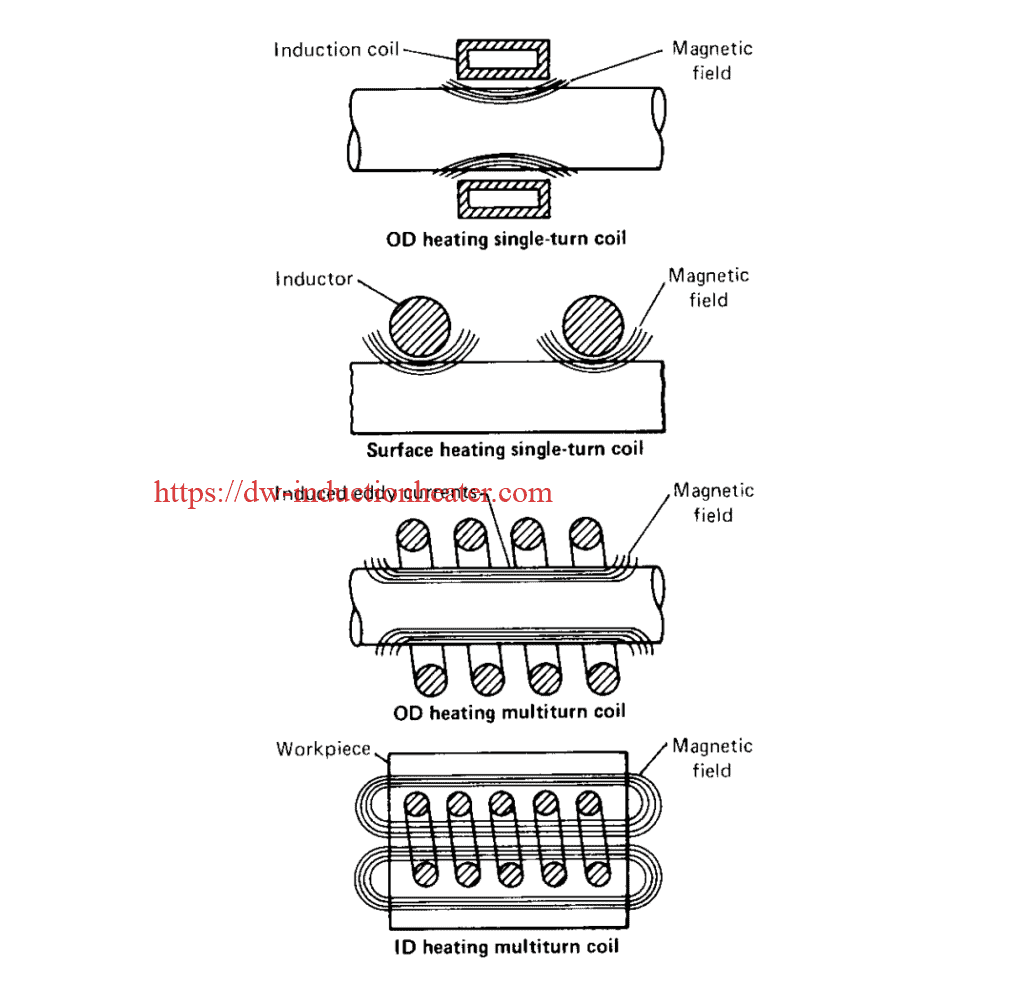
INDUCTION HEATING was first noted when it was found that heat was produced in transformer and motor windings, as mentioned in the Chapter “Heat Treating of Metal” in this book. Accordingly, the theory of induction heating was studied so that motors and transformers could be built for maximum efficiency by minimizing heating losses. The development of high-frequency induction power supplies provided a means of using induction heating for surface hardening. The early use of induction involved trial and error with built-up personal knowledge of specific
applications, but a lack of understanding of the induction heating principles. Throughout the years the understanding of the basic principles has been expanded, extending currently into computer modeling of heating applications and processes. Knowledge of these basic theories of induction heating helps to understand the application of induction heating as applied to induction heat treating. Induction heating occurs due to electromagnetic force fields producing an electrical current in a part. The parts heat due to the resistance to the flow of this electric current.....
 [pdf-embedder url="https://dw-inductionheater.com/wp-content/uploads/2020/05/induction_heating_theory.pdf"]
induction_heating_theory
[pdf-embedder url="https://dw-inductionheater.com/wp-content/uploads/2020/05/induction_heating_theory.pdf"]
induction_heating_theory
[pdf-embedder url="https://dw-inductionheater.com/wp-content/uploads/2020/05/induction_heating_theory.pdf"]
induction_heating_theory
2023年8月24日星期四
Induction Heating Basic
Induction Heating Basics
Induction heating takes place in an electrically conducting object (not necessarily magnetic steel) when the object is placed in a varying magnetic field. Induction heating is due to the hysteresis and eddy-current losses.Induction heating is the process of heating an electrically conducting object (usually a metal) by electromagnetic induction, through heat generated in the object by eddy currents. An induction heater consists of an electromagnet and an electronic oscillator that passes a high-frequency alternating current (AC) through the electromagnet. The rapidly alternating magnetic field penetrates the object, generating electric currents inside the conductor, called eddy currents. The eddy currents flowing through the resistance of the material heat it by Joule heating. In ferromagnetic (and ferrimagnetic) materials like iron, heat may also be generated by magnetic hysteresis losses. The frequency of current used depends on the object size, material type, coupling (between the work coil and the object to be heated) and the penetration depth.
Hysteresis losses only occur in magnetic materials such as steel, nickel, and very few others. Hysteresis loss states that this is caused by friction between molecules when the material is magnetized first in one direction, and then in the other. The molecules may be regarded as small magnets which turn around with each reversal of direction of the magnetic field. Work (energy) is required to turn them around. The energy converts into heat. The rate of expenditure of energy (power) increases with an increased rate of reversal (frequency).
Eddy-current losses occur in any conducting material in a varying magnetic field. This causes heading, even if the materials do not have any of the magnetic properties usually associated with iron and steel. Examples are copper, brass, aluminum, zirconium, nonmagnetic stainless steel, and uranium. Eddy currents are electric currents inducted by transformer action in the material. As their name implies, they appear to flow around in swirls on eddies within a solid mass of material. Eddy-current losses are much more important than hysteresis losses in induction heating. Note that induction heating is applied to nonmagnetic materials, where no hysteresis losses occur.
For the heating of steel for hardening, forging, melting, or any other purposes which require a temperature above Curie temperature, we cannot depend upon hysteresis. Steel loses its magnetic properties above this temperature. When steel is heated below the Curie point, the contribution of hysteresis is usually so small that it can be ignored. For all practical purposes, the I2R of the eddy currents is the only way in which electrical energy can be turned into heat for induction heating purposes.
Two basic things for induction heating to occur:
- A changing magnetic field
- An electrically conductive material placed into the magnetic field
2023年8月23日星期三
Induction Heating Basic
Induction Heating Basics
Induction heating takes place in an electrically conducting object (not necessarily magnetic steel) when the object is placed in a varying magnetic field. Induction heating is due to the hysteresis and eddy-current losses.Induction heating is the process of heating an electrically conducting object (usually a metal) by electromagnetic induction, through heat generated in the object by eddy currents. An induction heater consists of an electromagnet and an electronic oscillator that passes a high-frequency alternating current (AC) through the electromagnet. The rapidly alternating magnetic field penetrates the object, generating electric currents inside the conductor, called eddy currents. The eddy currents flowing through the resistance of the material heat it by Joule heating. In ferromagnetic (and ferrimagnetic) materials like iron, heat may also be generated by magnetic hysteresis losses. The frequency of current used depends on the object size, material type, coupling (between the work coil and the object to be heated) and the penetration depth.
Hysteresis losses only occur in magnetic materials such as steel, nickel, and very few others. Hysteresis loss states that this is caused by friction between molecules when the material is magnetized first in one direction, and then in the other. The molecules may be regarded as small magnets which turn around with each reversal of direction of the magnetic field. Work (energy) is required to turn them around. The energy converts into heat. The rate of expenditure of energy (power) increases with an increased rate of reversal (frequency).
Eddy-current losses occur in any conducting material in a varying magnetic field. This causes heading, even if the materials do not have any of the magnetic properties usually associated with iron and steel. Examples are copper, brass, aluminum, zirconium, nonmagnetic stainless steel, and uranium. Eddy currents are electric currents inducted by transformer action in the material. As their name implies, they appear to flow around in swirls on eddies within a solid mass of material. Eddy-current losses are much more important than hysteresis losses in induction heating. Note that induction heating is applied to nonmagnetic materials, where no hysteresis losses occur.
For the heating of steel for hardening, forging, melting, or any other purposes which require a temperature above Curie temperature, we cannot depend upon hysteresis. Steel loses its magnetic properties above this temperature. When steel is heated below the Curie point, the contribution of hysteresis is usually so small that it can be ignored. For all practical purposes, the I2R of the eddy currents is the only way in which electrical energy can be turned into heat for induction heating purposes.
Two basic things for induction heating to occur:
- A changing magnetic field
- An electrically conductive material placed into the magnetic field
2023年7月31日星期一
Induction Heating Basic
Induction Heating Basics
Induction heating takes place in an electrically conducting object (not necessarily magnetic steel) when the object is placed in a varying magnetic field. Induction heating is due to the hysteresis and eddy-current losses.Induction heating is the process of heating an electrically conducting object (usually a metal) by electromagnetic induction, through heat generated in the object by eddy currents. An induction heater consists of an electromagnet and an electronic oscillator that passes a high-frequency alternating current (AC) through the electromagnet. The rapidly alternating magnetic field penetrates the object, generating electric currents inside the conductor, called eddy currents. The eddy currents flowing through the resistance of the material heat it by Joule heating. In ferromagnetic (and ferrimagnetic) materials like iron, heat may also be generated by magnetic hysteresis losses. The frequency of current used depends on the object size, material type, coupling (between the work coil and the object to be heated) and the penetration depth.
Hysteresis losses only occur in magnetic materials such as steel, nickel, and very few others. Hysteresis loss states that this is caused by friction between molecules when the material is magnetized first in one direction, and then in the other. The molecules may be regarded as small magnets which turn around with each reversal of direction of the magnetic field. Work (energy) is required to turn them around. The energy converts into heat. The rate of expenditure of energy (power) increases with an increased rate of reversal (frequency).
Eddy-current losses occur in any conducting material in a varying magnetic field. This causes heading, even if the materials do not have any of the magnetic properties usually associated with iron and steel. Examples are copper, brass, aluminum, zirconium, nonmagnetic stainless steel, and uranium. Eddy currents are electric currents inducted by transformer action in the material. As their name implies, they appear to flow around in swirls on eddies within a solid mass of material. Eddy-current losses are much more important than hysteresis losses in induction heating. Note that induction heating is applied to nonmagnetic materials, where no hysteresis losses occur.
For the heating of steel for hardening, forging, melting, or any other purposes which require a temperature above Curie temperature, we cannot depend upon hysteresis. Steel loses its magnetic properties above this temperature. When steel is heated below the Curie point, the contribution of hysteresis is usually so small that it can be ignored. For all practical purposes, the I2R of the eddy currents is the only way in which electrical energy can be turned into heat for induction heating purposes.
Two basic things for induction heating to occur:
- A changing magnetic field
- An electrically conductive material placed into the magnetic field
2023年7月22日星期六
Induction Heating Theory PDF
INDUCTION HEATING was first noted when it was found that heat was produced in transformer and motor windings, as mentioned in the Chapter “Heat Treating of Metal” in this book. Accordingly, the theory of induction heating was studied so that motors and transformers could be built for maximum efficiency by minimizing heating losses. The development of high-frequency induction power supplies provided a means of using induction heating for surface hardening. The early use of induction involved trial and error with built-up personal knowledge of specific
applications, but a lack of understanding of the induction heating principles. Throughout the years the understanding of the basic principles has been expanded, extending currently into computer modeling of heating applications and processes. Knowledge of these basic theories of induction heating helps to understand the application of induction heating as applied to induction heat treating. Induction heating occurs due to electromagnetic force fields producing an electrical current in a part. The parts heat due to the resistance to the flow of this electric current.....
[pdf-embedder url="https://dw-inductionheater.com/wp-content/uploads/2020/05/induction_heating_theory.pdf"]
induction_heating_theory
https://dw-inductionheater.com/induction-heating-theory-pdf.html?feed_id=219961&_unique_id=64bbbc5219638
2023年5月2日星期二
Induction Heating Basic
Induction Heating Basics
Induction heating takes place in an electrically conducting object (not necessarily magnetic steel) when the object is placed in a varying magnetic field. Induction heating is due to the hysteresis and eddy-current losses.Induction heating is the process of heating an electrically conducting object (usually a metal) by electromagnetic induction, through heat generated in the object by eddy currents. An induction heater consists of an electromagnet and an electronic oscillator that passes a high-frequency alternating current (AC) through the electromagnet. The rapidly alternating magnetic field penetrates the object, generating electric currents inside the conductor, called eddy currents. The eddy currents flowing through the resistance of the material heat it by Joule heating. In ferromagnetic (and ferrimagnetic) materials like iron, heat may also be generated by magnetic hysteresis losses. The frequency of current used depends on the object size, material type, coupling (between the work coil and the object to be heated) and the penetration depth.
Hysteresis losses only occur in magnetic materials such as steel, nickel, and very few others. Hysteresis loss states that this is caused by friction between molecules when the material is magnetized first in one direction, and then in the other. The molecules may be regarded as small magnets which turn around with each reversal of direction of the magnetic field. Work (energy) is required to turn them around. The energy converts into heat. The rate of expenditure of energy (power) increases with an increased rate of reversal (frequency).
Eddy-current losses occur in any conducting material in a varying magnetic field. This causes heading, even if the materials do not have any of the magnetic properties usually associated with iron and steel. Examples are copper, brass, aluminum, zirconium, nonmagnetic stainless steel, and uranium. Eddy currents are electric currents inducted by transformer action in the material. As their name implies, they appear to flow around in swirls on eddies within a solid mass of material. Eddy-current losses are much more important than hysteresis losses in induction heating. Note that induction heating is applied to nonmagnetic materials, where no hysteresis losses occur.
For the heating of steel for hardening, forging, melting, or any other purposes which require a temperature above Curie temperature, we cannot depend upon hysteresis. Steel loses its magnetic properties above this temperature. When steel is heated below the Curie point, the contribution of hysteresis is usually so small that it can be ignored. For all practical purposes, the I2R of the eddy currents is the only way in which electrical energy can be turned into heat for induction heating purposes.
Two basic things for induction heating to occur:
- A changing magnetic field
- An electrically conductive material placed into the magnetic field
2023年4月2日星期日
Induction Heating Theory PDF
INDUCTION HEATING was first noted when it was found that heat was produced in transformer and motor windings, as mentioned in the Chapter “Heat Treating of Metal” in this book. Accordingly, the theory of induction heating was studied so that motors and transformers could be built for maximum efficiency by minimizing heating losses. The development of high-frequency induction power supplies provided a means of using induction heating for surface hardening. The early use of induction involved trial and error with built-up personal knowledge of specific
applications, but a lack of understanding of the induction heating principles. Throughout the years the understanding of the basic principles has been expanded, extending currently into computer modeling of heating applications and processes. Knowledge of these basic theories of induction heating helps to understand the application of induction heating as applied to induction heat treating. Induction heating occurs due to electromagnetic force fields producing an electrical current in a part. The parts heat due to the resistance to the flow of this electric current.....
[pdf-embedder url="https://dw-inductionheater.com/wp-content/uploads/2020/05/induction_heating_theory.pdf"]
induction_heating_theory
[pdf-embedder url="https://dw-inductionheater.com/wp-content/uploads/2020/05/induction_heating_theory.pdf"]
induction_heating_theory
2023年1月28日星期六
Induction Heating Theory PDF
INDUCTION HEATING was first noted when it was found that heat was produced in transformer and motor windings, as mentioned in the Chapter “Heat Treating of Metal” in this book. Accordingly, the theory of induction heating was studied so that motors and transformers could be built for maximum efficiency by minimizing heating losses. The development of high-frequency induction power supplies provided a means of using induction heating for surface hardening. The early use of induction involved trial and error with built-up personal knowledge of specific
applications, but a lack of understanding of the induction heating principles. Throughout the years the understanding of the basic principles has been expanded, extending currently into computer modeling of heating applications and processes. Knowledge of these basic theories of induction heating helps to understand the application of induction heating as applied to induction heat treating. Induction heating occurs due to electromagnetic force fields producing an electrical current in a part. The parts heat due to the resistance to the flow of this electric current.....
[pdf-embedder url="https://dw-inductionheater.com/wp-content/uploads/2020/05/induction_heating_theory.pdf"]
induction_heating_theory
[pdf-embedder url="https://dw-inductionheater.com/wp-content/uploads/2020/05/induction_heating_theory.pdf"]
induction_heating_theory
2023年1月7日星期六
how does induction heating work?
A source of high frequency electricity is used to drive a large alternating current through a induction coil. This induction heating coil is known as the work coil. See the picture opposite.
The passage of current through this induction heating coil generates a very intense and rapidly changing magnetic field in the space within the work coil. The workpiece to be heated is placed within this intense alternating magnetic field.
Depending on the nature of the workpiece material, a number of things happen...
The alternating magnetic field induces a current flow in the conductive workpiece. The arrangement of the work coil and the workpiece can be thought of as an electrical transformer. The work coil is like the primary where electrical energy is fed in, and the workpiece is like a single turn secondary that is short-circuited. This causes tremendous currents to flow through the workpiece. These are known as eddy currents.
In addition to this, the high frequency used in Induction Heating applications gives rise to a phenomenon called skin effect. This skin effect forces the alternating current to flow in a thin layer towards the surface of the workpiece. The skin effect increases the effective resistance of the metal to the passage of the large current. Therefore it greatly increases the induction heating effect of the induction heater caused by the current induced in the workpiece.
[pdf-embedder url="https://dw-inductionheater.com/wp-content/uploads/2018/08/induction_heating_principle-1.pdf" title="induction_heating_principle"]
2022年12月25日星期日
Induction Heating Basic
Induction Heating Basics
Induction heating takes place in an electrically conducting object (not necessarily magnetic steel) when the object is placed in a varying magnetic field. Induction heating is due to the hysteresis and eddy-current losses.Induction heating is the process of heating an electrically conducting object (usually a metal) by electromagnetic induction, through heat generated in the object by eddy currents. An induction heater consists of an electromagnet and an electronic oscillator that passes a high-frequency alternating current (AC) through the electromagnet. The rapidly alternating magnetic field penetrates the object, generating electric currents inside the conductor, called eddy currents. The eddy currents flowing through the resistance of the material heat it by Joule heating. In ferromagnetic (and ferrimagnetic) materials like iron, heat may also be generated by magnetic hysteresis losses. The frequency of current used depends on the object size, material type, coupling (between the work coil and the object to be heated) and the penetration depth.
Hysteresis losses only occur in magnetic materials such as steel, nickel, and very few others. Hysteresis loss states that this is caused by friction between molecules when the material is magnetized first in one direction, and then in the other. The molecules may be regarded as small magnets which turn around with each reversal of direction of the magnetic field. Work (energy) is required to turn them around. The energy converts into heat. The rate of expenditure of energy (power) increases with an increased rate of reversal (frequency).
Eddy-current losses occur in any conducting material in a varying magnetic field. This causes heading, even if the materials do not have any of the magnetic properties usually associated with iron and steel. Examples are copper, brass, aluminum, zirconium, nonmagnetic stainless steel, and uranium. Eddy currents are electric currents inducted by transformer action in the material. As their name implies, they appear to flow around in swirls on eddies within a solid mass of material. Eddy-current losses are much more important than hysteresis losses in induction heating. Note that induction heating is applied to nonmagnetic materials, where no hysteresis losses occur.
For the heating of steel for hardening, forging, melting, or any other purposes which require a temperature above Curie temperature, we cannot depend upon hysteresis. Steel loses its magnetic properties above this temperature. When steel is heated below the Curie point, the contribution of hysteresis is usually so small that it can be ignored. For all practical purposes, the I2R of the eddy currents is the only way in which electrical energy can be turned into heat for induction heating purposes.
Two basic things for induction heating to occur:
- A changing magnetic field
- An electrically conductive material placed into the magnetic field
2022年12月16日星期五
Induction Heating Theory PDF
INDUCTION HEATING was first noted when it was found that heat was produced in transformer and motor windings, as mentioned in the Chapter “Heat Treating of Metal” in this book. Accordingly, the theory of induction heating was studied so that motors and transformers could be built for maximum efficiency by minimizing heating losses. The development of high-frequency induction power supplies provided a means of using induction heating for surface hardening. The early use of induction involved trial and error with built-up personal knowledge of specific
applications, but a lack of understanding of the induction heating principles. Throughout the years the understanding of the basic principles has been expanded, extending currently into computer modeling of heating applications and processes. Knowledge of these basic theories of induction heating helps to understand the application of induction heating as applied to induction heat treating. Induction heating occurs due to electromagnetic force fields producing an electrical current in a part. The parts heat due to the resistance to the flow of this electric current.....
[pdf-embedder url="https://dw-inductionheater.com/wp-content/uploads/2020/05/induction_heating_theory.pdf"]
induction_heating_theory
[pdf-embedder url="https://dw-inductionheater.com/wp-content/uploads/2020/05/induction_heating_theory.pdf"]
induction_heating_theory
2022年12月13日星期二
Induction Heating Theory PDF
INDUCTION HEATING was first noted when it was found that heat was produced in transformer and motor windings, as mentioned in the Chapter “Heat Treating of Metal” in this book. Accordingly, the theory of induction heating was studied so that motors and transformers could be built for maximum efficiency by minimizing heating losses. The development of high-frequency induction power supplies provided a means of using induction heating for surface hardening. The early use of induction involved trial and error with built-up personal knowledge of specific
applications, but a lack of understanding of the induction heating principles. Throughout the years the understanding of the basic principles has been expanded, extending currently into computer modeling of heating applications and processes. Knowledge of these basic theories of induction heating helps to understand the application of induction heating as applied to induction heat treating. Induction heating occurs due to electromagnetic force fields producing an electrical current in a part. The parts heat due to the resistance to the flow of this electric current.....
[pdf-embedder url="https://dw-inductionheater.com/wp-content/uploads/2020/05/induction_heating_theory.pdf"]
induction_heating_theory
[pdf-embedder url="https://dw-inductionheater.com/wp-content/uploads/2020/05/induction_heating_theory.pdf"]
induction_heating_theory
2022年12月11日星期日
Induction Heating Theory PDF
INDUCTION HEATING was first noted when it was found that heat was produced in transformer and motor windings, as mentioned in the Chapter “Heat Treating of Metal” in this book. Accordingly, the theory of induction heating was studied so that motors and transformers could be built for maximum efficiency by minimizing heating losses. The development of high-frequency induction power supplies provided a means of using induction heating for surface hardening. The early use of induction involved trial and error with built-up personal knowledge of specific
applications, but a lack of understanding of the induction heating principles. Throughout the years the understanding of the basic principles has been expanded, extending currently into computer modeling of heating applications and processes. Knowledge of these basic theories of induction heating helps to understand the application of induction heating as applied to induction heat treating. Induction heating occurs due to electromagnetic force fields producing an electrical current in a part. The parts heat due to the resistance to the flow of this electric current.....
[pdf-embedder url="https://dw-inductionheater.com/wp-content/uploads/2020/05/induction_heating_theory.pdf"]
induction_heating_theory
[pdf-embedder url="https://dw-inductionheater.com/wp-content/uploads/2020/05/induction_heating_theory.pdf"]
induction_heating_theory
2022年12月3日星期六
Induction Heating Basic
Induction Heating Basics
Induction heating takes place in an electrically conducting object (not necessarily magnetic steel) when the object is placed in a varying magnetic field. Induction heating is due to the hysteresis and eddy-current losses.Induction heating is the process of heating an electrically conducting object (usually a metal) by electromagnetic induction, through heat generated in the object by eddy currents. An induction heater consists of an electromagnet and an electronic oscillator that passes a high-frequency alternating current (AC) through the electromagnet. The rapidly alternating magnetic field penetrates the object, generating electric currents inside the conductor, called eddy currents. The eddy currents flowing through the resistance of the material heat it by Joule heating. In ferromagnetic (and ferrimagnetic) materials like iron, heat may also be generated by magnetic hysteresis losses. The frequency of current used depends on the object size, material type, coupling (between the work coil and the object to be heated) and the penetration depth.
Hysteresis losses only occur in magnetic materials such as steel, nickel, and very few others. Hysteresis loss states that this is caused by friction between molecules when the material is magnetized first in one direction, and then in the other. The molecules may be regarded as small magnets which turn around with each reversal of direction of the magnetic field. Work (energy) is required to turn them around. The energy converts into heat. The rate of expenditure of energy (power) increases with an increased rate of reversal (frequency).
Eddy-current losses occur in any conducting material in a varying magnetic field. This causes heading, even if the materials do not have any of the magnetic properties usually associated with iron and steel. Examples are copper, brass, aluminum, zirconium, nonmagnetic stainless steel, and uranium. Eddy currents are electric currents inducted by transformer action in the material. As their name implies, they appear to flow around in swirls on eddies within a solid mass of material. Eddy-current losses are much more important than hysteresis losses in induction heating. Note that induction heating is applied to nonmagnetic materials, where no hysteresis losses occur.
For the heating of steel for hardening, forging, melting, or any other purposes which require a temperature above Curie temperature, we cannot depend upon hysteresis. Steel loses its magnetic properties above this temperature. When steel is heated below the Curie point, the contribution of hysteresis is usually so small that it can be ignored. For all practical purposes, the I2R of the eddy currents is the only way in which electrical energy can be turned into heat for induction heating purposes.
Two basic things for induction heating to occur:
- A changing magnetic field
- An electrically conductive material placed into the magnetic field
2022年12月2日星期五
how does induction heating work?
A source of high frequency electricity is used to drive a large alternating current through a induction coil. This induction heating coil is known as the work coil. See the picture opposite.
The passage of current through this induction heating coil generates a very intense and rapidly changing magnetic field in the space within the work coil. The workpiece to be heated is placed within this intense alternating magnetic field.
Depending on the nature of the workpiece material, a number of things happen...
The alternating magnetic field induces a current flow in the conductive workpiece. The arrangement of the work coil and the workpiece can be thought of as an electrical transformer. The work coil is like the primary where electrical energy is fed in, and the workpiece is like a single turn secondary that is short-circuited. This causes tremendous currents to flow through the workpiece. These are known as eddy currents.
In addition to this, the high frequency used in Induction Heating applications gives rise to a phenomenon called skin effect. This skin effect forces the alternating current to flow in a thin layer towards the surface of the workpiece. The skin effect increases the effective resistance of the metal to the passage of the large current. Therefore it greatly increases the induction heating effect of the induction heater caused by the current induced in the workpiece.
[pdf-embedder url="https://dw-inductionheater.com/wp-content/uploads/2018/08/induction_heating_principle-1.pdf" title="induction_heating_principle"]
2022年10月3日星期一
how does induction heating work?
A source of high frequency electricity is used to drive a large alternating current through a induction coil. This induction heating coil is known as the work coil. See the picture opposite.
The passage of current through this induction heating coil generates a very intense and rapidly changing magnetic field in the space within the work coil. The workpiece to be heated is placed within this intense alternating magnetic field.
Depending on the nature of the workpiece material, a number of things happen...
The alternating magnetic field induces a current flow in the conductive workpiece. The arrangement of the work coil and the workpiece can be thought of as an electrical transformer. The work coil is like the primary where electrical energy is fed in, and the workpiece is like a single turn secondary that is short-circuited. This causes tremendous currents to flow through the workpiece. These are known as eddy currents.
In addition to this, the high frequency used in Induction Heating applications gives rise to a phenomenon called skin effect. This skin effect forces the alternating current to flow in a thin layer towards the surface of the workpiece. The skin effect increases the effective resistance of the metal to the passage of the large current. Therefore it greatly increases the induction heating effect of the induction heater caused by the current induced in the workpiece.
[pdf-embedder url="https://dw-inductionheater.com/wp-content/uploads/2018/08/induction_heating_principle-1.pdf" title="induction_heating_principle"]
订阅:
博文 (Atom)
我的简介

- HLQ induction heating machine
- HLQ induction heating machine manufacturer provides the service of induction brazing,melting,hot forming,hardening surface,annealing,shrink fitting,PWHT,etc.