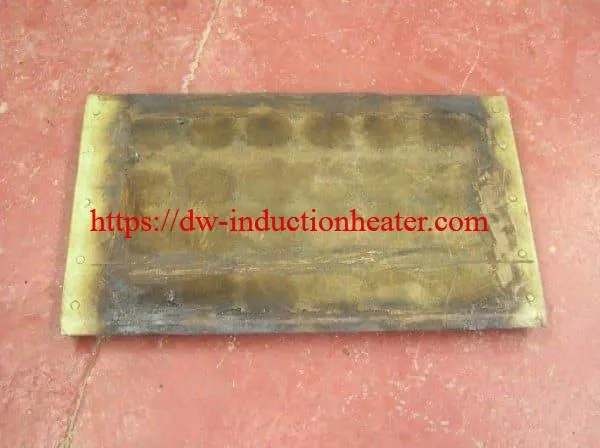
Induction Heating Steel Plate for Forging and Hot Forming
Metal induction heating steel plate for forging and hot forming are excellent induction heating applications. Industrial
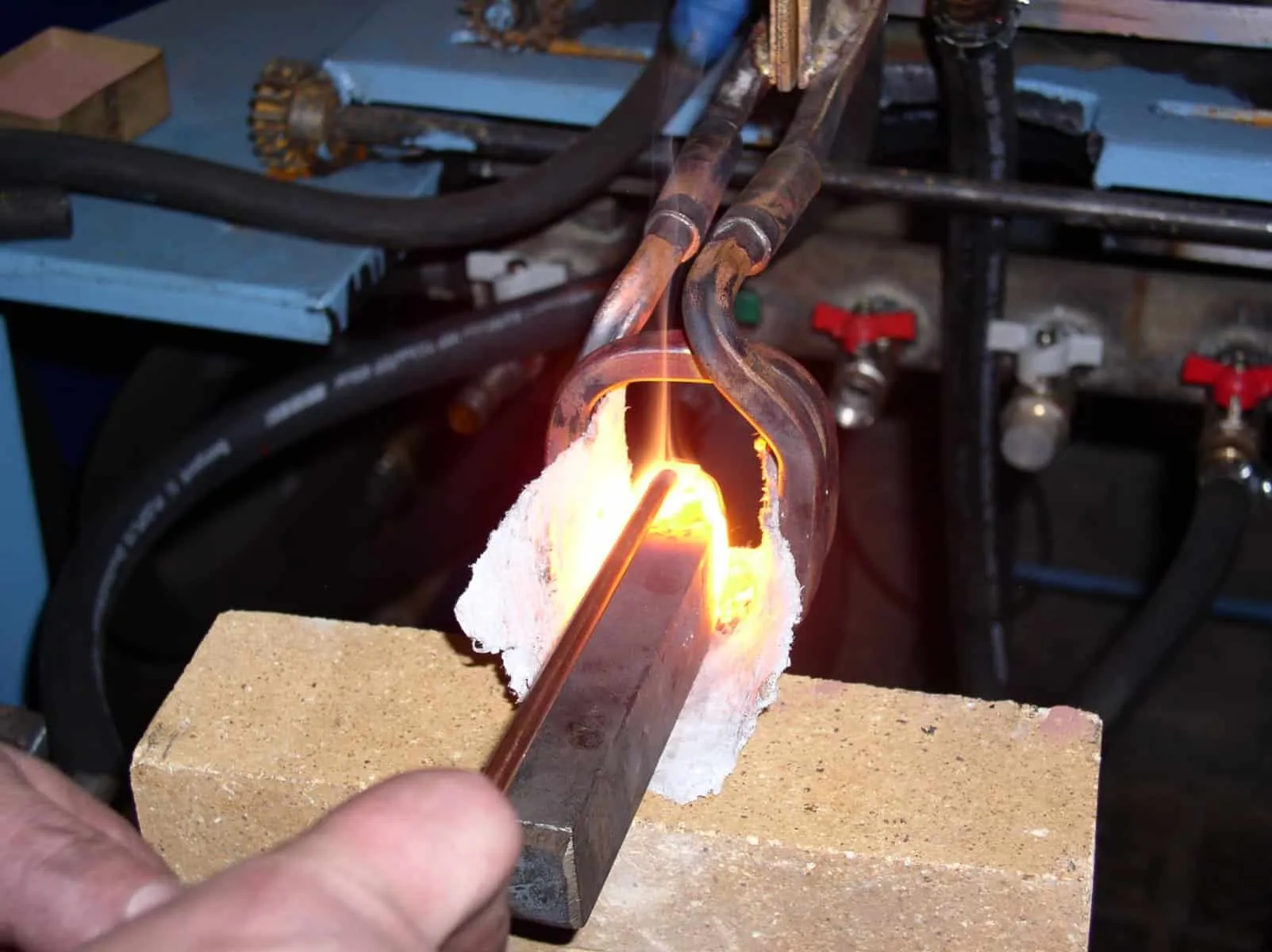
Induction forging and hot forming processes involve bending or shaping a metal billet or bloom after it has been heated to a temperature at which its resistance to deformation is weak. Blocks of non-ferrous materials can also be used.
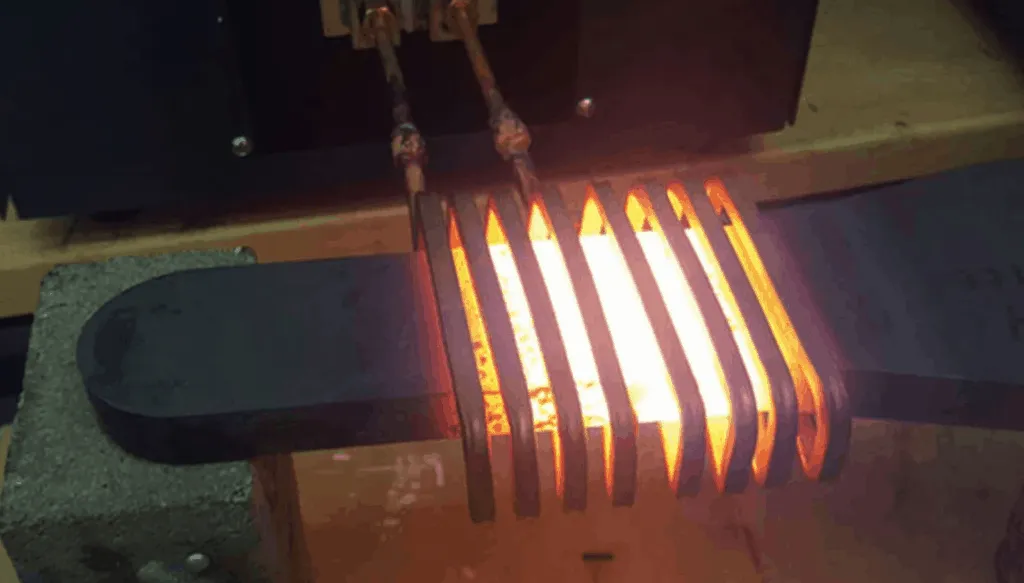 Induction heating machines
 or conventional furnaces are used for the initial heating process. Billets can be transported through the inductor via a pneumatic or hydraulic pusher; pinch roller drive; tractor drive; or walking beam. Non-contact pyrometers are used to measure the billet temperature.
Other machines such as mechanical impact presses, bending machines, and hydraulic extrusion presses are used to bend or shape the metal.
Objective: Preheat a steel plate (3.9” x 7.5” x 0.75” / 100mm x 190mm x 19mm) prior to forging to create a hoe head with the goal of increasing production compared to preheating with a gas furnace.
Material: Steel Plate
Temperature: 2192 ºF (1200 ºC)
Frequency: 7 kHz
Induction Heating Equipment: DW-MF-125/100, 125 kW
induction heating system equipped with a remote heat station containing three 26.8 μF capacitors.
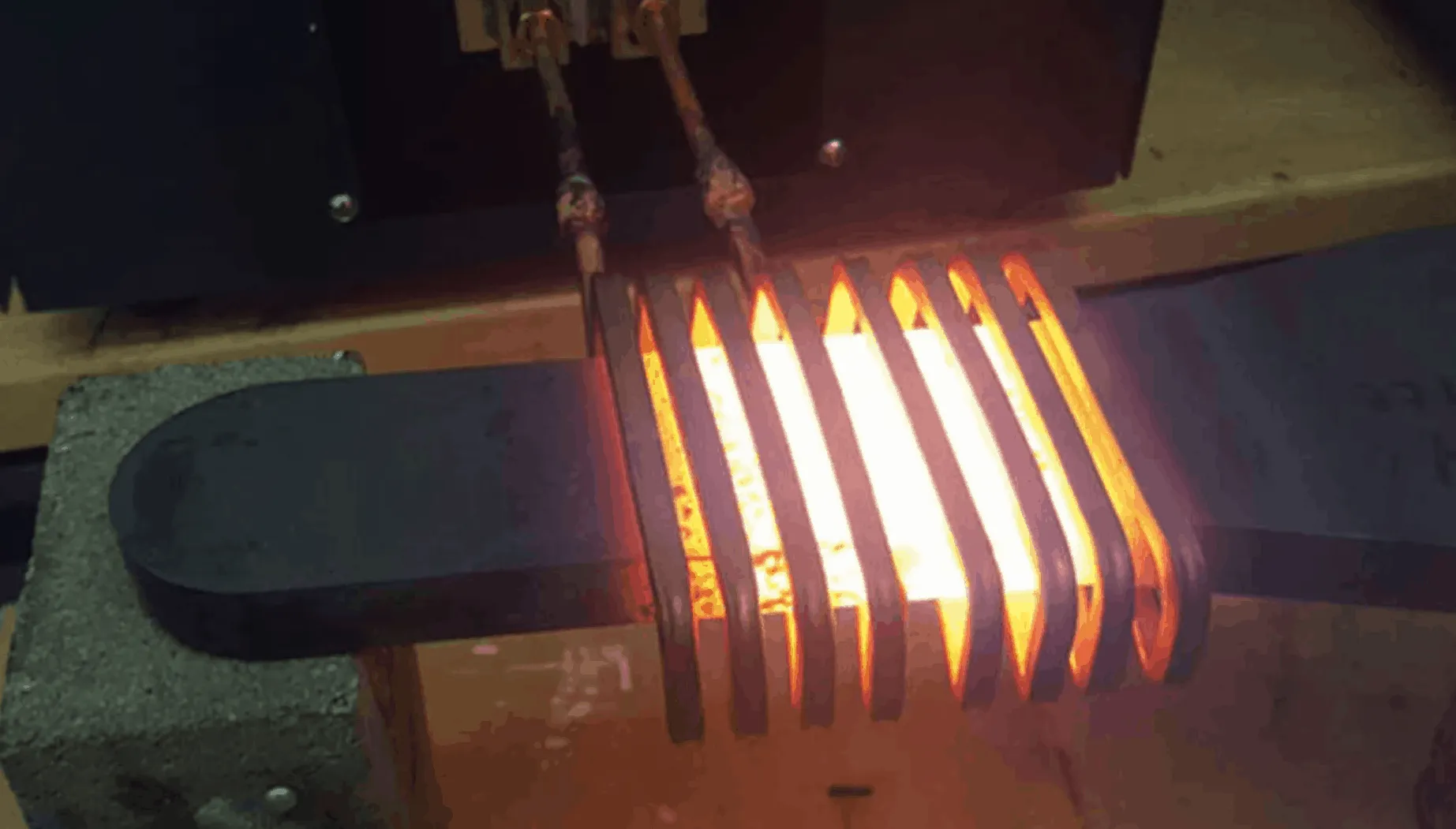
- A three position, multi-turn helical coil designed and developed to generate the required heat for this application.
Process The steel plate was inserted into the three position multi-turn helical coil and the power supply was turned on. At 37 seconds, a second stainless steel plate was inserted, and at 75 seconds a third stainless steel plate was inserted. At 115 seconds, the desired temperature was achieved for the first part, and the process continued.
After startup, parts can be heated every 37 seconds from the sequence they were entered. While total cycle time is 115
seconds, a part can be removed every 37 seconds, which allowed for induction to achieve the desired production rate
and realize considerable gains when compared to using a gas furnace.
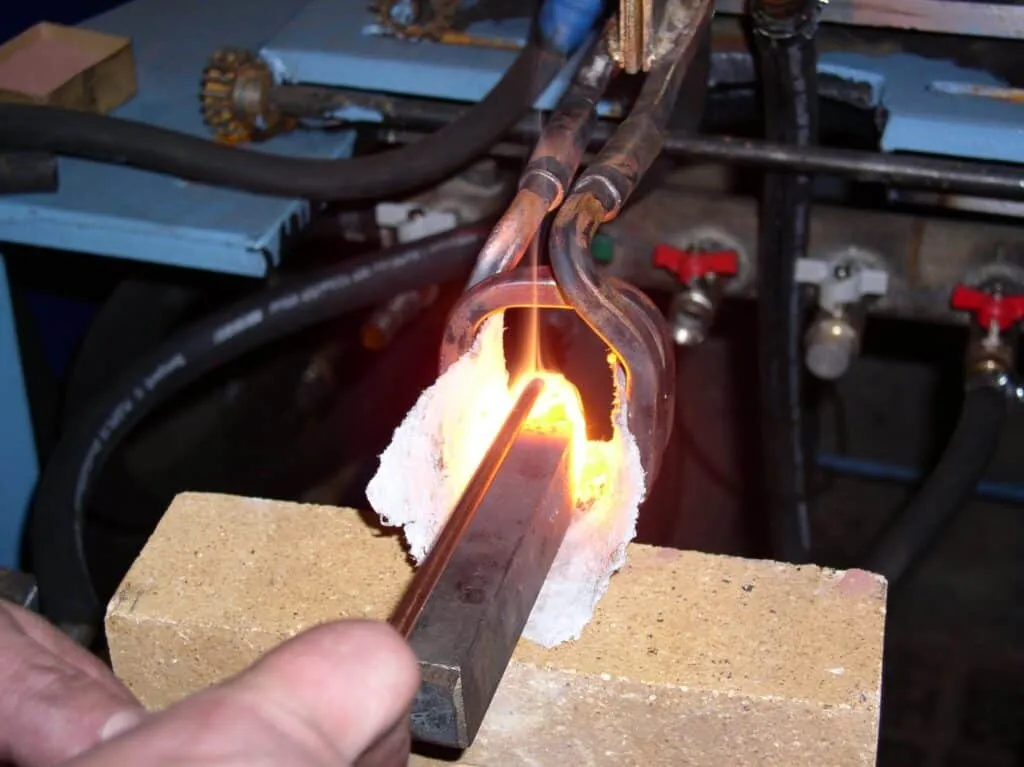 Results/Benefits
Higher production rate: The process achieved a production rate of 100 parts per hour, while a gas furnace produced 83 parts per hour
- Repeatability: This process is repeatable and can be integrated into a production process
- Precision and efficiency: Heating is precise and efficient, with heat only applied to the steel plates
The approximate hot forming temperatures of the most commonly used industrial materials are:
• Steel 1200º C • Brass 750º C • Aluminium 550º C
Total Induction Hot Forming Applications
Induction heating machines are commonly used to heat steel billets, bars, brass blocks, and titanium blocks to the proper temperature for forging and hot forming.
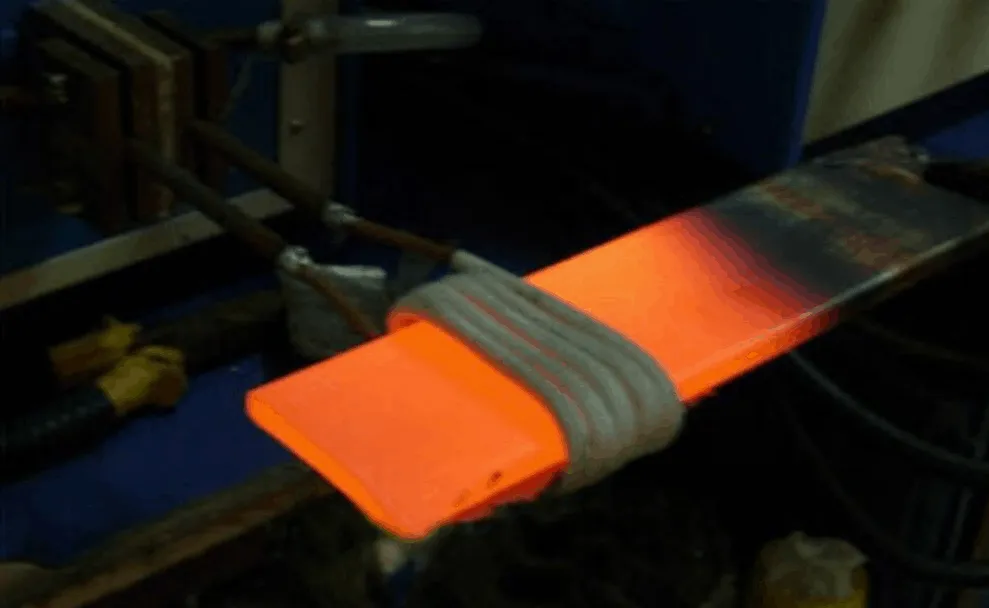 Partial Forming Applications
Induction heating is also used to heat parts such as pipe ends, axle ends, automotive parts, and bar ends for partial forming and forging processes.
The Induction Heating Advantage
When compared to conventional furnaces, induction heating machines for forging offer significant process and quality advantages:
Much shorter heating times, minimizing scaling and oxidation
Easy and accurate temperature temperature control. Parts at temperatures outside specifications can be detected and removed
No time lost waiting for the furnace to ramp up to the required temperature
Automated
induction heating machines require minimal manual labor
Heat can be directed to one specific point, which is highly important for parts with only one forming area.
Greater thermal efficiency - heat is generated in the part itself and does not need to be heated in a large chamber.
Better working conditions. The only heat present in the air is that of the parts themselves. The working conditions are much more pleasant than with a fuel furnace.
 Induction heating machines or conventional furnaces are used for the initial heating process. Billets can be transported through the inductor via a pneumatic or hydraulic pusher; pinch roller drive; tractor drive; or walking beam. Non-contact pyrometers are used to measure the billet temperature.
Other machines such as mechanical impact presses, bending machines, and hydraulic extrusion presses are used to bend or shape the metal.
Objective: Preheat a steel plate (3.9” x 7.5” x 0.75” / 100mm x 190mm x 19mm) prior to forging to create a hoe head with the goal of increasing production compared to preheating with a gas furnace.
Material: Steel Plate
Temperature: 2192 ºF (1200 ºC)
Frequency: 7 kHz
Induction Heating Equipment: DW-MF-125/100, 125 kW induction heating system equipped with a remote heat station containing three 26.8 μF capacitors.
- A three position, multi-turn helical coil designed and developed to generate the required heat for this application.
Process The steel plate was inserted into the three position multi-turn helical coil and the power supply was turned on. At 37 seconds, a second stainless steel plate was inserted, and at 75 seconds a third stainless steel plate was inserted. At 115 seconds, the desired temperature was achieved for the first part, and the process continued.
After startup, parts can be heated every 37 seconds from the sequence they were entered. While total cycle time is 115
seconds, a part can be removed every 37 seconds, which allowed for induction to achieve the desired production rate
and realize considerable gains when compared to using a gas furnace.
Induction heating machines or conventional furnaces are used for the initial heating process. Billets can be transported through the inductor via a pneumatic or hydraulic pusher; pinch roller drive; tractor drive; or walking beam. Non-contact pyrometers are used to measure the billet temperature.
Other machines such as mechanical impact presses, bending machines, and hydraulic extrusion presses are used to bend or shape the metal.
Objective: Preheat a steel plate (3.9” x 7.5” x 0.75” / 100mm x 190mm x 19mm) prior to forging to create a hoe head with the goal of increasing production compared to preheating with a gas furnace.
Material: Steel Plate
Temperature: 2192 ºF (1200 ºC)
Frequency: 7 kHz
Induction Heating Equipment: DW-MF-125/100, 125 kW induction heating system equipped with a remote heat station containing three 26.8 μF capacitors.
- A three position, multi-turn helical coil designed and developed to generate the required heat for this application.
Process The steel plate was inserted into the three position multi-turn helical coil and the power supply was turned on. At 37 seconds, a second stainless steel plate was inserted, and at 75 seconds a third stainless steel plate was inserted. At 115 seconds, the desired temperature was achieved for the first part, and the process continued.
After startup, parts can be heated every 37 seconds from the sequence they were entered. While total cycle time is 115
seconds, a part can be removed every 37 seconds, which allowed for induction to achieve the desired production rate
and realize considerable gains when compared to using a gas furnace.
 Results/Benefits
Higher production rate: The process achieved a production rate of 100 parts per hour, while a gas furnace produced 83 parts per hour
- Repeatability: This process is repeatable and can be integrated into a production process
- Precision and efficiency: Heating is precise and efficient, with heat only applied to the steel plates
The approximate hot forming temperatures of the most commonly used industrial materials are:
• Steel 1200º C • Brass 750º C • Aluminium 550º C
Total Induction Hot Forming Applications
Induction heating machines are commonly used to heat steel billets, bars, brass blocks, and titanium blocks to the proper temperature for forging and hot forming.
Results/Benefits
Higher production rate: The process achieved a production rate of 100 parts per hour, while a gas furnace produced 83 parts per hour
- Repeatability: This process is repeatable and can be integrated into a production process
- Precision and efficiency: Heating is precise and efficient, with heat only applied to the steel plates
The approximate hot forming temperatures of the most commonly used industrial materials are:
• Steel 1200º C • Brass 750º C • Aluminium 550º C
Total Induction Hot Forming Applications
Induction heating machines are commonly used to heat steel billets, bars, brass blocks, and titanium blocks to the proper temperature for forging and hot forming.