 https://dw-inductionheater.com/what-is-induction-bonding.html?feed_id=273577&_unique_id=67e1c119b4af1
2025年3月24日星期一
What is induction bonding?
What is induction bonding?
https://dw-inductionheater.com/what-is-induction-bonding.html?feed_id=273577&_unique_id=67e1c119b4af1
https://dw-inductionheater.com/what-is-induction-bonding.html?feed_id=273577&_unique_id=67e1c119b4af1

2024年11月24日星期日
2024年11月23日星期六

Bonding Steel Into Rubber With Induction Heater
Bonding Steel Into Rubber With Induction Heater
 https://dw-inductionheater.com/product/bonding-steel-into-rubber-with-induction-heater?feed_id=261571&_unique_id=6741a0b978272
2024年11月22日星期五
2024年5月2日星期四
What is induction bonding?
What is induction bonding?
Induction bonding uses induction heating to cure bonding adhesives. Induction is the main method for curing adhesives and sealants for car components such as doors, hoods, fenders, rearview mirrors and magnets. Induction also cures the adhesives in composite- to-metal and carbon fiber-to-carbon fiber joints. There are two main types of automotive bonding: spotbonding,
which heats small segments of the materials to be joined; full-ring bonding, which heats complete joints.
What are the benefits?
DAWEI Induction spot bonding systems ensure precise energy inputs for each panel. Small heat affected zones minimize total panel elongation. Clamping is not needed when bonding steel panels, which reduces stresses and distortion. Each panel is electronically monitored to ensure that energy input deviations are within tolerances. With full-ring bonding, a one-sizefits-
all coil reduces the need for spare coils.
Where is it used?
Induction is the preferred bonding method in the automotive industry. Widely used to bond steel and aluminum sheet metal, induction is increasingly employed to bond new lightweight composite and carbon fiber materials. Induction is used to bond curved strands, brake shoes and magnets in the electrotechnical industry.
It is also used for guides, rails, shelves and panels in the white goods sector.
What equipment is available?
DAWEI Induction is the professional induction curing specialist. In fact, we invented induction spot curing.
The equipment we deliver ranges from individual system elements such as power sources and coils, to complete and fully supported turn-key solutions.
https://dw-inductionheater.com/what-is-induction-bonding.html?feed_id=244100&_unique_id=66342bb1d44c6
2023年9月10日星期日
What is induction bonding?
What is induction bonding?
Induction bonding uses induction heating to cure bonding adhesives. Induction is the main method for curing adhesives and sealants for car components such as doors, hoods, fenders, rearview mirrors and magnets. Induction also cures the adhesives in composite- to-metal and carbon fiber-to-carbon fiber joints. There are two main types of automotive bonding: spotbonding,
which heats small segments of the materials to be joined; full-ring bonding, which heats complete joints.
What are the benefits?
DAWEI Induction spot bonding systems ensure precise energy inputs for each panel. Small heat affected zones minimize total panel elongation. Clamping is not needed when bonding steel panels, which reduces stresses and distortion. Each panel is electronically monitored to ensure that energy input deviations are within tolerances. With full-ring bonding, a one-sizefits-
all coil reduces the need for spare coils.
Where is it used?
Induction is the preferred bonding method in the automotive industry. Widely used to bond steel and aluminum sheet metal, induction is increasingly employed to bond new lightweight composite and carbon fiber materials. Induction is used to bond curved strands, brake shoes and magnets in the electrotechnical industry.
It is also used for guides, rails, shelves and panels in the white goods sector.
What equipment is available?
DAWEI Induction is the professional induction curing specialist. In fact, we invented induction spot curing.
The equipment we deliver ranges from individual system elements such as power sources and coils, to complete and fully supported turn-key solutions.
https://dw-inductionheater.com/what-is-induction-bonding.html?feed_id=227011&_unique_id=64fd868b7cb23
2023年2月12日星期日
What is induction bonding?
What is induction bonding?
Induction bonding uses induction heating to cure bonding adhesives. Induction is the main method for curing adhesives and sealants for car components such as doors, hoods, fenders, rearview mirrors and magnets. Induction also cures the adhesives in composite- to-metal and carbon fiber-to-carbon fiber joints. There are two main types of automotive bonding: spotbonding,
which heats small segments of the materials to be joined; full-ring bonding, which heats complete joints.
What are the benefits?
DAWEI Induction spot bonding systems ensure precise energy inputs for each panel. Small heat affected zones minimize total panel elongation. Clamping is not needed when bonding steel panels, which reduces stresses and distortion. Each panel is electronically monitored to ensure that energy input deviations are within tolerances. With full-ring bonding, a one-sizefits-
all coil reduces the need for spare coils.
Where is it used?
Induction is the preferred bonding method in the automotive industry. Widely used to bond steel and aluminum sheet metal, induction is increasingly employed to bond new lightweight composite and carbon fiber materials. Induction is used to bond curved strands, brake shoes and magnets in the electrotechnical industry.
It is also used for guides, rails, shelves and panels in the white goods sector.
What equipment is available?
DAWEI Induction is the professional induction curing specialist. In fact, we invented induction spot curing.
The equipment we deliver ranges from individual system elements such as power sources and coils, to complete and fully supported turn-key solutions.
2022年11月14日星期一
What is induction bonding?
What is induction bonding?
Induction bonding uses induction heating to cure bonding adhesives. Induction is the main method for curing adhesives and sealants for car components such as doors, hoods, fenders, rearview mirrors and magnets. Induction also cures the adhesives in composite- to-metal and carbon fiber-to-carbon fiber joints. There are two main types of automotive bonding: spotbonding,
which heats small segments of the materials to be joined; full-ring bonding, which heats complete joints.
What are the benefits?
DAWEI Induction spot bonding systems ensure precise energy inputs for each panel. Small heat affected zones minimize total panel elongation. Clamping is not needed when bonding steel panels, which reduces stresses and distortion. Each panel is electronically monitored to ensure that energy input deviations are within tolerances. With full-ring bonding, a one-sizefits-
all coil reduces the need for spare coils.
Where is it used?
Induction is the preferred bonding method in the automotive industry. Widely used to bond steel and aluminum sheet metal, induction is increasingly employed to bond new lightweight composite and carbon fiber materials. Induction is used to bond curved strands, brake shoes and magnets in the electrotechnical industry.
It is also used for guides, rails, shelves and panels in the white goods sector.
What equipment is available?
DAWEI Induction is the professional induction curing specialist. In fact, we invented induction spot curing.
The equipment we deliver ranges from individual system elements such as power sources and coils, to complete and fully supported turn-key solutions.
2022年10月14日星期五
What is induction bonding?
What is induction bonding?
Induction bonding uses induction heating to cure bonding adhesives. Induction is the main method for curing adhesives and sealants for car components such as doors, hoods, fenders, rearview mirrors and magnets. Induction also cures the adhesives in composite- to-metal and carbon fiber-to-carbon fiber joints. There are two main types of automotive bonding: spotbonding,
which heats small segments of the materials to be joined; full-ring bonding, which heats complete joints.
What are the benefits?
DAWEI Induction spot bonding systems ensure precise energy inputs for each panel. Small heat affected zones minimize total panel elongation. Clamping is not needed when bonding steel panels, which reduces stresses and distortion. Each panel is electronically monitored to ensure that energy input deviations are within tolerances. With full-ring bonding, a one-sizefits-
all coil reduces the need for spare coils.
Where is it used?
Induction is the preferred bonding method in the automotive industry. Widely used to bond steel and aluminum sheet metal, induction is increasingly employed to bond new lightweight composite and carbon fiber materials. Induction is used to bond curved strands, brake shoes and magnets in the electrotechnical industry.
It is also used for guides, rails, shelves and panels in the white goods sector.
What equipment is available?
DAWEI Induction is the professional induction curing specialist. In fact, we invented induction spot curing.
The equipment we deliver ranges from individual system elements such as power sources and coils, to complete and fully supported turn-key solutions.
2022年10月8日星期六
What is induction bonding?
What is induction bonding?
Induction bonding uses induction heating to cure bonding adhesives. Induction is the main method for curing adhesives and sealants for car components such as doors, hoods, fenders, rearview mirrors and magnets. Induction also cures the adhesives in composite- to-metal and carbon fiber-to-carbon fiber joints. There are two main types of automotive bonding: spotbonding,
which heats small segments of the materials to be joined; full-ring bonding, which heats complete joints.
What are the benefits?
DAWEI Induction spot bonding systems ensure precise energy inputs for each panel. Small heat affected zones minimize total panel elongation. Clamping is not needed when bonding steel panels, which reduces stresses and distortion. Each panel is electronically monitored to ensure that energy input deviations are within tolerances. With full-ring bonding, a one-sizefits-
all coil reduces the need for spare coils.
Where is it used?
Induction is the preferred bonding method in the automotive industry. Widely used to bond steel and aluminum sheet metal, induction is increasingly employed to bond new lightweight composite and carbon fiber materials. Induction is used to bond curved strands, brake shoes and magnets in the electrotechnical industry.
It is also used for guides, rails, shelves and panels in the white goods sector.
What equipment is available?
DAWEI Induction is the professional induction curing specialist. In fact, we invented induction spot curing.
The equipment we deliver ranges from individual system elements such as power sources and coils, to complete and fully supported turn-key solutions.
2022年9月18日星期日
What is induction bonding?
What is induction bonding?
Induction bonding uses induction heating to cure bonding adhesives. Induction is the main method for curing adhesives and sealants for car components such as doors, hoods, fenders, rearview mirrors and magnets. Induction also cures the adhesives in composite- to-metal and carbon fiber-to-carbon fiber joints. There are two main types of automotive bonding: spotbonding,
which heats small segments of the materials to be joined; full-ring bonding, which heats complete joints.
What are the benefits?
DAWEI Induction spot bonding systems ensure precise energy inputs for each panel. Small heat affected zones minimize total panel elongation. Clamping is not needed when bonding steel panels, which reduces stresses and distortion. Each panel is electronically monitored to ensure that energy input deviations are within tolerances. With full-ring bonding, a one-sizefits-
all coil reduces the need for spare coils.
Where is it used?
Induction is the preferred bonding method in the automotive industry. Widely used to bond steel and aluminum sheet metal, induction is increasingly employed to bond new lightweight composite and carbon fiber materials. Induction is used to bond curved strands, brake shoes and magnets in the electrotechnical industry.
It is also used for guides, rails, shelves and panels in the white goods sector.
What equipment is available?
DAWEI Induction is the professional induction curing specialist. In fact, we invented induction spot curing.
The equipment we deliver ranges from individual system elements such as power sources and coils, to complete and fully supported turn-key solutions.
2022年5月24日星期二
What is induction bonding?
What is induction bonding?
Induction bonding uses induction heating to cure bonding adhesives. Induction is the main method for curing adhesives and sealants for car components such as doors, hoods, fenders, rearview mirrors and magnets. Induction also cures the adhesives in composite- to-metal and carbon fiber-to-carbon fiber joints. There are two main types of automotive bonding: spotbonding,
which heats small segments of the materials to be joined; full-ring bonding, which heats complete joints.
What are the benefits?
DAWEI Induction spot bonding systems ensure precise energy inputs for each panel. Small heat affected zones minimize total panel elongation. Clamping is not needed when bonding steel panels, which reduces stresses and distortion. Each panel is electronically monitored to ensure that energy input deviations are within tolerances. With full-ring bonding, a one-sizefits-
all coil reduces the need for spare coils.
Where is it used?
Induction is the preferred bonding method in the automotive industry. Widely used to bond steel and aluminum sheet metal, induction is increasingly employed to bond new lightweight composite and carbon fiber materials. Induction is used to bond curved strands, brake shoes and magnets in the electrotechnical industry.
It is also used for guides, rails, shelves and panels in the white goods sector.
What equipment is available?
DAWEI Induction is the professional induction curing specialist. In fact, we invented induction spot curing.
The equipment we deliver ranges from individual system elements such as power sources and coils, to complete and fully supported turn-key solutions.
2022年5月22日星期日
What is induction bonding?
What is induction bonding?
Induction bonding uses induction heating to cure bonding adhesives. Induction is the main method for curing adhesives and sealants for car components such as doors, hoods, fenders, rearview mirrors and magnets. Induction also cures the adhesives in composite- to-metal and carbon fiber-to-carbon fiber joints. There are two main types of automotive bonding: spotbonding,
which heats small segments of the materials to be joined; full-ring bonding, which heats complete joints.
What are the benefits?
DAWEI Induction spot bonding systems ensure precise energy inputs for each panel. Small heat affected zones minimize total panel elongation. Clamping is not needed when bonding steel panels, which reduces stresses and distortion. Each panel is electronically monitored to ensure that energy input deviations are within tolerances. With full-ring bonding, a one-sizefits-
all coil reduces the need for spare coils.
Where is it used?
Induction is the preferred bonding method in the automotive industry. Widely used to bond steel and aluminum sheet metal, induction is increasingly employed to bond new lightweight composite and carbon fiber materials. Induction is used to bond curved strands, brake shoes and magnets in the electrotechnical industry.
It is also used for guides, rails, shelves and panels in the white goods sector.
What equipment is available?
DAWEI Induction is the professional induction curing specialist. In fact, we invented induction spot curing.
The equipment we deliver ranges from individual system elements such as power sources and coils, to complete and fully supported turn-key solutions.
2022年5月21日星期六
What is induction bonding?
What is induction bonding?
Induction bonding uses induction heating to cure bonding adhesives. Induction is the main method for curing adhesives and sealants for car components such as doors, hoods, fenders, rearview mirrors and magnets. Induction also cures the adhesives in composite- to-metal and carbon fiber-to-carbon fiber joints. There are two main types of automotive bonding: spotbonding,
which heats small segments of the materials to be joined; full-ring bonding, which heats complete joints.
What are the benefits?
DAWEI Induction spot bonding systems ensure precise energy inputs for each panel. Small heat affected zones minimize total panel elongation. Clamping is not needed when bonding steel panels, which reduces stresses and distortion. Each panel is electronically monitored to ensure that energy input deviations are within tolerances. With full-ring bonding, a one-sizefits-
all coil reduces the need for spare coils.
Where is it used?
Induction is the preferred bonding method in the automotive industry. Widely used to bond steel and aluminum sheet metal, induction is increasingly employed to bond new lightweight composite and carbon fiber materials. Induction is used to bond curved strands, brake shoes and magnets in the electrotechnical industry.
It is also used for guides, rails, shelves and panels in the white goods sector.
What equipment is available?
DAWEI Induction is the professional induction curing specialist. In fact, we invented induction spot curing.
The equipment we deliver ranges from individual system elements such as power sources and coils, to complete and fully supported turn-key solutions.
2022年5月13日星期五
What is induction bonding?
What is induction bonding?
Induction bonding uses induction heating to cure bonding adhesives. Induction is the main method for curing adhesives and sealants for car components such as doors, hoods, fenders, rearview mirrors and magnets. Induction also cures the adhesives in composite- to-metal and carbon fiber-to-carbon fiber joints. There are two main types of automotive bonding: spotbonding,
which heats small segments of the materials to be joined; full-ring bonding, which heats complete joints.
What are the benefits?
DAWEI Induction spot bonding systems ensure precise energy inputs for each panel. Small heat affected zones minimize total panel elongation. Clamping is not needed when bonding steel panels, which reduces stresses and distortion. Each panel is electronically monitored to ensure that energy input deviations are within tolerances. With full-ring bonding, a one-sizefits-
all coil reduces the need for spare coils.
Where is it used?
Induction is the preferred bonding method in the automotive industry. Widely used to bond steel and aluminum sheet metal, induction is increasingly employed to bond new lightweight composite and carbon fiber materials. Induction is used to bond curved strands, brake shoes and magnets in the electrotechnical industry.
It is also used for guides, rails, shelves and panels in the white goods sector.
What equipment is available?
DAWEI Induction is the professional induction curing specialist. In fact, we invented induction spot curing.
The equipment we deliver ranges from individual system elements such as power sources and coils, to complete and fully supported turn-key solutions.
2021年11月15日星期一
Induction Bonding
What is induction bonding?
Induction bonding uses induction heating to cure bonding adhesives. Induction is the main method for curing adhesives and sealants for car components such as doors, hoods, fenders, rearview mirrors and magnets. Induction also cures the adhesives in composite- to-metal and carbon fiber-to-carbon fiber joints. There are two main types of automotive bonding: spotbonding, which heats small segments of the materials to be joined; full-ring bonding, which heats complete joints. [caption id="attachment_192" align="alignnone" width="600"]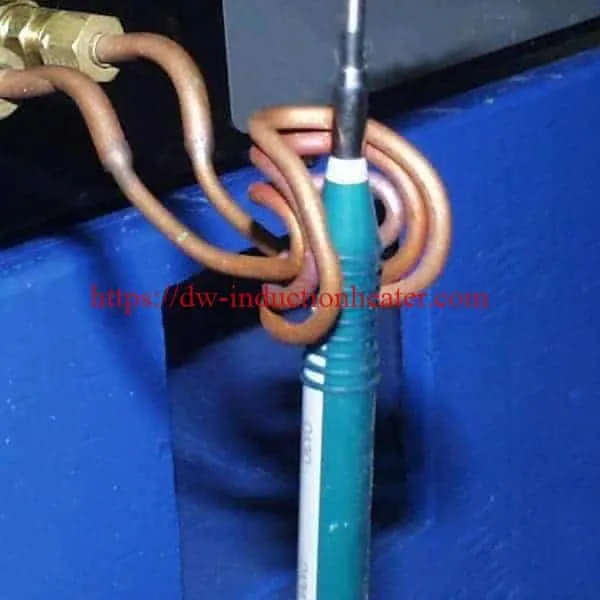 induction bonding plastic with metal[/caption]
What are the benefits?
DAWEI Induction bonding systems ensure precise energy inputs for each panel. Small heat affected zones minimize total panel elongation. Clamping is not needed when bonding steel panels, which reduces stresses and distortion. Each panel is electronically monitored to ensure that energy input deviations are within tolerances. With full-ring bonding, a one-sizefits- all coil reduces the need for spare coils.
Where is it used?
Induction Heating is the preferred bonding method in the automotive industry. Widely used to bond steel and aluminum sheet metal, induction is increasingly employed to bond new lightweight composite and carbon fiber materials. Induction is used to bond curved strands, brake shoes and magnets in the electrotechnical industry. It is also used for guides, rails, shelves and panels in the white goods sector.
What equipment is available?
The DW-UHF and DW-HF series are the primary induction heating power supplies for induction bonding applications.
2021年11月14日星期日
Induction Bonding Rubber To Steel
Induction Bonding Rubber To Steel With High Frequency Heating System
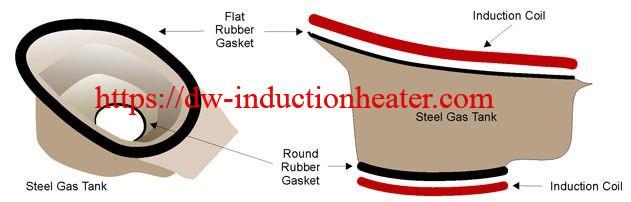
Objective To bond rubber gaskets to the top and bottom of a steel gas tank assembly.
Material Flat and round rubber gaskets, steel gas tank assembly
Temperature 300 to 350°F(148.9-176.7°C)
Frequency 200 kHz for the flat gasket; 231 kHz for the round gasket
Equipment • DW-UHF-10kW induction heating system equipped with a remote workhead containing two 1.25 μF capacitors for a total of 0.625 μF
• An induction heating coil designed and developed specifically for this application.
Process Two two-turn pancake coils are specially contoured to the the shape of the steel assembly to produce uniform heat in the gasket areas. The gaskets are positioned over the joint areas.
Power is applied for 6.5 seconds to reach the bonding temperature of 320°F (160°C).
Results/Benefits Induction heating provides:
• Repeatable, rapid & accurate heating cycles
• Reduced process time
• Even distribution of heat
Bonding Steel Into Rubber With Induction Heater
Bonding Steel Into Rubber With Induction Heater
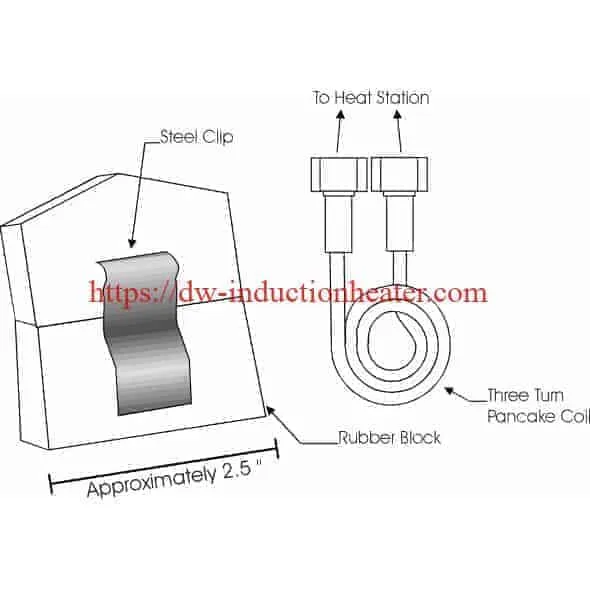
Objective To heat metal clips and press-bond them into rubber seals.
The metal needs to be heated to 250°F to 350°F with a cycle time not exceeding 3 seconds
Material Steel clips and rubber sealer blocks
Temperature 250°F to 350°F
Frequency 400 kHz
Equipment DW-UHF-4.5kW power supply including one remote heat station with one 1.2 μF capacitor using a specially designed 3-turn pancake coil
Process As illustrated below
Results Heating time of 1.5 seconds was attained; shorter heating times are possible due to fast response of the power supply.
Bond formation is acceptable due to the even heat pattern produced through induction heating.
Induction Bonding Solar Panel
Induction Bonding Solar Panel With High Frequency Heating System
Objective To heat the stainless steel substrate of a solar panel shingle in order to melt the polymer encapsulant, allowing two shingles to bond together with a 3 inch overlap.
Material 3" by 10.25" section of a 21" solar panel shingle
 Temperature 130 ºC
Frequency 300 kHz
Equipment DW-UHF-4.5kW power supply equipped with a remote heat station containing one 0.66mF capacitor. A custom-made
coil: 4 turns of 1/4" x 1/2" rectangular copper tubing, measuring 24" by 2 1/4".
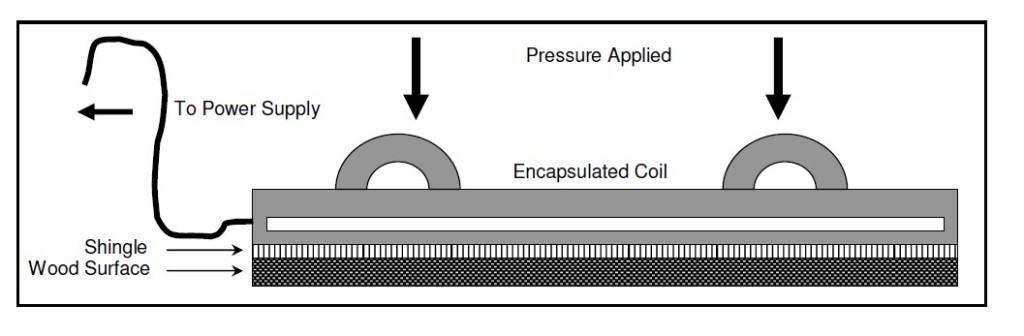
Process Stationary heating - with the coil located on the topside of the sample - was utilized to achieve uniform melt and adhesion. The shingles were overlapped according to requirements and placed on wood to simulate the installation on a roofing surface. In addition, pressure was applied by pressing the
water-cooled coil against the shingle to facilitate the bonding (illustration). Tests are performed at several time-voltage settings.
Results Tests resulted in excellent bond formation with the absence of encapsulant bubbling and only slight surface texture change.
 Temperature 130 ºC
Frequency 300 kHz
Equipment DW-UHF-4.5kW power supply equipped with a remote heat station containing one 0.66mF capacitor. A custom-made
coil: 4 turns of 1/4" x 1/2" rectangular copper tubing, measuring 24" by 2 1/4".
Process Stationary heating - with the coil located on the topside of the sample - was utilized to achieve uniform melt and adhesion. The shingles were overlapped according to requirements and placed on wood to simulate the installation on a roofing surface. In addition, pressure was applied by pressing the
water-cooled coil against the shingle to facilitate the bonding (illustration). Tests are performed at several time-voltage settings.
Results Tests resulted in excellent bond formation with the absence of encapsulant bubbling and only slight surface texture change.
订阅:
博文 (Atom)
我的简介

- HLQ induction heating machine
- HLQ induction heating machine manufacturer provides the service of induction brazing,melting,hot forming,hardening surface,annealing,shrink fitting,PWHT,etc.